
Free Safe Operating Procedure (Drone Ground Handling) Template
Download our free Safe Operating Procedure (Drone Ground Handling) template to manage risks associated with non-flight drone activities. Customise today.
Free Safe Operating Procedure (Drone Ground Handling) Template
DOCX • 126 KB + PDF
Updated Oct 2026
No signup required
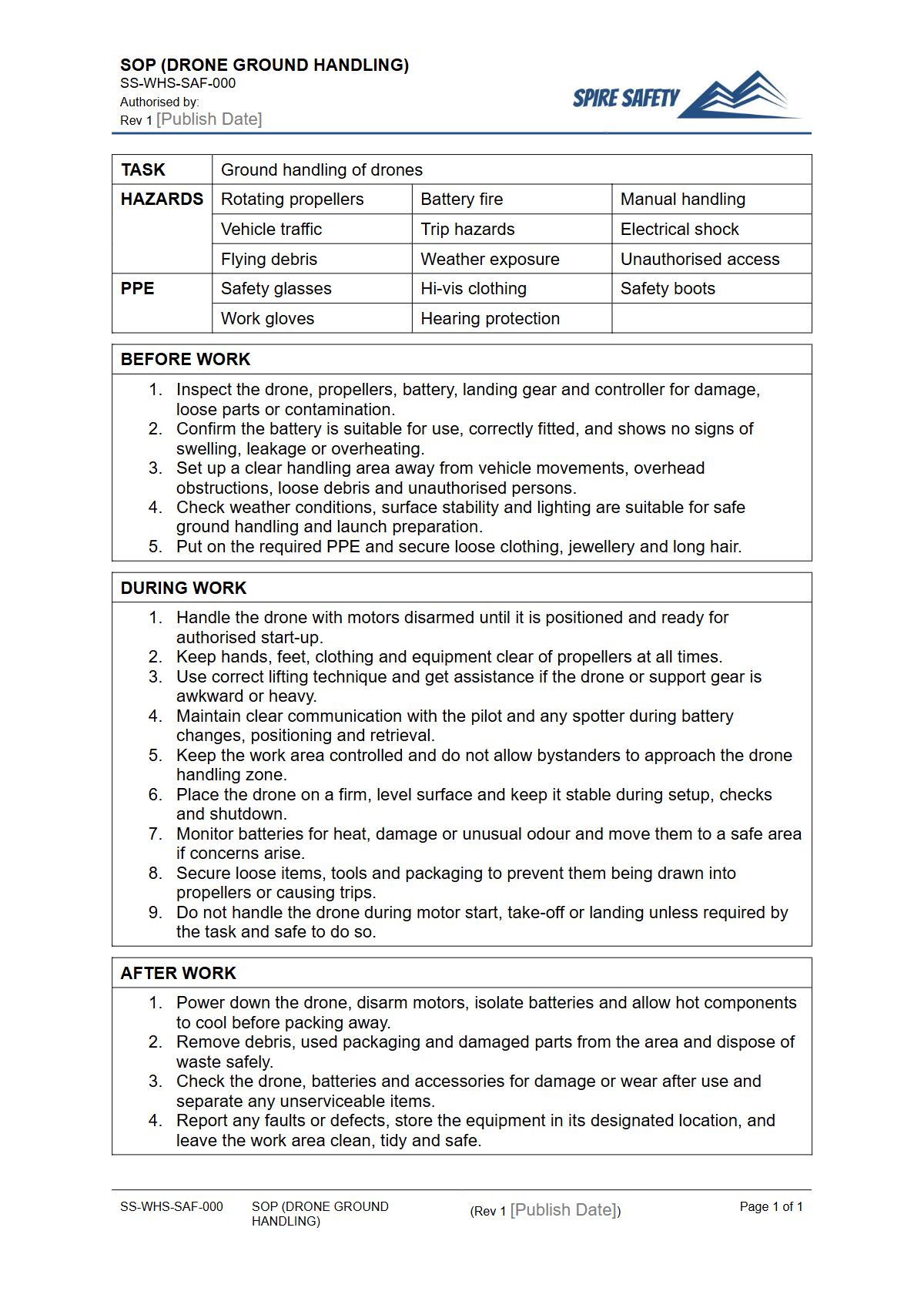
Purpose of the Free Safe Operating Procedure (Drone Ground Handling) Template
This free Safe Operating Procedure (Drone Ground Handling) template provides a structured starting point for documenting the risks and controls associated with non-flight drone tasks. While flight operations carry obvious risks, the ground-based activities—such as setup, battery management, maintenance, and pack-down—present their own unique set of hazards.
Using a formal SOP helps organisations systematically identify these risks, from electrical hazards during charging to manual handling injuries during transport, and implement effective control measures to ensure worker safety.
A well-developed SOP demonstrates a commitment to proactive safety management and forms a critical component of broader WHS management systems. It serves as a practical tool for training, inductions, and ongoing supervision, ensuring that all personnel involved in drone operations, not just the remote pilot, follow a consistent and safe process. Formalising these procedures helps meet WHS obligations to provide a safe system of work for all tasks undertaken in the workplace.
Video walkthrough
How to use the Free Safe Operating Procedure (Drone Ground Handling) Template
This document is a template and must be customised to reflect your specific operational context. To use it effectively, begin by conducting a risk assessment of your drone ground handling activities.
Involve your team, including remote pilots, observers, and ground crew, to identify all potential hazards. Edit the template to include details about your specific drone models, battery types, charging equipment, transport methods, and worksite conditions.
Your procedure should be more specific than a manufacturer's manual, which provides general advice.
For example, your SOP should detail the exact steps for inspecting propellers, calibrating sensors before take-off, and safely connecting and disconnecting LiPo batteries. Ensure the control measures listed are practical and relevant to your workplace.
The final document should be a clear, step-by-step guide that any trained worker can follow. Remember, the effectiveness of a safety document like a Safe Operating Procedure for a circular saw or this drone handling guide depends entirely on how well it is adapted to the specific task and environment.
A Note on Customisation
This template is a starting point. We are not WHS consultants for your business, and this document does not constitute legal advice.
You must adapt this Safe Operating Procedure to the specific equipment, personnel, and risks in your workplace. This process of customisation is crucial for ensuring the procedure is effective and helps you meet your safety duties.
When to use a Safe Operating Procedure
A Safe Operating Procedure for drone ground handling should be used consistently before, during, and after any drone operation. It is not a document to be filed away; it is an active tool for daily use.
It should be referenced during pre-start checks to ensure all safety equipment is in place and the drone is inspected correctly. It also serves as a critical training resource for new team members, providing clear instructions on the established safe way to perform tasks.
The SOP should also be a key document during toolbox talks or safety briefings, especially when operating in new or challenging environments. It provides a framework for discussing site-specific hazards, such as uneven terrain for take-off/landing zones or proximity to the public.
Regular review and reference to the SOP reinforces safe work habits and helps maintain a high standard of safety awareness among the entire team, much like a procedure for operating a trencher or other specialised equipment.
Who should use this document
This Safe Operating Procedure is intended for use by a range of personnel within an organisation that utilises drones. This includes not only the certified Remote Pilot in Command (RPIC) but also all ground support crew, visual observers, maintenance staff, and payload operators.
A Person Conducting a Business or Undertaking (PCBU) or their management representatives, such as project managers and safety officers, are responsible for ensuring the SOP is developed, implemented, and reviewed.
Supervisors should use the SOP to induct new workers and verify that established procedures are being followed on-site. Workers should use it as their primary guide for performing ground handling tasks safely.
Incorporating this and other key documents into your company’s processes, and reviewing them through periodic WHS compliance auditing, ensures your safety framework remains robust and effective. You can find more templates like this in our extensive free WHS resources library to support your safety management system.
If you require further guidance on adapting this template or developing comprehensive safety systems for complex operations like those involving drones, our team can provide expert WHS consulting support to help you navigate your obligations.
Common mistakes
Common mistakes to avoid
- Neglecting specific battery charging and storage safety protocols.
- Failing to establish clear and communicated exclusion zones for take-off and landing.
- Assuming the drone manufacturer's manual is a substitute for a site-specific SOP.
- Overlooking pre- and post-operation equipment inspections as part of the formal procedure.
Legal references
Legal considerations
The following legal requirements may be relevant to this type of work.
- Work Health and Safety Act (Harmonised) — Provides the primary duties for protecting workers and other people from work health and safety risks.
- Work Health and Safety Regulations (Harmonised) — Sets out requirements supporting the management of workplace hazards and risks.
The following codes may be relevant to this type of work.
- Managing WHS Risks Code of Practice — Provides practical guidance on identifying hazards, assessing risks and applying effective controls.
- Work Health and Safety Consultation, Cooperation and Coordination Code of Practice — Provides practical guidance on consulting workers and coordinating with other duty holders.
- Managing the Work Environment and Facilities Code of Practice — Provides practical guidance on safe work environments, workplace facilities and related controls.
Did you know
Battery Risks
Lithium-polymer (LiPo) batteries used in most commercial drones pose a significant fire risk if damaged, overcharged, or stored incorrectly. Specific handling and charging procedures are essential safety controls.
Beyond the Pilot
Drone ground crew, including observers and payload operators, also fall under WHS duties. Their safety during setup, pack-down, and battery management is just as critical as the pilot's during flight.
FAQ
Frequently asked questions
01What is the difference between ground handling and flight operations in a drone SOP?
02Who is responsible for developing a drone ground handling SOP?
03How often should a Safe Operating Procedure for drone handling be reviewed?
04Can this template be used for commercial drone operations under CASA rules?
Share this resource
Free Safe Operating Procedure (Drone Ground Handling) Template
Browse Categories
How To Use It
- 1Download and open in Word or PDF.
- 2Replace the placeholders with your business details.
- 3Get it reviewed by a WHS specialist before rollout.
Need it customised?
Our WHS consultants can adapt this template to your site, run a gap analysis, or audit what you already have in place.
Book a Free Consultation WHS consulting servicesor call 1300 156 382
Related templates
- Free Safe Operating Procedure (Drone Takeoff and Landing) Template
- Free Safe Operating Procedure (Drop Saw Mitre Saw Operation) Template
- Free Safe Operating Procedure (Drum Decanting) Template
- Free Safe Operating Procedure (Drum Handler) Template
- Free Safe Operating Procedure (Drum Lifter) Template
- Free Safe Operating Procedure (Drum Pump) Template