
Free Safe Operating Procedure (Drum Lifter) Template
Download our free Safe Operating Procedure (Drum Lifter) template to establish clear guidelines for safely handling drums. Get your DOCX and PDF now.
Free Safe Operating Procedure (Drum Lifter) Template
DOCX • 126 KB + PDF
Updated Oct 2026
No signup required
Purpose of the Free Safe Operating Procedure (Drum Lifter) Template
Effectively managing workplace risks requires clear, documented processes for high-risk activities. This Free Safe Operating Procedure (Drum Lifter) Template provides a structured starting point for your organisation to formalise the steps for the safe use of mechanical drum lifting equipment.
Using a drum lifter mitigates the significant manual handling risks associated with moving 205-litre drums, but the equipment itself introduces new hazards like crushing, tipping, and mechanical failure. This SOP helps you document risk controls to protect workers.
A well-developed SOP is a critical component of your overall safety framework, demonstrating a commitment to proactive risk management. It serves as a practical tool for training and supervision, ensuring tasks are performed consistently and safely every time.
Integrating specific SOPs into your broader safety strategy helps build robust WHS management systems that are tailored to your operational realities.
Video walkthrough
How to use the Free Safe Operating Procedure (Drum Lifter) Template
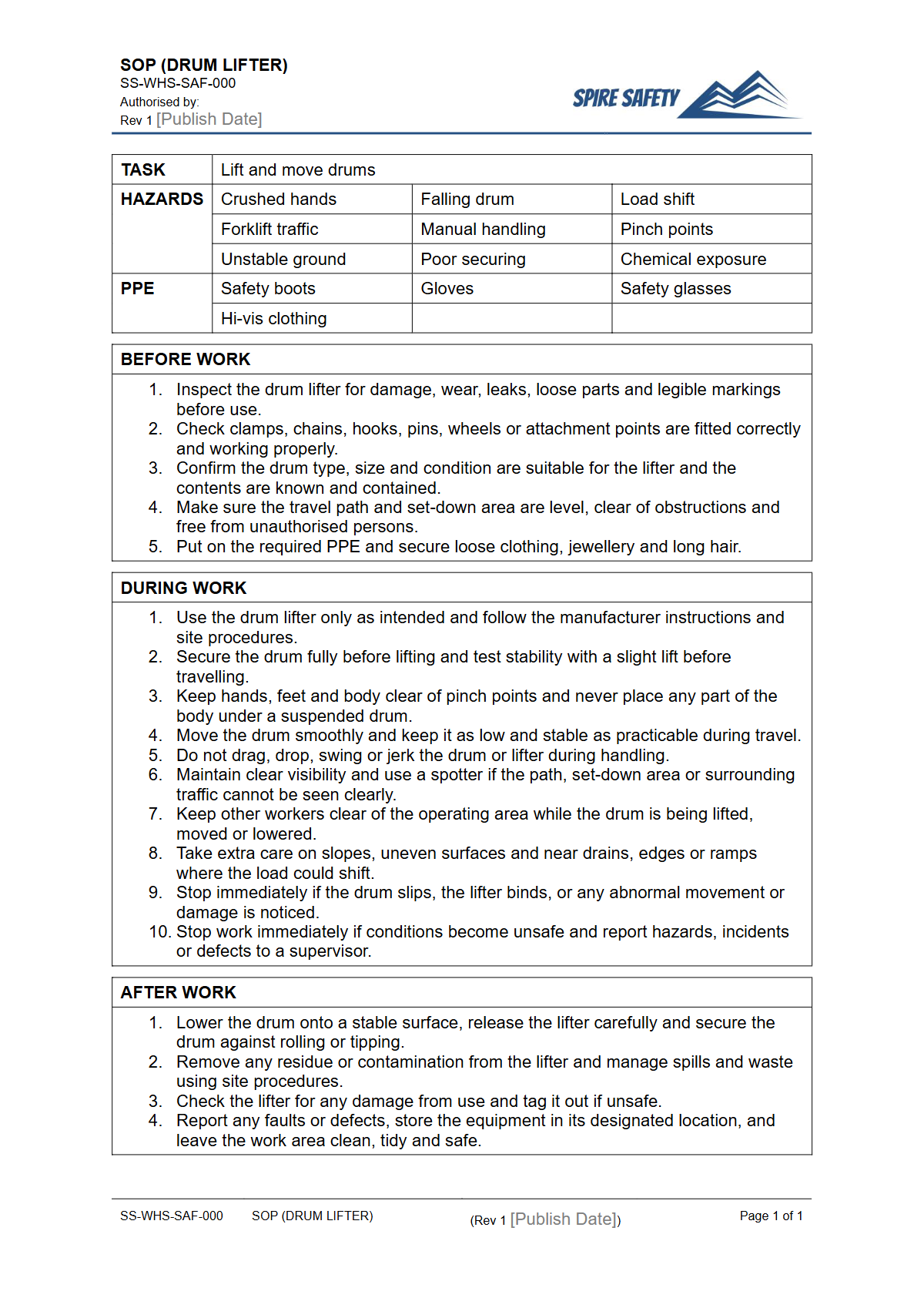
This Free Safe Operating Procedure (Drum Lifter) Template is provided in both DOCX and PDF formats for your convenience. The DOCX file is fully editable, allowing you to adapt the content to your specific operational needs.
To use it effectively, you must review and modify the document in consultation with the workers and supervisors who will be using the equipment. This process ensures the final SOP reflects the actual tasks, equipment, and environment at your workplace.
IMPORTANT: This document is a template only. We have provided a structured starting point, but you must adapt it to the specific drum lifters, drum types (steel, plastic), and working environment at your site.
Include details such as brand and model of the equipment, site-specific hazards, and emergency contact information. A generic procedure is not sufficient; customisation is essential for it to be an effective risk control. This principle of site-specific adaptation applies to all plant, as seen in resources like the FREE Telehandler SOP Template.
When to use a Drum Lifter Safe Operating Procedure
A Safe Operating Procedure for a drum lifter should be a central document in your daily safety practices. It is not a document to be filed away and forgotten.
It should be actively used during worker induction and onboarding, specific task training, and competency assessments. Operators should have easy access to the SOP as a reference guide before commencing work.
It is also an essential document during routine safety observations, incident investigations, and formal WHS compliance auditing activities to verify that prescribed safety measures are being followed.
Key Elements of This Safe Operating Procedure
Our template is structured to guide you through documenting a comprehensive safe work method. It includes sections for:
- Required Personal Protective Equipment (PPE): Specifies PPE like steel-cap boots, gloves, and safety glasses.
- Pre-Operational Checks: A checklist to ensure the drum lifter, attachments, and work area are safe before starting. This includes checking hydraulic lines, wheels, and the gripping mechanism.
- Step-by-Step Operating Sequence: A logical flow of actions from securing the drum to transport and placement, focusing on key safety actions at each stage.
- Post-Operational Tasks: Details for safely shutting down, cleaning, and storing the equipment.
- Emergency Procedures: Outlines immediate actions in case of a spill, equipment failure, or injury.
If your team requires assistance in adapting this template or developing a suite of SOPs for your unique operational risks, consider engaging expert WHS consulting services.
Who should use this Safe Operating Procedure
This SOP is intended for several key roles within an organisation. It is a vital tool for Persons Conducting a Business or Undertaking (PCBUs) to fulfil their primary duty of care.
Managers and supervisors must use the SOP to train workers, oversee tasks, and enforce safe work practices. They are responsible for ensuring procedures are understood and followed, whether it's for operating a drum lifter or managing workflows around plant covered by a FREE Conveyer System SOP. Most importantly, operators of drum lifting equipment must be trained on and follow the SOP to ensure their own safety and the safety of others around them.
By implementing and consistently using this procedure, you create a safer environment for everyone involved in handling heavy drums. You can explore more templates and guides in our complete free WHS resources library to support your safety management efforts.
Common mistakes
Common mistakes to avoid
- Using a generic SOP without customising it for the specific workplace, drum type, and lifter model.
- Failing to conduct and document pre-operational checks of the equipment before every use.
- Neglecting to provide practical, hands-on training for operators on the procedures outlined in the SOP.
- Exceeding the rated Safe Working Load (SWL) of the drum lifter or host equipment (e.g., forklift).
Legal references
Legal considerations
The following legal requirements may be relevant to this type of work.
- Work Health and Safety Act (Harmonised) — Provides the primary duties for protecting workers and other people from work health and safety risks.
- Work Health and Safety Regulations (Harmonised) — Sets out requirements supporting the management of workplace hazards and risks.
The following codes may be relevant to this type of work.
- Managing WHS Risks Code of Practice — Provides practical guidance on identifying hazards, assessing risks and applying effective controls.
- Work Health and Safety Consultation, Cooperation and Coordination Code of Practice — Provides practical guidance on consulting workers and coordinating with other duty holders.
- Managing the Work Environment and Facilities Code of Practice — Provides practical guidance on safe work environments, workplace facilities and related controls.
Did you know
The Weight of a Drum
A standard 205-litre (44-gallon) steel drum of oil can weigh over 200kg, placing it well into the high-risk category for manual handling and making mechanical aids like drum lifters essential.
Control Hierarchy
Using a drum lifter is an example of an engineering control. It is a higher-order risk control measure that is more effective than relying on administrative controls (like an SOP alone) or PPE.
FAQ
Frequently asked questions
01What should be included in a drum lifter SOP?
02How often should a Safe Operating Procedure for a drum lifter be reviewed?
03Is a drum lifter SOP a legal requirement in Australia?
04Who is responsible for training workers on the drum lifter SOP?
Share this resource
Free Safe Operating Procedure (Drum Lifter) Template
Browse Categories
How To Use It
- 1Download and open in Word or PDF.
- 2Replace the placeholders with your business details.
- 3Get it reviewed by a WHS specialist before rollout.
Need it customised?
Our WHS consultants can adapt this template to your site, run a gap analysis, or audit what you already have in place.
Book a Free Consultation WHS consulting servicesor call 1300 156 382
Related templates
- Free Safe Operating Procedure (Drum Pump) Template
- Free Safe Operating Procedure (Drum Sander) Template
- Free Safe Operating Procedure (Drum Transfer Pump) Template
- Free Safe Operating Procedure (Dry Cleaning Machine) Template
- Free Safe Operating Procedure (Dry Dock Cleaning) Template
- Free Safe Operating Procedure (Dry Goods Handling) Template