
Free Safe Operating Procedure (Drum Sander) Template
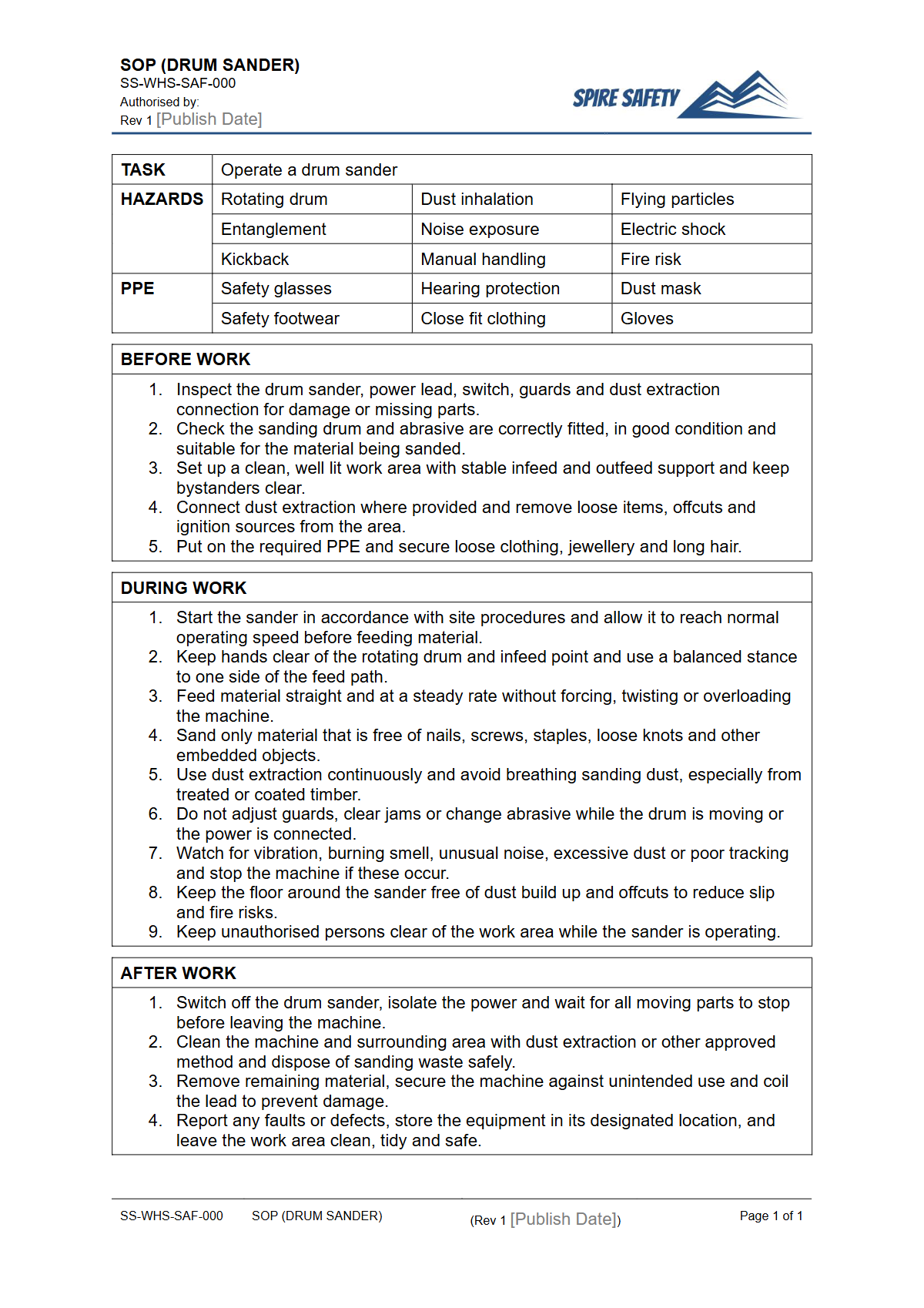
Standardise your workshop safety with our free Safe Operating Procedure (Drum Sander) Template. Download the DOCX file to customise your safety steps.
Free Safe Operating Procedure (Drum Sander) Template
DOCX • 126 KB + PDF
Updated Oct 2026
No signup required
Purpose of the Free Safe Operating Procedure (Drum Sander) Template
A drum sander is a powerful finishing tool that presents significant workplace health and safety risks if not used correctly. This free Safe Operating Procedure (Drum Sander) Template provides a structured starting point for your organisation to document the required steps for operating the machine safely.
A well-drafted SOP is a critical control measure for managing hazards such as entanglement in moving parts, abrasion, wood dust inhalation, excessive noise, and fire.
By formalising procedures, you establish a clear, consistent standard for all workers, reducing the likelihood of incidents and promoting a proactive safety culture. This document helps you define pre-operational checks, step-by-step usage instructions, and post-operational clean-up tasks.
Similar to our FREE Circular Saw SOP Template, it provides a logical format that can be easily adapted to your specific machinery and operational context, helping you meet your primary duty of care obligations under WHS legislation.
Key Hazards to Address
When customising this Safe Operating Procedure, your risk assessment should focus on several key hazards associated with drum sanders:
- Mechanical Hazards: The rotating drum creates a serious risk of entanglement and abrasion. Nip points between the drum and the conveyor belt or workpiece can cause severe crush injuries.
- Airborne Contaminants: Wood dust is a hazardous substance. Inhaling fine dust can lead to respiratory diseases, while some hardwood dusts are classified as carcinogens. Effective dust extraction is a critical control.
- Noise: Drum sanders often generate noise levels that exceed the workplace exposure standard, potentially causing permanent hearing loss over time.
- Fire and Explosion: The accumulation of fine, dry wood dust in extraction systems or around the machine creates a significant fire or dust explosion risk.
- Manual Tasks: Lifting and handling large or heavy timber workpieces can lead to musculoskeletal injuries if not managed with proper techniques or lifting aids.
Video walkthrough
How to use the Free Safe Operating Procedure (Drum Sander) Template
This resource is available for download in both DOCX and PDF formats. We recommend using the DOCX version, as it is fully editable in Microsoft Word or other compatible software.
This allows you to tailor the content directly to the make and model of your drum sander, your specific work environment, and the tasks your operators perform. When customising the document, it is vital to consult with the workers who actually use the equipment, as their direct experience is invaluable for identifying practical risks and effective controls.
Please note: This template provides a foundational structure aligned with Australian WHS principles. We have designed it as a starting point for you to build upon. You must customise it to accurately reflect the specific equipment, materials, processes, and personnel in your workplace to ensure it is effective.
Once completed and approved, the Safe Operating Procedure should be integrated into your safety management framework. These documented procedures form a critical part of broader WHS management systems, supporting everything from worker training to incident investigation.
When to use it
A Safe Operating Procedure for a drum sander should be used as a primary reference document in several key situations. It is essential for the induction and training of new operators, ensuring they learn the correct, safe method from the very beginning.
The SOP also serves as a valuable tool for refresher training for experienced staff, reinforcing safe work habits and communicating any changes to procedures.
Furthermore, the SOP should be readily accessible in the work area for quick reference. It is also a critical document to review after any incident or near-miss involving the drum sander to identify whether procedural gaps contributed to the event.
Regular reviews should also be scheduled when new equipment is introduced or modifications are made to existing machinery. If your organisation requires expert help in developing these processes, our WHS consulting services can provide tailored guidance.
Who should use it
Various personnel within an organisation have a role related to this Safe Operating Procedure. The primary users are the machine operators, who must understand and follow the documented steps to perform their work safely.
Supervisors and team leaders are responsible for ensuring operators are trained on the SOP and adhere to it during daily work, providing coaching and correction where necessary.
WHS managers or officers use the SOP as a tool for risk management, training development, and compliance monitoring. They are often responsible for drafting, reviewing, and updating the procedure in consultation with workers and management.
Just as with other plant like that covered in our Free Air Compressor SOP Template, clear documentation is the backbone of safe plant management. Finally, maintenance personnel should be familiar with the SOP, particularly the sections on lock-out tag-out (LOTO) and safe decommissioning for servicing.
To ensure your safety documents remain effective and aligned with current practice and legislation, regular reviews are crucial. For a more formal assessment of your overall safety framework, scheduling periodic WHS compliance auditing can help identify areas for improvement across your entire operation.
You can also browse our extensive free WHS resources library for other helpful templates and safety guides.
Common mistakes
Common mistakes to avoid
- Failing to use or properly maintain the dust extraction system, leading to hazardous dust levels.
- Wearing loose clothing, jewellery, or gloves that can get caught in the rotating drum or conveyor.
- Attempting to sand pieces of wood that are too small or short, which can be ejected or pull the operator's hands in.
- Neglecting to disconnect the power source using a lock-out tag-out procedure before performing maintenance or clearing jams.
Legal references
Legal considerations
The following legal requirements may be relevant to this type of work.
- Work Health and Safety Act (Harmonised) — Provides the primary duties for protecting workers and other people from work health and safety risks.
- Work Health and Safety Regulations (Harmonised) — Sets out requirements supporting the management of workplace hazards and risks.
The following codes may be relevant to this type of work.
- Managing WHS Risks Code of Practice — Provides practical guidance on identifying hazards, assessing risks and applying effective controls.
- Work Health and Safety Consultation, Cooperation and Coordination Code of Practice — Provides practical guidance on consulting workers and coordinating with other duty holders.
- Managing the Work Environment and Facilities Code of Practice — Provides practical guidance on safe work environments, workplace facilities and related controls.
Did you know
Hazardous Dust
Wood dust is not just a nuisance; it's a hazardous substance under WHS regulations. Long-term exposure to certain hardwood dusts is linked to serious health issues, including nasal cancer.
Noise Exposure
A typical industrial drum sander can operate at over 90 decibels (dB). This exceeds the Australian workplace exposure standard for noise (85 dB averaged over 8 hours), making hearing protection essential to prevent permanent hearing loss.
FAQ
Frequently asked questions
01What is the main purpose of a Safe Operating Procedure for a drum sander?
02How often should a drum sander SOP be reviewed?
03Is this drum sander SOP template compliant with Australian WHS laws?
04What PPE is generally required when using a drum sander?
Share this resource
Free Safe Operating Procedure (Drum Sander) Template
Browse Categories
How To Use It
- 1Download and open in Word or PDF.
- 2Replace the placeholders with your business details.
- 3Get it reviewed by a WHS specialist before rollout.
Need it customised?
Our WHS consultants can adapt this template to your site, run a gap analysis, or audit what you already have in place.
Book a Free Consultation WHS consulting servicesor call 1300 156 382
Related templates
- Free Safe Operating Procedure (Drum Transfer Pump) Template
- Free Safe Operating Procedure (Dry Cleaning Machine) Template
- Free Safe Operating Procedure (Dry Dock Cleaning) Template
- Free Safe Operating Procedure (Dry Goods Handling) Template
- Free Safe Operating Procedure (Dry Ice Handling) Template
- Free Safe Operating Procedure (Dryer Lint Cleaning) Template