
Free Safe Operating Procedure (Dry Cleaning Machine) Template
Download our free Safe Operating Procedure (Dry Cleaning Machine) Template to guide your team.
Free Safe Operating Procedure (Dry Cleaning Machine) Template
DOCX • 126 KB + PDF
Updated Oct 2026
No signup required
Purpose of the Free Safe Operating Procedure (Dry Cleaning Machine) Template
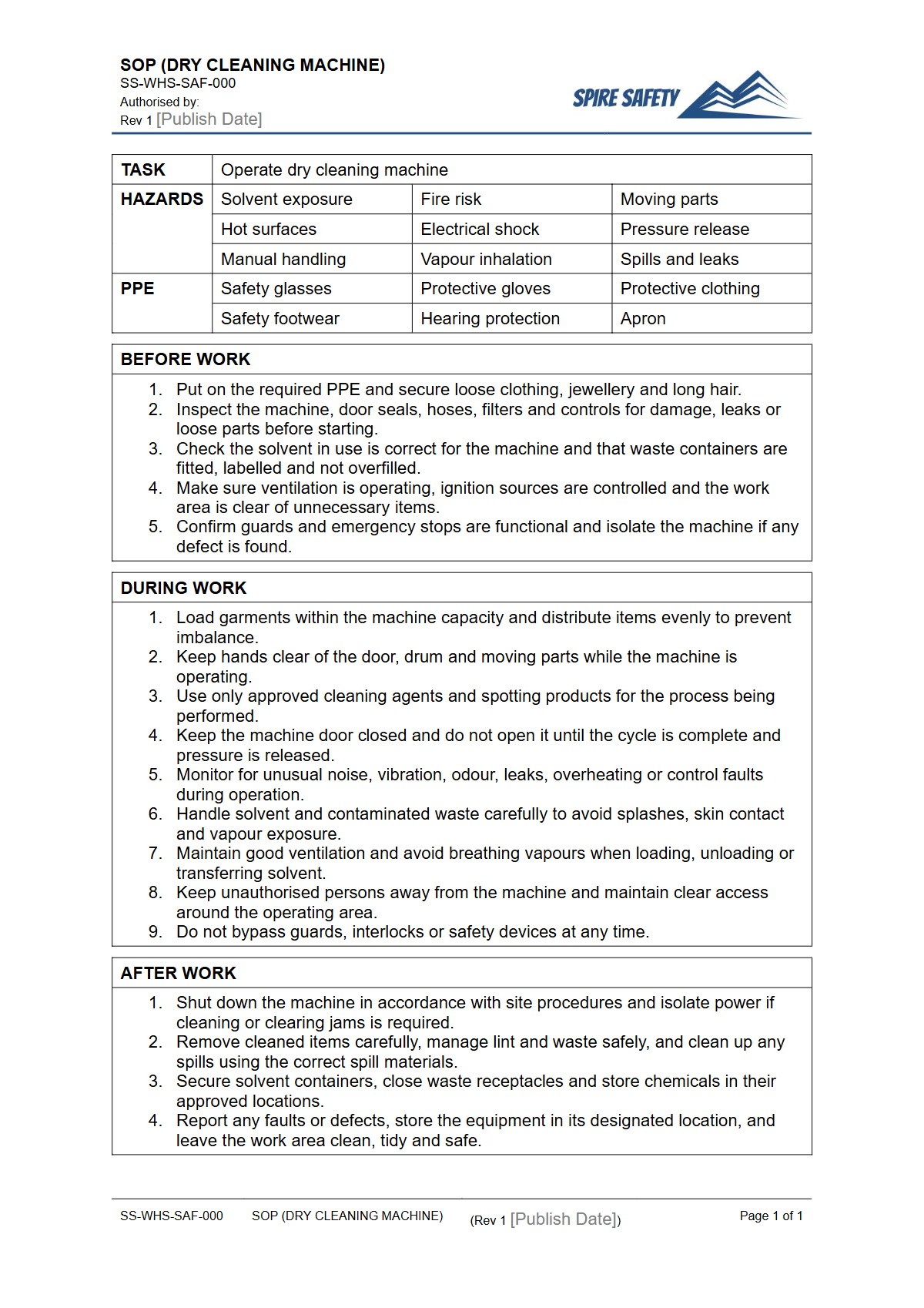
Operating a dry cleaning machine involves significant risks, including exposure to hazardous chemicals, high temperatures, and moving parts. This free Safe Operating Procedure (Dry Cleaning Machine) Template provides a structured framework for documenting the safest way to perform this task.
An SOP is a fundamental tool for risk management, providing clear, step-by-step instructions that ensure tasks are performed consistently and safely every time. It serves as a vital training resource for new employees and a reference for experienced operators, helping to minimise the risk of incidents, injuries, and non-compliance.
By implementing a clear SOP, your business demonstrates a commitment to health and safety, forming a crucial component of your overall WHS management systems. This document helps standardise operator behaviour, streamline training, and provides a clear benchmark for supervision and performance evaluation. It outlines required personal protective equipment (PPE), pre-start checks, operational steps, shutdown procedures, and emergency responses.
Video walkthrough
How to use the Free Safe Operating Procedure (Dry Cleaning Machine) Template
This template is provided as a starting point. To make it effective, you must customise it to reflect the specific circumstances of your workplace.
Download the DOCX file and adapt it to your unique environment, including the make and model of your dry cleaning machines, the specific solvents you use (e.g., perchloroethylene, hydrocarbon, silicone-based), and your site-specific emergency procedures. We strongly recommend a consultation process involving the workers who operate the machinery to ensure the SOP is practical, accurate, and reflects how the work is actually done.
Important: This document must be adapted to your business. We are not familiar with your operational specifics, the chemicals you use, your machinery, or the competency of your people.
You must conduct your own risk assessment and tailor this procedure accordingly. If you need assistance, consider engaging our WHS consulting services for expert guidance.
Key Customisation Steps:
- Plant and Equipment Details: Insert the specific brand, model, and serial number of your dry cleaning machine.
- Chemicals: List all chemicals and solvents used, referencing their Safety Data Sheets (SDS) for handling and PPE requirements.
- Site-Specific Hazards: Add any hazards unique to your laundry or facility, such as ventilation issues, confined space considerations, or proximity to other operations. A related process might involve an Air Compressor SOP template for associated equipment.
- Emergency Contacts: Update the emergency procedures section with your site's specific contact numbers and assembly points.
When to use a Safe Operating Procedure
An SOP for a dry cleaning machine should be a living document, integrated into your daily operations. It should be used during new worker inductions to provide foundational safety training before they are permitted to operate the machine.
It also serves as a critical tool for refresher training to prevent complacency among experienced staff. The SOP should be readily accessible near the machine for quick reference.
Furthermore, it should be reviewed and potentially updated following any incident, near miss, or when changes are made to the equipment, chemicals, or work process.
Who should use this SOP
This Safe Operating Procedure is intended for several key personnel within your organisation. Primarily, it is for the machine operators themselves, who must understand and follow the instructions to protect their health and safety.
Supervisors and managers should use the SOP to train staff, monitor safe work practices, and conduct safety observations. WHS personnel and management can use it as part of regular WHS compliance audits to verify that established procedures are being followed.
Formalising these processes is also a key step for businesses seeking to align with international standards, which our ISO 45001 consulting team can assist with.
Ultimately, anyone involved in the operation, supervision, or maintenance of a dry cleaning machine will benefit from a well-drafted SOP. It establishes a clear, mutual understanding of the safety requirements for the task. In a larger laundry facility, you may have other key procedures, such as an SOP for a conveyer system used to transport garments. You can find more templates like these in our free WHS resources library to build a comprehensive safety system.
Common mistakes
Common mistakes to avoid
- Failing to regularly inspect and maintain door seals and gaskets, leading to solvent vapour leaks.
- Neglecting to wear appropriate personal protective equipment (PPE), such as chemical-resistant gloves and respirators with organic vapour cartridges.
- Improper storage of hazardous waste, such as used filters and separator water, without secondary containment.
- Skipping pre-operational safety checks, such as verifying the function of safety interlocks and ventilation systems.
Legal references
Legal considerations
The following legal requirements may be relevant to this type of work.
- Work Health and Safety Act (Harmonised) — Provides the primary duties for protecting workers and other people from work health and safety risks.
- Work Health and Safety Regulations (Harmonised) — Sets out requirements supporting the management of workplace hazards and risks.
The following codes may be relevant to this type of work.
- Managing WHS Risks Code of Practice — Provides practical guidance on identifying hazards, assessing risks and applying effective controls.
- Work Health and Safety Consultation, Cooperation and Coordination Code of Practice — Provides practical guidance on consulting workers and coordinating with other duty holders.
- Managing the Work Environment and Facilities Code of Practice — Provides practical guidance on safe work environments, workplace facilities and related controls.
Did you know
Closed-Loop Systems
Modern dry cleaning machines are 'closed-loop' systems designed to recover and recycle over 99.9% of the solvent used. This significantly reduces chemical waste, environmental impact, and operator exposure.
Solvent Classification
The most common dry cleaning solvent, perchloroethylene (perc), is classified by the International Agency for Research on Cancer (IARC) as a Group 2A carcinogen, meaning it is probably carcinogenic to humans.
FAQ
Frequently asked questions
01What are the main hazards of a dry cleaning machine?
02How often should an SOP for a dry cleaning machine be reviewed?
03Is this template suitable for all types of dry cleaning machines?
04Why is training on a Safe Operating Procedure so important?
Share this resource
Free Safe Operating Procedure (Dry Cleaning Machine) Template
Browse Categories
How To Use It
- 1Download and open in Word or PDF.
- 2Replace the placeholders with your business details.
- 3Get it reviewed by a WHS specialist before rollout.
Need it customised?
Our WHS consultants can adapt this template to your site, run a gap analysis, or audit what you already have in place.
Book a Free Consultation WHS consulting servicesor call 1300 156 382
Related templates
- Free Safe Operating Procedure (Dry Dock Cleaning) Template
- Free Safe Operating Procedure (Dry Goods Handling) Template
- Free Safe Operating Procedure (Dry Ice Handling) Template
- Free Safe Operating Procedure (Dryer Lint Cleaning) Template
- Free Safe Operating Procedure (Drywall Lift) Template
- Free Safe Operating Procedure (Duct Access Cleaning) Template