
Free Safe Operating Procedure (Dry Goods Handling) Template
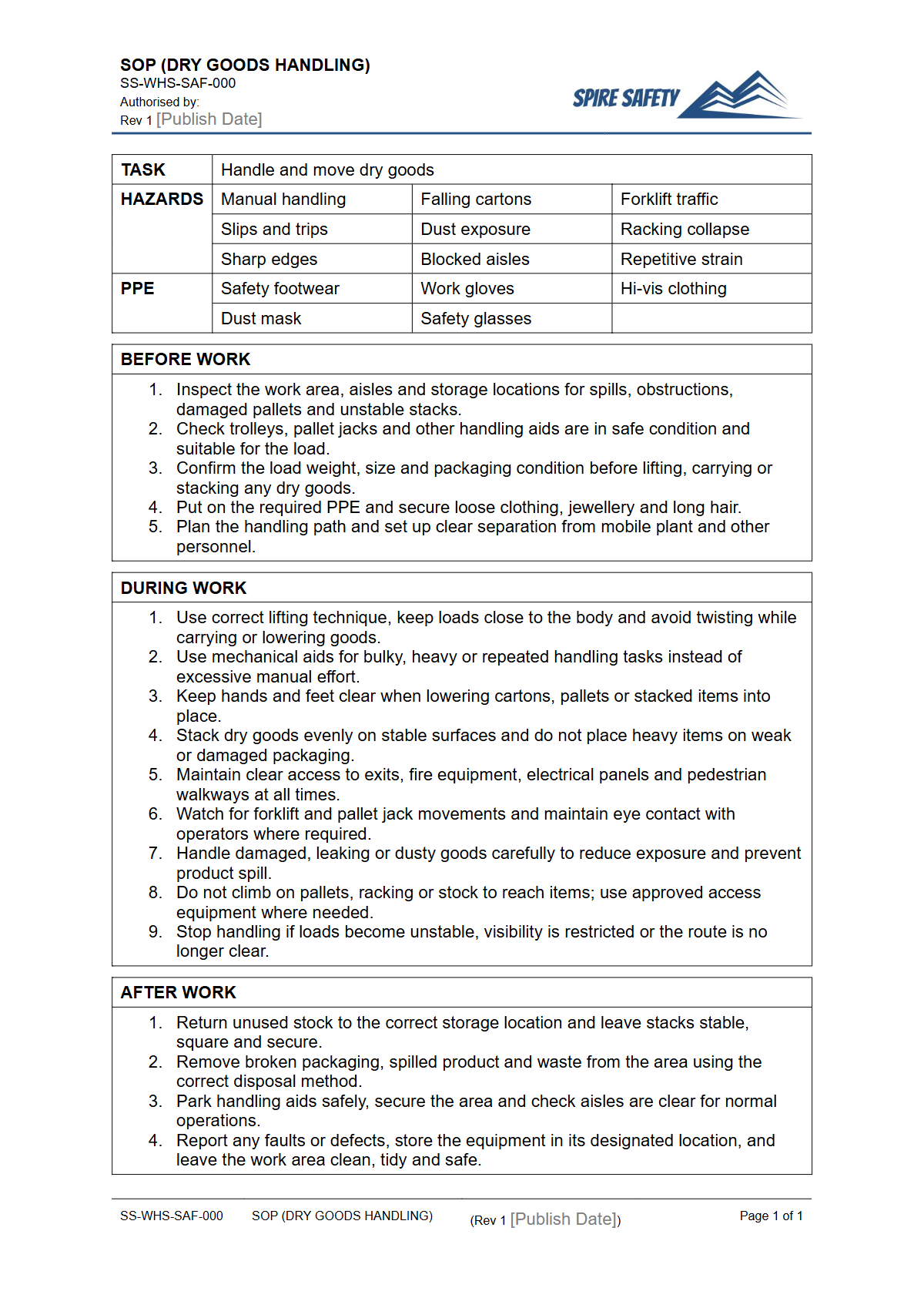
Download our free Safe Operating Procedure (Dry Goods Handling) template.
Free Safe Operating Procedure (Dry Goods Handling) Template
DOCX • 126 KB + PDF
Updated Oct 2026
No signup required
Purpose of the Free Safe Operating Procedure (Dry Goods Handling) Template
Handling dry goods, from bags of cement to boxes in a warehouse, presents significant workplace health and safety risks. This Free Safe Operating Procedure (Dry Goods Handling) Template provides a structured starting point for your organisation to document a safe system of work for these common tasks.
Its primary purpose is to help you control hazards associated with manual tasks, reducing the risk of musculoskeletal disorders (MSDs), which are among the most common and costly work-related injuries in Australia.
A well-drafted Safe Operating Procedure (SOP) is a critical administrative control. It formalises the safest way to perform a task, detailing steps, identifying hazards, and specifying control measures.
For dry goods handling, this includes addressing risks like incorrect lifting techniques, repetitive movements, awkward postures, exposure to airborne dust, and trips or falls. By implementing a clear SOP, you provide workers with essential information and instruction, helping to meet your primary duty of care under WHS legislation.
This document serves as a key component of your broader approach to WHS management systems, ensuring consistency and clarity in your safety practices.
Video walkthrough
How to use the Free Safe Operating Procedure (Dry Goods Handling) Template
This template is a foundation, not a final document. To make it effective, you must customise it to reflect the specific circumstances of your workplace.
Generic procedures are insufficient for managing site-specific risks. Download the DOCX file and adapt it by incorporating details unique to your operations.
Customisation Checklist:
- Site-Specific Hazards: Identify all potential hazards related to handling dry goods at your site. Consider the types of goods, packaging (bags, boxes, drums), storage systems (racking, floor stacking), and work environment (lighting, flooring, ventilation).
- Equipment: List all mechanical aids used, such as forklifts, pallet jacks, or trolleys. If heavier machinery is involved, you may need a separate free Telehandler SOP template to supplement this procedure.
- Control Measures: Detail the specific controls you have implemented. This includes preferred lifting techniques (e.g., team lifts), use of mechanical aids, required ventilation, and housekeeping rules to manage dust and prevent slips.
- Personal Protective Equipment (PPE): Specify the exact PPE required for the task, such as safety footwear, gloves, P2-rated dust masks, and safety glasses.
- Emergency Procedures: Outline the steps to take in case of an incident, such as a spillage, injury, or exposure to a hazardous substance. Include contact details for first aid officers and emergency services.
Important Note: We have developed this template as a guide based on Australian WHS principles. You are responsible for ensuring it is adapted to cover all risks at your worksite and complies with the relevant legislation in your state or territory.
For complex operations, consider seeking professional advice from a WHS consulting specialist.
When to use it
An SOP for dry goods handling should be used as a core part of your daily safety management. It is not a document to be filed and forgotten. Integrate it into your operations in the following ways:
- Worker Training and Induction: Use the SOP as a training tool for new and existing workers to ensure they understand the approved, safe method for handling goods.
- Pre-Task Planning: Refer to the SOP during pre-start meetings or toolbox talks to refresh workers on hazards and controls before the task begins.
- Supervision and Monitoring: Supervisors can use the SOP as a benchmark to monitor work practices and confirm that tasks are being performed safely and correctly. For related tasks involving access equipment, a FREE Step Ladder SOP Template can provide similar guidance.
- Incident Investigation: Following an incident or near miss, the SOP should be reviewed to determine if the procedure was followed and if it needs to be updated to prevent a recurrence.
Who should use it
This Safe Operating Procedure is intended for a broad range of personnel within any organisation where dry goods are handled manually or with basic mechanical aids. Key users include:
- Warehouse and Logistics Staff: The primary audience, who perform the physical tasks of receiving, moving, stacking, and dispatching goods.
- Supervisors and Team Leaders: Responsible for enforcing the procedure, training their teams, and monitoring for compliance.
- WHS Managers and Officers: Responsible for developing, implementing, and reviewing safety procedures as part of the overall WHS system. Regular reviews can be supported by a formal WHS compliance auditing process.
- Delivery Drivers and Couriers: While often third-party, they interact with your site's procedures. Making them aware of key rules, especially for loading and unloading, is crucial. If they operate their own vehicles on site, a FREE Body Truck SOP (Safe Operating Procedure) Template can inform your site traffic management plan.
Ultimately, anyone involved in the lifecycle of handling dry goods should be familiar with this SOP. For a wider selection of procedural documents, you can browse our complete free WHS resources library.
Common mistakes
Common mistakes to avoid
- Using a generic template without customising it for site-specific equipment, materials, and layouts.
- Failing to adequately train all relevant workers on the contents of the finalised SOP.
- Not reviewing or updating the SOP after an incident or when a process changes.
- Treating the SOP as a 'tick-and-flick' compliance document instead of a practical tool for daily use.
Legal references
Legal considerations
The following legal requirements may be relevant to this type of work.
- Work Health and Safety Act (Harmonised) — Provides the primary duties for protecting workers and other people from work health and safety risks.
- Work Health and Safety Regulations (Harmonised) — Sets out requirements supporting the management of workplace hazards and risks.
The following codes may be relevant to this type of work.
- Managing WHS Risks Code of Practice — Provides practical guidance on identifying hazards, assessing risks and applying effective controls.
- Work Health and Safety Consultation, Cooperation and Coordination Code of Practice — Provides practical guidance on consulting workers and coordinating with other duty holders.
- Managing the Work Environment and Facilities Code of Practice — Provides practical guidance on safe work environments, workplace facilities and related controls.
Did you know
Injury Statistics
According to Safe Work Australia, serious claims for injuries resulting from manual handling have one of the longest recovery times, with a median of 7.0 working weeks lost per claim.
Hierarchy of Control
An SOP is an administrative control. It's more effective to first try and eliminate the hazard (e.g., automate the task) or substitute the risk (e.g., use mechanical aids like forklifts) before relying on procedures alone.
FAQ
Frequently asked questions
01What are the main hazards of handling dry goods?
02Is a Safe Operating Procedure a legal requirement in Australia?
03How often should an SOP for dry goods handling be reviewed?
04What is the difference between an SOP and a Safe Work Method Statement (SWMS)?
Share this resource
Free Safe Operating Procedure (Dry Goods Handling) Template
Browse Categories
How To Use It
- 1Download and open in Word or PDF.
- 2Replace the placeholders with your business details.
- 3Get it reviewed by a WHS specialist before rollout.
Need it customised?
Our WHS consultants can adapt this template to your site, run a gap analysis, or audit what you already have in place.
Book a Free Consultation WHS consulting servicesor call 1300 156 382
Related templates
- Free Safe Operating Procedure (Dry Ice Handling) Template
- Free Safe Operating Procedure (Dryer Lint Cleaning) Template
- Free Safe Operating Procedure (Drywall Lift) Template
- Free Safe Operating Procedure (Duct Access Cleaning) Template
- Free Safe Operating Procedure (Duct Crimper) Template
- Free Safe Operating Procedure (Duct Cutter) Template