
Free Safe Operating Procedure (Dryer Lint Cleaning) Template
Need to document the process for safely cleaning dryer lint? Our free Safe Operating Procedure (Dryer Lint Cleaning) Template is a great starting point.
Free Safe Operating Procedure (Dryer Lint Cleaning) Template
DOCX • 126 KB + PDF
Updated Oct 2026
No signup required
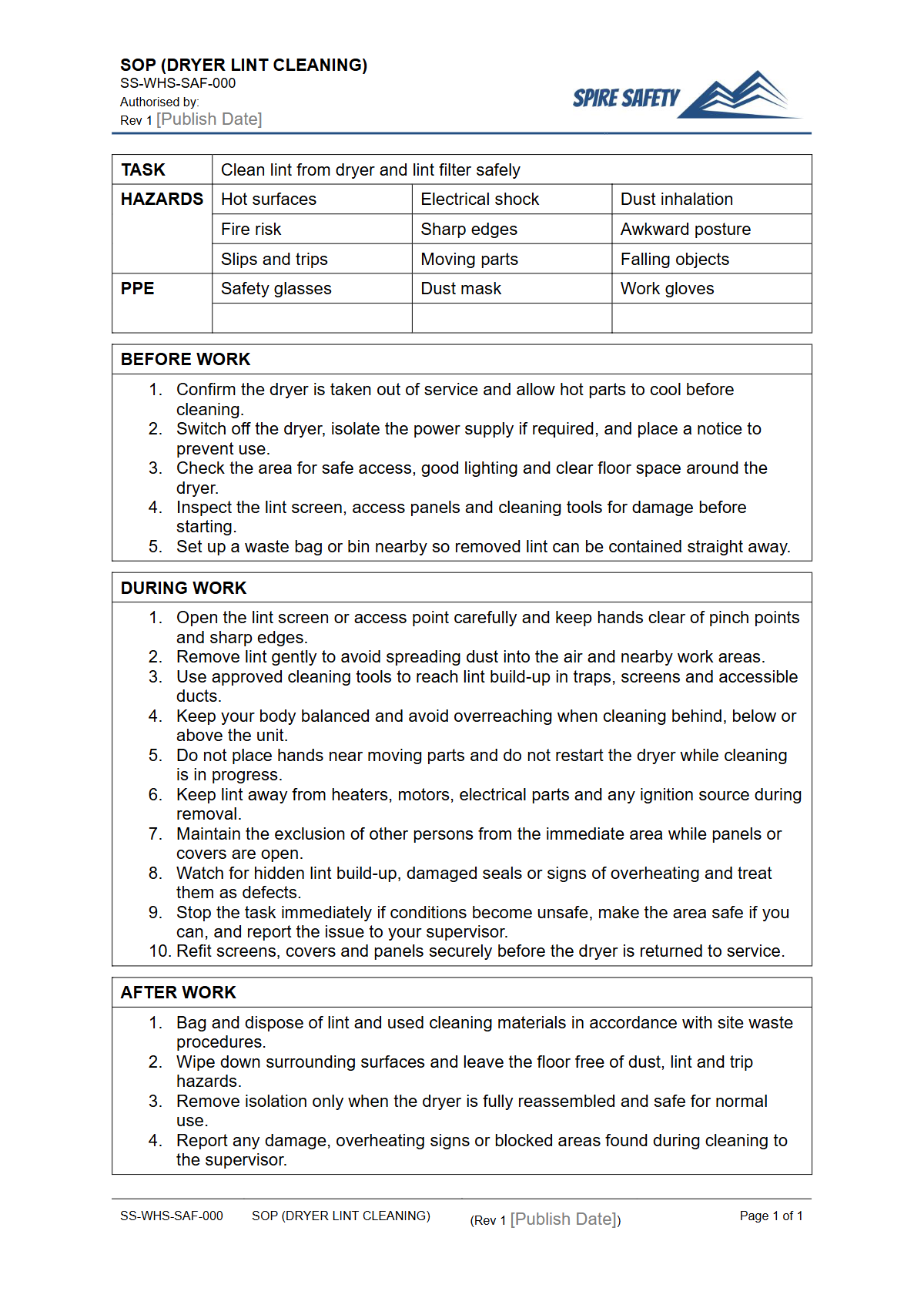
Purpose of the Free Safe Operating Procedure (Dryer Lint Cleaning) Template
Managing workplace safety involves identifying risks and implementing clear, repeatable controls. This Free Safe Operating Procedure (Dryer Lint Cleaning) Template provides a structured framework for documenting the process of cleaning lint and debris from commercial or industrial clothes dryers.
Lint accumulation is a significant fire hazard, and improper cleaning methods can lead to equipment damage or injury. Using this SOP helps ensure that maintenance tasks are performed consistently and safely, reducing the risk of fire, electrical shock, and equipment malfunction.
It formalises your approach to a critical maintenance task, demonstrating a commitment to workplace health and safety.
An SOP is a foundational document within a broader safety framework. Integrating procedures like this one into your company's overall approach is essential for building a robust safety culture.
A comprehensive safety system ensures that individual procedures are supported by overarching policies, training programs, and regular reviews. Developing strong WHS management systems provides this crucial context, turning isolated documents into a cohesive and effective safety strategy for your entire organisation.
Video walkthrough
How to use the Free Safe Operating Procedure (Dryer Lint Cleaning) Template
This template is available for immediate download in DOCX and PDF formats. The DOCX file is fully editable, allowing you to tailor the content to the specific models of dryers, tools, and workplace environment at your site.
We have structured the document to align with Australian WHS best practices, including sections for hazard identification, required Personal Protective Equipment (PPE), a step-by-step procedure, and emergency protocols.
Important: This document is a template and must be customised. It is not a complete, ready-to-use procedure.
You must review and edit every section to reflect your specific operational context. This includes listing the exact dryer models, specifying the types of tools required, detailing your site's lockout-tagout procedure, and inserting relevant emergency contact information.
We have included prompts throughout the document to guide your customisation process. For other equipment-specific procedures, you might find our Free Air Compressor SOP (Safe Operating Procedure) Template useful as a comparative example.
When to Use This SOP
A Safe Operating Procedure for dryer lint cleaning should be used as a primary reference document for both training and operational guidance. It is essential during the induction of new maintenance personnel or laundry staff responsible for the task.
It should also be reviewed regularly, at least annually or whenever a new model of dryer is introduced. Furthermore, this SOP serves as a critical checklist before, during, and after the cleaning task is performed to ensure all safety steps are followed. Regular reviews of such procedures are often a key part of formal WHS compliance auditing.
Key Considerations for Dryer Lint Cleaning
When customising this template, pay close attention to the unique hazards associated with your equipment. These typically include:
- Fire Hazard: Lint is highly flammable. The procedure must detail cleaning the filter, internal cavities, and the full length of the exhaust ducting.
- Electrical Hazard: Dryers must be fully isolated from their power source before any internal cleaning or maintenance begins. Your Lockout-Tagout (LOTO) procedure is critical here.
- Manual Handling: Moving dryers to access rear panels and ducting can pose a risk. The SOP should outline safe methods for moving equipment if required.
- Confined Spaces: In some large industrial laundry setups, ductwork may be large enough to be considered a confined space, requiring specific permits and procedures.
Documenting procedures for various plant and equipment helps standardise safety across your operations. If your workplace uses other machinery, exploring resources like our FREE Circular Saw SOP (Safe Operating Procedure) Template can provide insight into structuring other task-specific safety documents.
Who Should Use This SOP
This template is designed for use by Persons Conducting a Business or Undertaking (PCBUs), WHS managers, maintenance supervisors, and team leaders. It is intended to be adapted for any workplace that uses commercial or industrial clothes dryers, including hotels, hospitals, care facilities, commercial laundries, and laundromats.
The final, customised procedure should be made easily accessible to all workers who are tasked with performing or supervising the cleaning of dryer lint. For businesses that operate complex industrial facilities, such as those with integrated laundry operations, our FREE Conveyer System SOP (Safe Operating Procedure) Template may also be relevant.
If you require assistance in adapting this template or developing a more comprehensive safety management system for your business, our team of specialists can provide expert WHS consulting. We can help you navigate your obligations and implement practical safety solutions. You can also browse our extensive free WHS resources library for more templates and guides.
Common mistakes
Common mistakes to avoid
- Only cleaning the removable lint filter and neglecting the ducting, vents, and internal cavities.
- Failing to completely disconnect the dryer from power (and gas, if applicable) before starting maintenance.
- Using incorrect tools, such as sharp objects, that can puncture or damage the flexible ducting.
- Not providing specific training on the customised cleaning procedure to all relevant staff.
Legal references
Legal considerations
The following legal requirements may be relevant to this type of work.
- Work Health and Safety Act (Harmonised) — Provides the primary duties for protecting workers and other people from work health and safety risks.
- Work Health and Safety Regulations (Harmonised) — Sets out requirements supporting the management of workplace hazards and risks.
The following codes may be relevant to this type of work.
- Managing WHS Risks Code of Practice — Provides practical guidance on identifying hazards, assessing risks and applying effective controls.
- Work Health and Safety Consultation, Cooperation and Coordination Code of Practice — Provides practical guidance on consulting workers and coordinating with other duty holders.
- Managing the Work Environment and Facilities Code of Practice — Provides practical guidance on safe work environments, workplace facilities and related controls.
Did you know
Fire Risk Statistic
According to the US National Fire Protection Association (NFPA), failure to clean is the leading cause of clothes dryer fires. Regular, thorough cleaning is the most effective preventative measure.
Efficiency Loss
A lint-clogged exhaust duct can dramatically increase drying times and energy consumption. A clean system not only improves safety but also reduces operational costs.
FAQ
Frequently asked questions
01How often should a commercial dryer's lint trap and ducting be cleaned?
02What PPE is required for cleaning dryer lint?
03Is a Safe Operating Procedure a legal requirement for dryer maintenance?
04Why is cleaning the entire dryer duct so important?
Share this resource
Free Safe Operating Procedure (Dryer Lint Cleaning) Template
Browse Categories
How To Use It
- 1Download and open in Word or PDF.
- 2Replace the placeholders with your business details.
- 3Get it reviewed by a WHS specialist before rollout.
Need it customised?
Our WHS consultants can adapt this template to your site, run a gap analysis, or audit what you already have in place.
Book a Free Consultation WHS consulting servicesor call 1300 156 382
Related templates
- Free Safe Operating Procedure (Drywall Lift) Template
- Free Safe Operating Procedure (Duct Access Cleaning) Template
- Free Safe Operating Procedure (Duct Crimper) Template
- Free Safe Operating Procedure (Duct Cutter) Template
- Free Safe Operating Procedure (Duct Grille Cleaning) Template
- Free Safe Operating Procedure (Duct Lifter) Template