
Free Safe Operating Procedure (Duct Grille Cleaning) Template
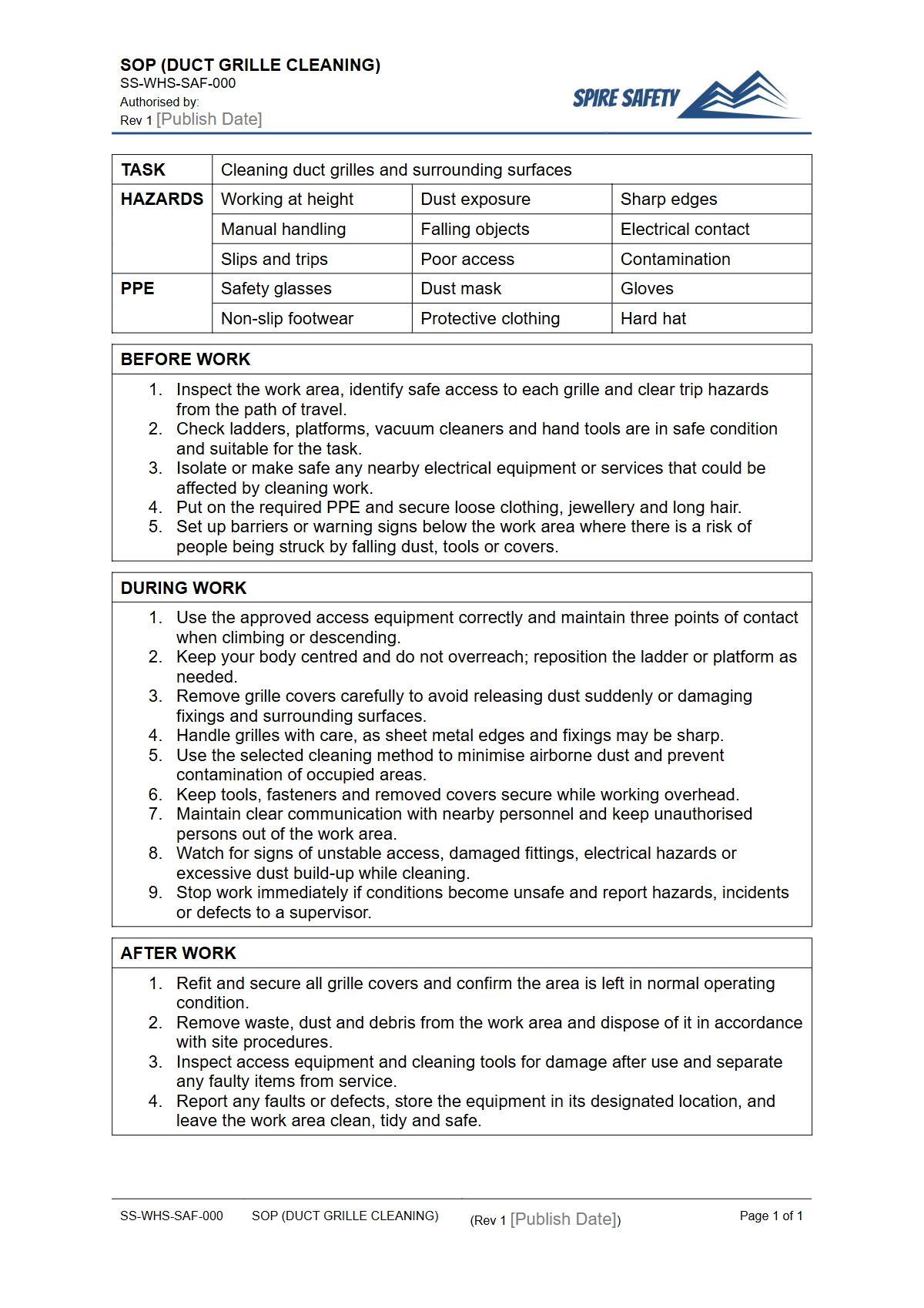
Download our free Safe Operating Procedure for duct grille cleaning. This template helps you document safety steps for maintaining ventilation systems.
Free Safe Operating Procedure (Duct Grille Cleaning) Template
DOCX • 126 KB + PDF
Updated Oct 2026
No signup required
Purpose of the Free Safe Operating Procedure (Duct Grille Cleaning) Template
Effectively managing workplace health and safety requires clear, documented procedures for routine tasks. This free Safe Operating Procedure (Duct Grille Cleaning) Template provides a structured starting point for organisations to formalise the process of cleaning ventilation duct grilles.
Its primary purpose is to help you systematically identify hazards associated with the task—such as working at heights, manual handling, and chemical exposure—and to document the specific control measures required to ensure worker safety. A documented SOP is a critical component of effective WHS management systems, promoting consistent, safe work practices across all teams.
By implementing a standardised procedure, you can reduce the likelihood of incidents, supports your compliance efforts with WHS duties, and improve overall air quality and system efficiency. This template guides you in outlining pre-operational checks, a step-by-step cleaning process, and post-operational tasks, creating a comprehensive safety document that can be used for training, inductions, and risk management.
Video walkthrough
How to use the Free Safe Operating Procedure (Duct Grille Cleaning) Template
This Safe Operating Procedure template is provided in both DOCX and PDF formats for your convenience. The DOCX file is fully editable, allowing you to tailor it to the unique requirements of your workplace.
To use it effectively, download the file and systematically work through each section, replacing the placeholder text with information specific to your equipment, cleaning agents, and site conditions. It is crucial to conduct a site-specific risk assessment to identify all potential hazards and determine the most effective controls for your environment.
Similar to our free Air Compressor SOP, this document provides a structured format you must adapt.
Consultation is a key part of this process. Involve the workers who will be performing the cleaning tasks, as their direct experience is invaluable for identifying practical risks and effective control measures.
Once customised, the SOP should be approved by a manager or WHS representative. The finalised procedure should then be used as a basis for training employees, ensuring everyone understands the safe way to perform the job. The procedure should be regularly reviewed and updated, a process that can be supported by formal WHS compliance auditing.
Please note: We've designed this document as a comprehensive starting point. You must customise it with your specific workplace details, including site-specific hazards, machinery, and control measures.
When to use a Duct Grille Cleaning SOP
A Safe Operating Procedure for duct grille cleaning should be used consistently as a reference tool to guide safe work practices. It is particularly important in several key situations:
- Worker Training and Induction: Use the SOP to train new employees or contractors on the established safe method for cleaning duct grilles.
- Refresher Training: Periodically review the SOP with existing staff to reinforce safety protocols and address any complacency.
- Pre-Task Planning: Workers should consult the SOP before commencing the task, especially if it is performed infrequently, to refresh their memory on hazards and controls.
- Incident Investigation: If a near-miss or injury occurs during cleaning, the SOP should be reviewed as part of the investigation to determine if the procedure was followed and if it needs revision.
- Process Changes: If new cleaning equipment, chemicals, or methods are introduced, the SOP must be updated accordingly before the new process is implemented. In a commercial kitchen, this is just as vital as a deep fryer SOP is for kitchen staff.
Who should use this Safe Operating Procedure
This SOP is intended for a range of personnel within an organisation to ensure a holistic approach to safety management. Key users include:
- Persons Conducting a Business or Undertaking (PCBUs): Business owners and managers use the SOP to fulfil their primary duty of care by providing safe systems of work.
- WHS Managers and Safety Officers: These professionals use the template to develop, implement, and review workplace-specific procedures as part of the broader safety framework. For assistance in developing comprehensive safety documentation, our WHS consulting services can provide expert guidance.
- Supervisors and Team Leaders: They are responsible for ensuring workers are trained on the SOP and follow it correctly during day-to-day operations.
- Workers and Cleaning Staff: The end-users of the SOP, who rely on it to understand the hazards and perform their tasks safely.
By making this procedure accessible to everyone involved, you foster a stronger safety culture where responsibilities are clear and everyone is empowered to work safely. To discover more templates and checklists, you can browse our extensive free WHS resources library.
Common mistakes
Common mistakes to avoid
- Failing to disconnect or lock out the HVAC system's power source before starting work.
- Using inappropriate or unstable ladders for working at heights, leading to falls.
- Neglecting to wear appropriate PPE, such as safety glasses, gloves, and respiratory protection.
- Using overly harsh chemicals that can damage the grilles or create respiratory hazards in a poorly ventilated area.
Legal references
Legal considerations
The following legal requirements may be relevant to this type of work.
- Work Health and Safety Act (Harmonised) — Provides the primary duties for protecting workers and other people from work health and safety risks.
- Work Health and Safety Regulations (Harmonised) — Sets out requirements supporting the management of workplace hazards and risks.
The following codes may be relevant to this type of work.
- Managing WHS Risks Code of Practice — Provides practical guidance on identifying hazards, assessing risks and applying effective controls.
- Work Health and Safety Consultation, Cooperation and Coordination Code of Practice — Provides practical guidance on consulting workers and coordinating with other duty holders.
- Managing the Work Environment and Facilities Code of Practice — Provides practical guidance on safe work environments, workplace facilities and related controls.
Did you know
Indoor Air Quality
Dirty duct grilles can restrict airflow and circulate dust, allergens, and other contaminants, significantly impacting a building's indoor air quality and occupant health.
Fire Hazard
In commercial kitchens, grease buildup on exhaust duct grilles is a significant fire hazard. Regular cleaning according to a safe procedure is a critical fire prevention measure.
FAQ
Frequently asked questions
01Why is a Safe Operating Procedure for duct grille cleaning necessary?
02What hazards are involved in cleaning duct grilles?
03Can I use this template for any type of ventilation system?
04How often should we review our duct grille cleaning SOP?
Share this resource
Free Safe Operating Procedure (Duct Grille Cleaning) Template
Browse Categories
How To Use It
- 1Download and open in Word or PDF.
- 2Replace the placeholders with your business details.
- 3Get it reviewed by a WHS specialist before rollout.
Need it customised?
Our WHS consultants can adapt this template to your site, run a gap analysis, or audit what you already have in place.
Book a Free Consultation WHS consulting servicesor call 1300 156 382
Related templates
- Free Safe Operating Procedure (Duct Lifter) Template
- Free Safe Operating Procedure (Duct Notcher) Template
- Free Safe Operating Procedure (Dump Point Cleaning) Template
- Free Safe Operating Procedure (Dump Point Inspection) Template
- Free Safe Operating Procedure (Dust Collector) Template
- Free Safe Operating Procedure (Dust Extractor) Template