
Free Safe Operating Procedure (Dust Extractor) Template
Download our free Safe Operating Procedure (Dust Extractor) Template to manage respiratory hazards.
Free Safe Operating Procedure (Dust Extractor) Template
DOCX • 126 KB + PDF
Updated Oct 2026
No signup required
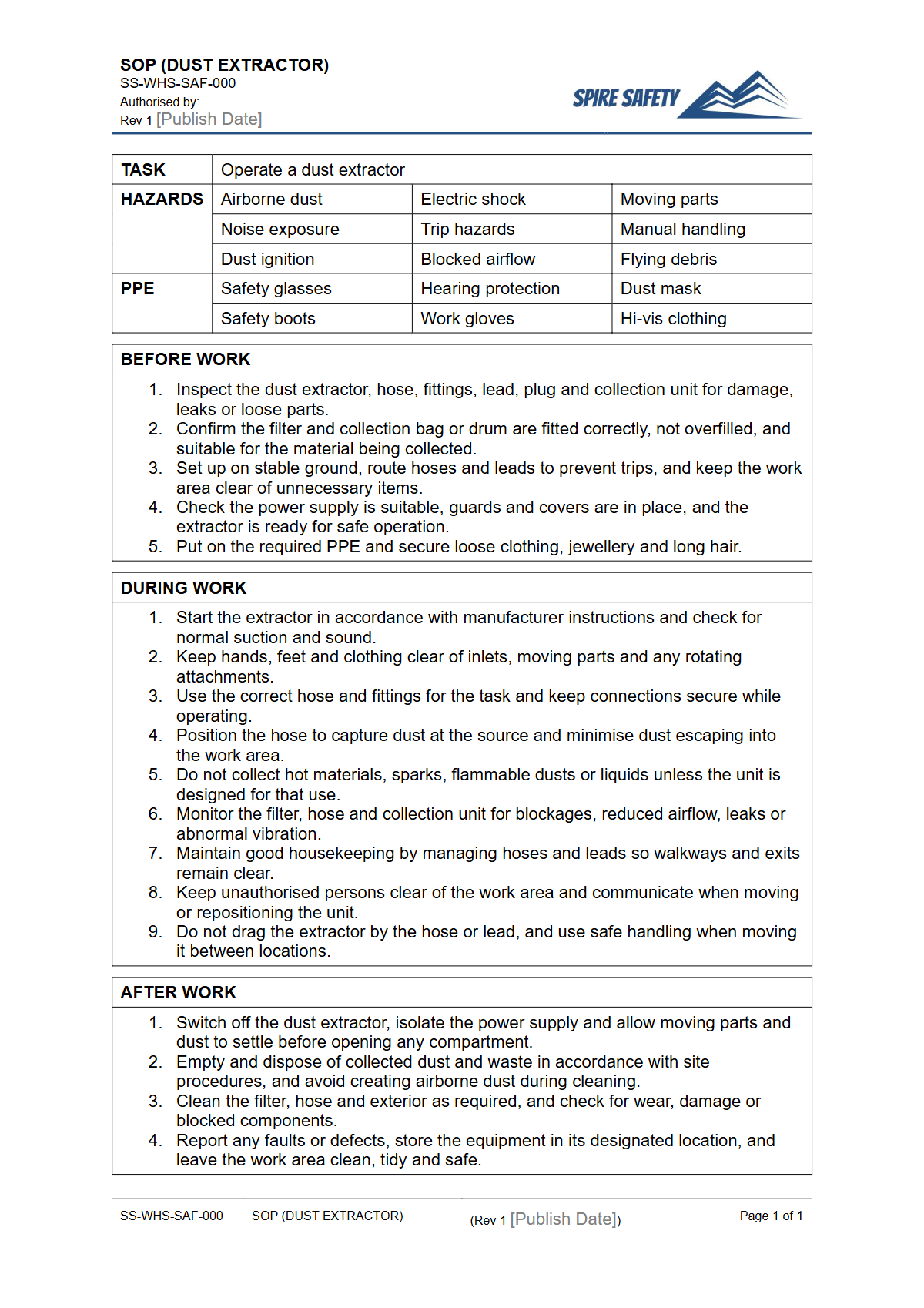
Purpose of the Free Safe Operating Procedure (Dust Extractor) Template
Operating a dust extractor involves more than just switching it on. To effectively control airborne contaminants and protect worker health, a documented process is essential.
This Free Safe Operating Procedure (Dust Extractor) Template provides a structured framework for outlining the required steps for the safe use, maintenance, and handling of dust extraction equipment. Its primary purpose is to minimise exposure to hazardous dusts, such as respirable crystalline silica (RCS), wood dust, and other particulates that can cause serious, irreversible lung diseases.
By implementing a formal SOP, you establish a consistent, safe method of work that can be used for training, supervision, and incident investigation. It serves as a key component in a hierarchy of controls, helping your organisation demonstrate due diligence in managing workplace hazards.
A documented procedure forms a critical part of broader WHS management systems, ensuring that control measures are understood, implemented, and maintained by all relevant personnel.
Video walkthrough
How to use the Free Safe Operating Procedure (Dust Extractor) Template
This template is designed for ease of use and customisation. After downloading the DOCX or PDF file, you will need to adapt it to your specific workplace conditions.
A generic procedure is not sufficient to control site-specific risks. The document includes sections covering pre-operational checks, operational steps, maintenance requirements, and emergency procedures.
Your task is to populate these sections with details relevant to your equipment and tasks.
Follow these steps to get the most out of the template:
- Review and Customise: Go through each section and replace the placeholder text with information specific to your dust extractor models (e.g., brand, class M or H), the tools they are connected to, and the types of dust being generated.
- Consult with Workers: Involve the operators who use the equipment daily. Their practical input is invaluable for creating a procedure that is both safe and workable.
- Obtain Approval: Once customised, the SOP should be reviewed and approved by a supervisor or manager before being implemented.
- Train and Communicate: Ensure all relevant workers are trained on the new SOP. Make the document readily accessible in the work area.
Important: This is a template only. You must adapt this document to reflect the specific equipment, chemicals, and processes used in your workplace.
We are not liable for any incidents that arise from using this template without proper, site-specific customisation. For related equipment, you might also find our FREE Circular Saw SOP Template helpful, as these tools are often used together.
When to use it
A Safe Operating Procedure for a dust extractor should be a constant reference point for any task that generates hazardous dust. It should be consulted before starting work, especially for non-routine tasks.
The SOP is a critical tool during worker inductions, new equipment commissioning, and refresher training sessions to reinforce correct and safe work practices.
Furthermore, the SOP should be used as a baseline document during safety inspections and risk assessments. It provides a benchmark against which actual work practices can be compared, helping to identify any deviations or gaps in your safety processes.
It can also be used for other common workshop equipment; a similar structured approach can be applied using our Free Air Compressor SOP (Safe Operating Procedure) Template to ensure consistency in your documentation.
Who should use it
The responsibility for using and enforcing a dust extractor SOP extends across several roles within an organisation:
- Workers/Operators: Must understand and follow the procedure for every task involving the dust extractor. They are responsible for conducting pre-start checks and reporting any faults or issues.
- Supervisors and Line Managers: Are responsible for ensuring that workers are trained on the SOP and adhere to it. They must also ensure the equipment is properly maintained and available for use.
- WHS Managers/Advisors: Use the SOP as part of the overall safety management system. They are often responsible for developing, reviewing, and updating the procedure in consultation with workers and management.
Management personnel should use the SOP as a tool to verify that controls are effective. The existence of a procedure is the first step; its consistent implementation is what matters.
This is often a focus during WHS compliance auditing, which checks that documented procedures match workplace reality. SOPs for other high-risk plant, such as our FREE Trencher SOP Template, follow the same principle of linking documentation to practical application.
By ensuring clear roles and responsibilities are assigned, the SOP becomes an active part of your workplace safety culture rather than just a document on a shelf. For more templates and safety resources, feel free to browse our complete free WHS resources library.
Common mistakes
Common mistakes to avoid
- Using the wrong class of extractor for the hazard (e.g., a standard vacuum cleaner for silica dust).
- Failing to maintain or clean filters regularly, which drastically reduces suction power and capture efficiency.
- Incorrectly handling and disposing of collected dust, creating a secondary exposure risk for workers.
- Not using a hose with the correct diameter or failing to ensure a secure connection to the power tool, leading to leaks.
Legal references
Legal considerations
The following legal requirements may be relevant to this type of work.
- Work Health and Safety Act (Harmonised) — Provides the primary duties for protecting workers and other people from work health and safety risks.
- Work Health and Safety Regulations (Harmonised) — Sets out requirements supporting the management of workplace hazards and risks.
The following codes may be relevant to this type of work.
- Managing WHS Risks Code of Practice — Provides practical guidance on identifying hazards, assessing risks and applying effective controls.
- Work Health and Safety Consultation, Cooperation and Coordination Code of Practice — Provides practical guidance on consulting workers and coordinating with other duty holders.
- Managing the Work Environment and Facilities Code of Practice — Provides practical guidance on safe work environments, workplace facilities and related controls.
Did you know
Silica Dust Exposure
An estimated 600,000 Australian workers are exposed to respirable crystalline silica (RCS) dust each year. Effective on-tool dust extraction is a primary control measure recommended by safety regulators to mitigate this risk.
HEPA Filter Efficiency
High-Efficiency Particulate Air (HEPA) filters used in H-class dust extractors are designed to capture at least 99.97% of airborne particles as small as 0.3 microns, making them essential for work with high-risk carcinogens.
FAQ
Frequently asked questions
01What is the main purpose of a Safe Operating Procedure for a dust extractor?
02Can this template be used for any brand or class of dust extractor?
03How often should a dust extractor SOP be reviewed?
04What are the risks of not using a dust extractor correctly?
Share this resource
Free Safe Operating Procedure (Dust Extractor) Template
Browse Categories
How To Use It
- 1Download and open in Word or PDF.
- 2Replace the placeholders with your business details.
- 3Get it reviewed by a WHS specialist before rollout.
Need it customised?
Our WHS consultants can adapt this template to your site, run a gap analysis, or audit what you already have in place.
Book a Free Consultation WHS consulting servicesor call 1300 156 382
Related templates
- Free Safe Operating Procedure (Dust Monitor) Template
- Free Safe Operating Procedure (Dye Penetrant Test) Template
- Free Safe Operating Procedure (Dyeing Machine) Template
- Free Safe Operating Procedure (Dynamic Cone Penetrometer) Template
- Free Safe Operating Procedure (E-Waste Collection) Template
- Free Safe Operating Procedure (E-Waste Dropoff Intake) Template