
Free Safe Operating Procedure (E-Waste Collection) Template
Formalise your electronic waste handling processes with our structured template. Download our free Safe Operating Procedure for e-waste collection today.
Free Safe Operating Procedure (E-Waste Collection) Template
DOCX • 126 KB + PDF
Updated Oct 2026
No signup required
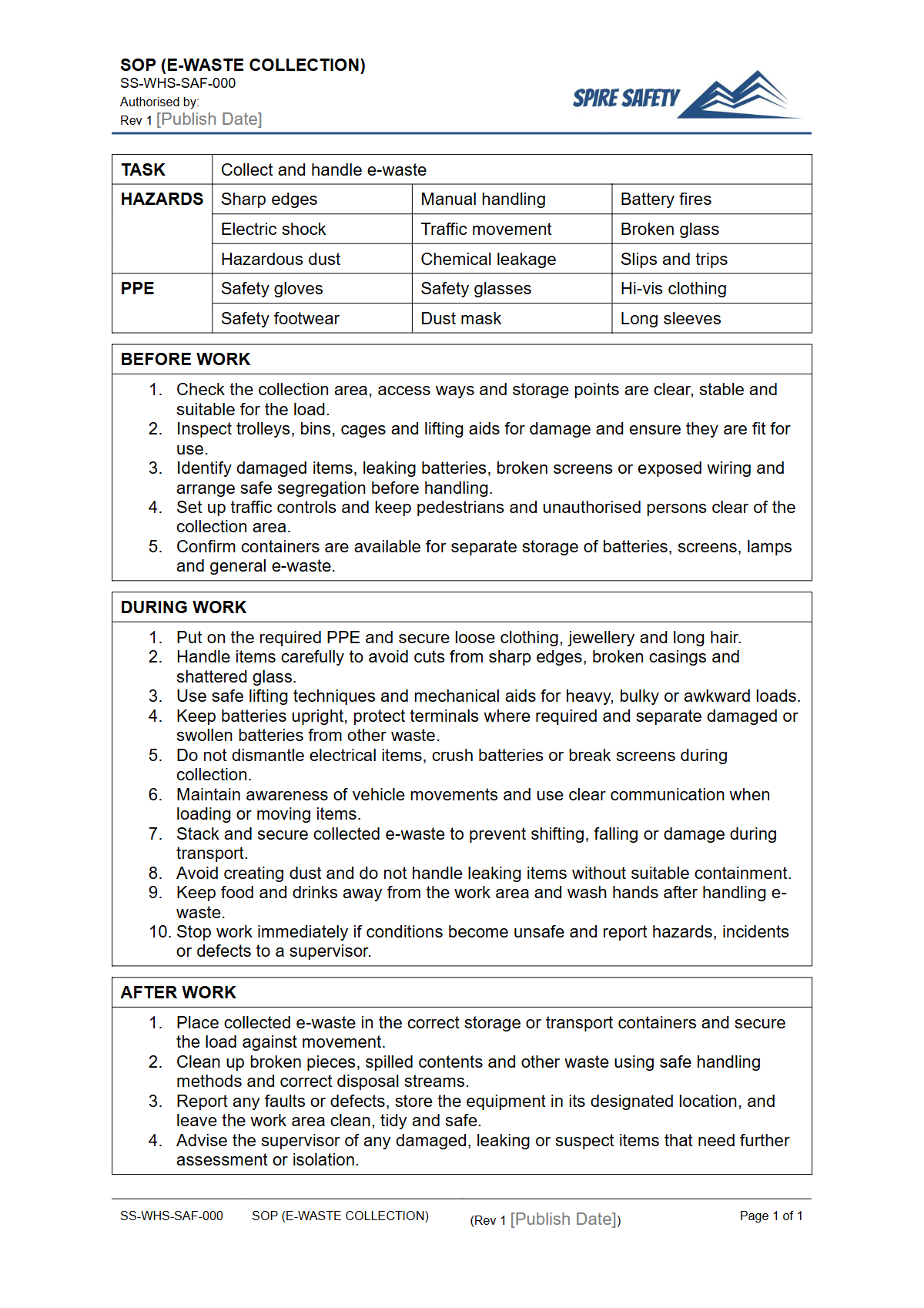
Purpose of the Free Safe Operating Procedure (E-Waste Collection) Template
This Free Safe Operating Procedure (E-Waste Collection) Template provides a comprehensive starting point for organisations to document the step-by-step process for safely collecting, sorting, and handling electronic waste. E-waste presents a unique combination of workplace hazards, including musculoskeletal injuries from manual handling, exposure to hazardous substances like lead, mercury, and cadmium, and electrical risks from residual energy.
A well-defined SOP is a critical tool for mitigating these risks and ensuring workers understand and follow established safety protocols.
Using a structured Safe Operating Procedure helps your business meet its duty of care under Australian WHS legislation by implementing a formal safe system of work. This document outlines key stages, from initial collection and transport to sorting and storage, specifying required personal protective equipment (PPE), identifying potential hazards, and detailing control measures for each step.
Integrating this SOP is a practical step towards building robust WHS management systems within your organisation.
Hazards Associated with E-Waste Collection
Workers involved in e-waste collection may face numerous risks, including:
- Manual Handling: Lifting, carrying, and moving heavy or awkward items like old televisions, computer monitors, and server racks can lead to sprains, strains, and other musculoskeletal disorders.
- Hazardous Substances: Many electronic devices contain toxic materials. Broken screens can release mercury, circuit boards contain lead solder, and batteries can leak corrosive acids.
- Cuts and Lacerations: Sharp edges on broken plastic casings, exposed metal components, and shattered glass are common hazards.
- Electrical Hazards: Devices may still hold an electrical charge, posing a risk of electric shock if not handled correctly.
- Plant and Equipment: Risks of crush injuries, entanglement, or being struck by moving equipment are present when using machinery like forklifts, balers, or conveyor belts. For tasks involving specific machinery, a dedicated procedure such as our FREE Conveyer System SOP should be developed.
Video walkthrough
How to use the Free Safe Operating Procedure (E-Waste Collection) Template
This template is provided as a fully editable DOCX file, allowing for complete customisation, along with a print-ready PDF. To use it effectively, you must adapt its contents to the specific context of your workplace.
Review each section and add or remove information based on the types of e-waste you handle, the equipment used, and your site layout.
Please note: This template is a starting point. We strongly advise that you customise this document to reflect the specific equipment, processes, and risks unique to your workplace.
A generic procedure is not sufficient to ensure safety; it must be made site-specific to be effective. Once customised, the SOP should form part of your worker training and induction process.
An effective SOP can also be a key document reviewed during WHS compliance auditing activities.
When to use it
A Safe Operating Procedure for e-waste collection should be used consistently as a reference and training tool. It is essential in several scenarios:
- Task execution: As a guide for workers to follow before and during e-waste handling tasks.
- Worker training: When inducting new employees or training existing staff on new or revised procedures.
- Risk assessments: As a reference document when conducting risk assessments for e-waste management activities.
- Toolbox talks: To reinforce key safety messages and discuss specific hazards before a shift begins.
The SOP should be readily accessible to all relevant personnel at the location where the work is performed. If heavy lifting equipment is involved in moving pallets of e-waste, this SOP should be used alongside specific machinery procedures, such as a FREE Telehandler SOP Template.
Who should use it
This SOP is intended for use by all personnel involved in the lifecycle of e-waste management within an organisation. This includes:
- Workers: Employees who physically collect, transport, sort, dismantle, and store e-waste.
- Supervisors and Team Leaders: To ensure their teams are following procedures, conduct training, and monitor compliance.
- WHS Managers and Personnel: To develop, implement, and review safety procedures as part of the overall safety management system.
- Contractors: To ensure any third parties operating on your site adhere to your safety standards.
For organisations looking for a broader range of safety documents, our free WHS resources library contains numerous templates for various high-risk tasks. Procedures should also be developed for ancillary equipment used in the process, and our Free Air Compressor SOP can be a useful reference if pneumatic tools or cleaning systems are in use.
Common mistakes
Common mistakes to avoid
- Using the template without customising it for site-specific equipment and hazards.
- Failing to adequately train all relevant workers on the finalised SOP.
- Neglecting to review and update the procedure after a process change or near miss.
- Underestimating the risks of exposure to hazardous substances found in batteries and circuit boards.
Legal references
Legal considerations
The following legal requirements may be relevant to this type of work.
- Work Health and Safety Act (Harmonised) — Provides the primary duties for protecting workers and other people from work health and safety risks.
- Work Health and Safety Regulations (Harmonised) — Sets out requirements supporting the management of workplace hazards and risks.
The following codes may be relevant to this type of work.
- Managing WHS Risks Code of Practice — Provides practical guidance on identifying hazards, assessing risks and applying effective controls.
- Work Health and Safety Consultation, Cooperation and Coordination Code of Practice — Provides practical guidance on consulting workers and coordinating with other duty holders.
- Managing the Work Environment and Facilities Code of Practice — Provides practical guidance on safe work environments, workplace facilities and related controls.
Did you know
Hidden Value
E-waste is rich in valuable materials like gold, silver, copper, and palladium. It is estimated that one tonne of mobile phones can contain more gold than one tonne of high-grade gold ore.
Growing Problem
Electronic waste is one of the fastest-growing waste streams in the world. Australia generates over 500,000 tonnes of e-waste annually, and much of it contains materials that are hazardous if not disposed of correctly.
FAQ
Frequently asked questions
01What are the main hazards in e-waste collection?
02Is a Safe Operating Procedure legally required for handling e-waste in Australia?
03How often should an e-waste collection SOP be reviewed?
04Can this template be used for large-scale recycling plants?
Share this resource
Free Safe Operating Procedure (E-Waste Collection) Template
Browse Categories
How To Use It
- 1Download and open in Word or PDF.
- 2Replace the placeholders with your business details.
- 3Get it reviewed by a WHS specialist before rollout.
Need it customised?
Our WHS consultants can adapt this template to your site, run a gap analysis, or audit what you already have in place.
Book a Free Consultation WHS consulting servicesor call 1300 156 382
Related templates
- Free Safe Operating Procedure (E-Waste Dropoff Intake) Template
- Free Safe Operating Procedure (Earth Tester) Template
- Free Safe Operating Procedure (Earthing Stick) Template
- Free Safe Operating Procedure (Edge Bander) Template
- Free Safe Operating Procedure (Edge Protection) Template
- Free Safe Operating Procedure (Effluent Area Check) Template