
Free Safe Operating Procedure (Edge Protection) Template
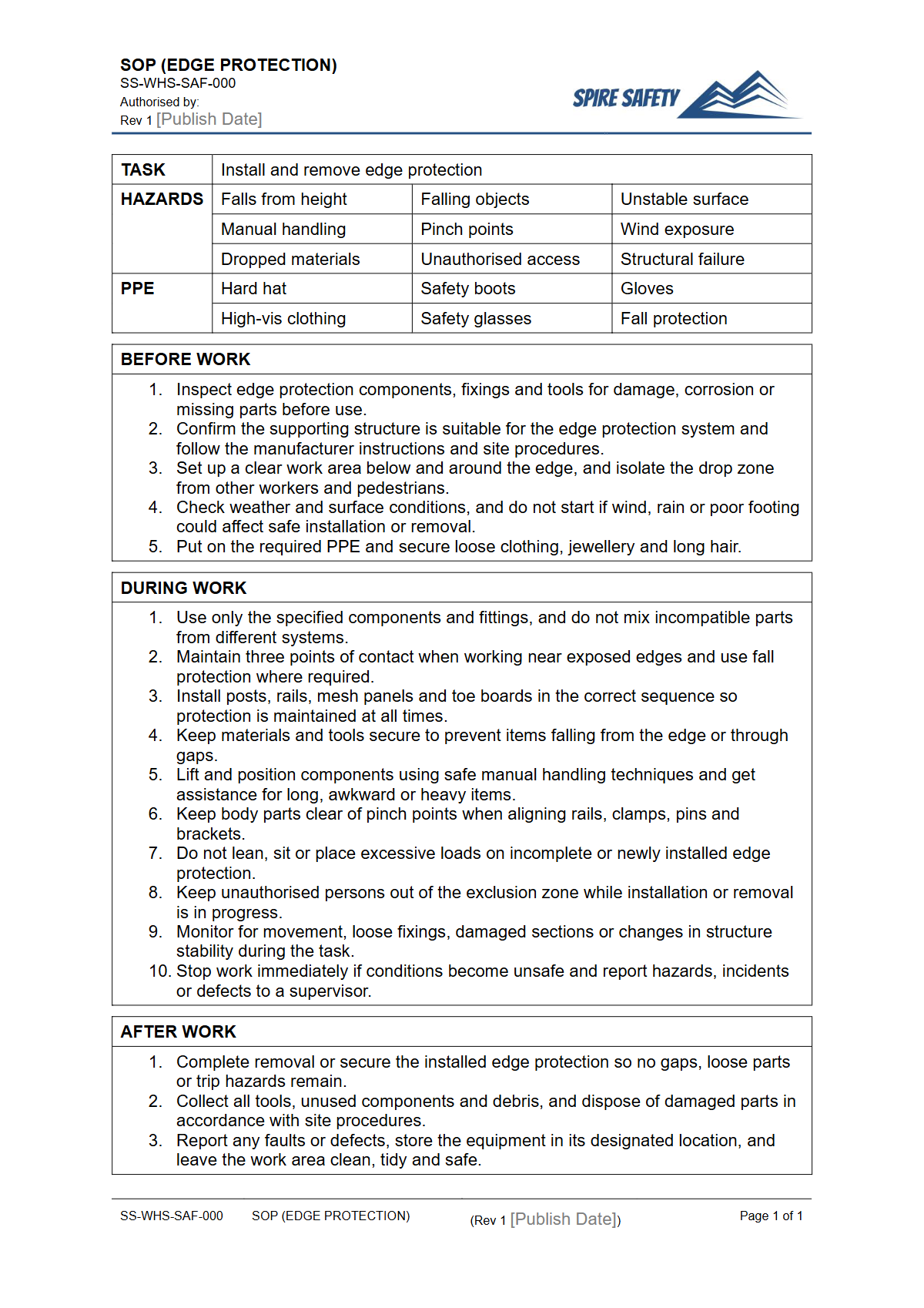
Effectively manage the risks of working at heights with our structured Safe Operating Procedure for edge protection systems. Download your free template now.
Free Safe Operating Procedure (Edge Protection) Template
DOCX • 126 KB + PDF
Updated Oct 2026
No signup required
Purpose of the Free Safe Operating Procedure (Edge Protection) Template
Working at heights is a high-risk activity, and unprotected edges are a leading contributor to serious incidents. This Free Safe Operating Procedure (Edge Protection) Template provides a structured framework for documenting the safe installation, use, inspection, maintenance, and dismantling of temporary edge protection systems.
Its primary purpose is to provide clear, step-by-step instructions to workers, ensuring a consistent and safe approach to controlling the risk of falls. By formalising these processes, you create a reliable reference for training, inductions, and operational checks.
A documented SOP serves as a critical tool in your risk management toolkit. It helps your organisation meet its duties under WHS legislation by demonstrating a planned, systematic approach to safety.
This procedure should form one part of your broader safety framework, which should include comprehensive WHS management systems to ensure all hazards are systematically addressed.
Video walkthrough
How to use the Free Safe Operating Procedure (Edge Protection) Template
This template is provided in both DOCX and PDF formats for your convenience. The DOCX file is fully editable, allowing you to adapt it to the unique requirements of your workplace, specific sites, and the types of edge protection systems you use (e.g., scaffolding with guardrails, proprietary screen systems, or safety nets).
It is designed as a starting point, not a finished document.
To use it effectively, you must review every section and add site-specific information. This includes details such as:
- Specific roles and responsibilities (e.g., who is authorised to install, inspect, or remove systems).
- The types of edge protection equipment used on your site.
- Site-specific hazard identification and risk controls.
- Emergency procedures and rescue plans relevant to a fall incident.
- The frequency and criteria for inspections.
Important: We have drafted this template to be aligned with the model WHS framework, but it is not a complete, out-of-the-box solution. You must customise it with your specific operational details to ensure it is suitable for your workplace and effectively controls your identified risks.
When to use an SOP for Edge Protection
An SOP for edge protection should be implemented on any site where there is a risk of a person or object falling from one level to another. It is particularly critical in construction, maintenance, and repair work.
Use this procedure for activities occurring on or near rooftops, mezzanines, balconies, open floors, excavations, and other platforms where a fall hazard exists. In construction, this is especially relevant for any work where there is a risk of a fall of two metres or more.
This SOP should be used as the primary guide for all workers involved with edge protection. It complements other task-specific documents, such as a Telehandler SOP when mobile plant is used near an unprotected edge.
It serves as a key document for worker training, site inductions, and for supervisors conducting pre-start talks or safety observations.
Who should use it
This Safe Operating Procedure template is intended for use by anyone responsible for workplace health and safety. This includes:
- Persons Conducting a Business or Undertaking (PCBUs): To help fulfil their primary duty of care.
- Project Managers and Site Supervisors: To manage day-to-day operations and ensure crews follow established safety protocols.
- WHS Managers and Safety Officers: To develop, implement, and review safety documentation as part of the wider WHS system.
- Workers and Installers: As a clear guide for performing their tasks safely and correctly.
It is valuable for any organisation aiming to standardise its approach to managing fall hazards. This includes anyone involved in high-risk construction work, where other procedures like a trencher SOP may also be required for related site activities. Having clear, repeatable instructions is vital for consistency. Just as you would have a circular saw SOP for power tool safety, this document formalises the process for managing fall risks. Regular reviews of the SOP are also critical and can be integrated into your WHS compliance auditing schedule to ensure ongoing suitability. Find more helpful documents like this in our free WHS resources library.
Common mistakes
Common mistakes to avoid
- Using the template without customising it for specific site conditions and equipment.
- Failing to adequately train workers on the procedures outlined in the SOP.
- Neglecting regular inspections of the edge protection system once installed.
- Not reviewing and updating the SOP after an incident or when processes change.
Legal references
Legal considerations
The following legal requirements may be relevant to this type of work.
- Work Health and Safety Act (Harmonised) — Provides the primary duties for protecting workers and other people from work health and safety risks.
- Work Health and Safety Regulations (Harmonised) — Sets out requirements supporting the management of workplace hazards and risks.
The following codes may be relevant to this type of work.
- Managing WHS Risks Code of Practice — Provides practical guidance on identifying hazards, assessing risks and applying effective controls.
- Work Health and Safety Consultation, Cooperation and Coordination Code of Practice — Provides practical guidance on consulting workers and coordinating with other duty holders.
- Managing the Work Environment and Facilities Code of Practice — Provides practical guidance on safe work environments, workplace facilities and related controls.
Did you know
Fall Statistics
Falls from a height are a leading cause of fatalities and serious injuries in Australian workplaces. According to Safe Work Australia, they are the cause of a significant number of worker fatalities, particularly in the construction industry.
FAQ
Frequently asked questions
01What should be included in an SOP for edge protection?
02How often should edge protection be inspected?
03Is a Safe Operating Procedure a legal requirement for edge protection in Australia?
04What is the difference between an SOP and a SWMS for fall protection?
Share this resource
Free Safe Operating Procedure (Edge Protection) Template
Browse Categories
How To Use It
- 1Download and open in Word or PDF.
- 2Replace the placeholders with your business details.
- 3Get it reviewed by a WHS specialist before rollout.
Need it customised?
Our WHS consultants can adapt this template to your site, run a gap analysis, or audit what you already have in place.
Book a Free Consultation WHS consulting servicesor call 1300 156 382
Related templates
- Free Safe Operating Procedure (Effluent Area Check) Template
- Free Safe Operating Procedure (Effluent Spill Cleanup) Template
- Free Safe Operating Procedure (Egg Collection) Template
- Free Safe Operating Procedure (Egg Grading) Template
- Free Safe Operating Procedure (Egg Packing) Template
- Free Safe Operating Procedure (Electric Bed Adjustment) Template