
Free Safe Operating Procedure (Egg Packing) Template
Download our free Safe Operating Procedure (Egg Packing) Template to document clear, safe work instructions. This customisable guide helps you manage risks.
Free Safe Operating Procedure (Egg Packing) Template
DOCX • 126 KB + PDF
Updated Oct 2026
No signup required
Purpose of the Free Safe Operating Procedure (Egg Packing) Template
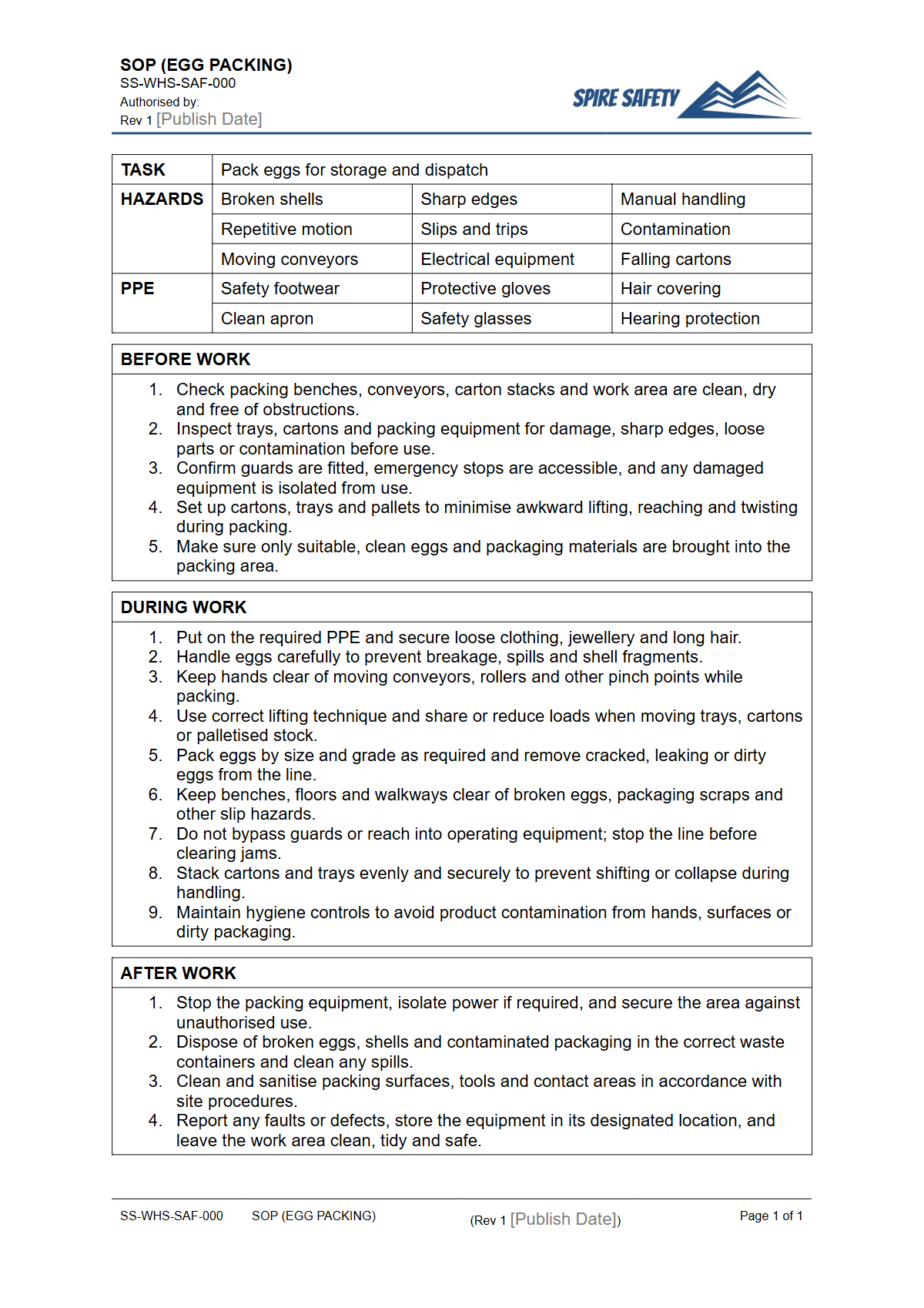
An effective Safe Operating Procedure (SOP) is a critical tool for ensuring tasks are performed safely and consistently. This free Safe Operating Procedure (Egg Packing) Template provides a structured starting point for documenting the approved method for packing eggs, helping to minimise risks for workers.
It formalises step-by-step instructions that integrate safety controls into routine operations, acting as both a guide for workers and a key component of your safety management system. A well-drafted SOP helps meet the duty of care obligations under Australian WHS laws by providing a clear safe system of work.
Egg packing facilities present a unique combination of hazards, including repetitive manual tasks, potential exposure to biological agents, and interaction with machinery. This template prompts you to consider risks such as musculoskeletal disorders from lifting and packing, entanglement in automated equipment, and slips on wet or contaminated floors.
For machinery-specific risks, such as those associated with automated packaging lines, you may need to develop additional procedures like a dedicated Conveyer System SOP to ensure all hazards are adequately controlled.
Video walkthrough
How to use the Free Safe Operating Procedure (Egg Packing) Template
This document is a foundation, not a final product. To implement it effectively, you must first download the DOCX file and adapt it to the specific context of your workplace.
This involves a thorough review of your existing egg packing processes, equipment, and environment. Consult with the workers who perform the task daily; their practical experience is invaluable for creating an SOP that is accurate and workable.
Identify the specific machinery models, chemical products, and personal protective equipment (PPE) used at your site and incorporate these details into the procedure.
Important: We have provided this template as a guide. You must customise it to reflect the unique hazards and control measures relevant to your specific workplace, equipment, and operational procedures.
Once customised, the SOP should be used as a primary training document for new employees and for refresher training. Regular checks and observations are necessary to ensure the procedure is being followed correctly, a process that can be formalised through periodic WHS compliance auditing.
When to use a Safe Operating Procedure
A Safe Operating Procedure for egg packing should be a living document, integrated into the daily rhythm of your operations. It is essential during the induction and training of new workers, ensuring they learn the correct, safe method from day one.
It also serves as a critical reference tool for experienced staff, promoting consistency and reinforcing safe work habits. The SOP should be readily accessible in the work area where egg packing occurs.
Furthermore, the SOP is a key document for procedural reviews and incident investigations. If an incident or near-miss occurs, the SOP should be one of the first documents reviewed to determine if the procedure was followed and if it remains adequate.
SOPs are a fundamental building block of robust WHS management systems, providing tangible evidence of your organisation's commitment to managing operational risks.
Who should use this document
This SOP is intended for a range of personnel within an organisation. Primarily, it is for the workers who carry out egg packing tasks, providing them with clear, unambiguous instructions on how to perform their duties safely.
Supervisors and team leaders should also use the SOP to oversee work, conduct training, and enforce safety standards on the floor.
Work Health and Safety (WHS) managers and coordinators will use this template as part of their risk management framework, ensuring that controls identified in risk assessments are translated into practical, documented procedures. For assistance in developing and implementing comprehensive safety documentation tailored to your business, consider engaging professional WHS consulting services.
Finally, remember to explore our full free WHS resources library for other templates that may support your operations, such as our Safe Operating Procedure for a Deep Fryer, which can be adapted for other food service equipment.
Common mistakes
Common mistakes to avoid
- Using the generic template without customising it for your specific site, machinery, and processes.
- Failing to consult with workers who perform the task when drafting or reviewing the SOP.
- Writing the SOP but failing to provide adequate training or making it accessible to workers.
- Treating the SOP as a one-time task and neglecting to review and update it regularly or after an incident.
Legal references
Legal considerations
The following legal requirements may be relevant to this type of work.
- Work Health and Safety Act (Harmonised) — Provides the primary duties for protecting workers and other people from work health and safety risks.
- Work Health and Safety Regulations (Harmonised) — Sets out requirements supporting the management of workplace hazards and risks.
The following codes may be relevant to this type of work.
- Managing WHS Risks Code of Practice — Provides practical guidance on identifying hazards, assessing risks and applying effective controls.
- Work Health and Safety Consultation, Cooperation and Coordination Code of Practice — Provides practical guidance on consulting workers and coordinating with other duty holders.
- Managing the Work Environment and Facilities Code of Practice — Provides practical guidance on safe work environments, workplace facilities and related controls.
Did you know
Manual Handling Risk
The food and beverage manufacturing industry has one of the highest rates of serious workers' compensation claims in Australia, with manual handling and muscular stress being leading causes of injury.
Production Scale
On average, Australia's commercial egg farms produce over 17 million eggs every day to meet national demand, making efficient and safe packing processes essential for the industry.
FAQ
Frequently asked questions
01What are the main hazards in egg packing operations?
02Is a Safe Operating Procedure a legal requirement in Australia?
03How often should our egg packing SOP be reviewed?
04Can I use this template for packing other food products?
Share this resource
Free Safe Operating Procedure (Egg Packing) Template
Browse Categories
How To Use It
- 1Download and open in Word or PDF.
- 2Replace the placeholders with your business details.
- 3Get it reviewed by a WHS specialist before rollout.
Need it customised?
Our WHS consultants can adapt this template to your site, run a gap analysis, or audit what you already have in place.
Book a Free Consultation WHS consulting servicesor call 1300 156 382
Related templates
- Free Safe Operating Procedure (Electric Bed Adjustment) Template
- Free Safe Operating Procedure (Electric Planer) Template
- Free Safe Operating Procedure (Electric Screwdriver) Template
- Free Safe Operating Procedure (Electric Shears) Template
- Free Safe Operating Procedure (Electric Stapler) Template
- Free Safe Operating Procedure (Electric Tug) Template