
Free Safe Operating Procedure (Electric Tug) Template
Manage the risks of using electric tugs in your workplace with our detailed template. Download your free Safe Operating Procedure (Electric Tug) template today.
Free Safe Operating Procedure (Electric Tug) Template
DOCX • 126 KB + PDF
Updated Oct 2026
No signup required
Purpose of the Free Safe Operating Procedure (Electric Tug) Template
Electric tugs, also known as pedestrian-operated tugs or tow tractors, are essential for moving heavy loads in warehouses, manufacturing plants, and logistics hubs. While they improve efficiency and reduce manual handling risks, they introduce hazards such as collisions with people or structures, crush injuries, and battery-related risks like spills or electrical faults.
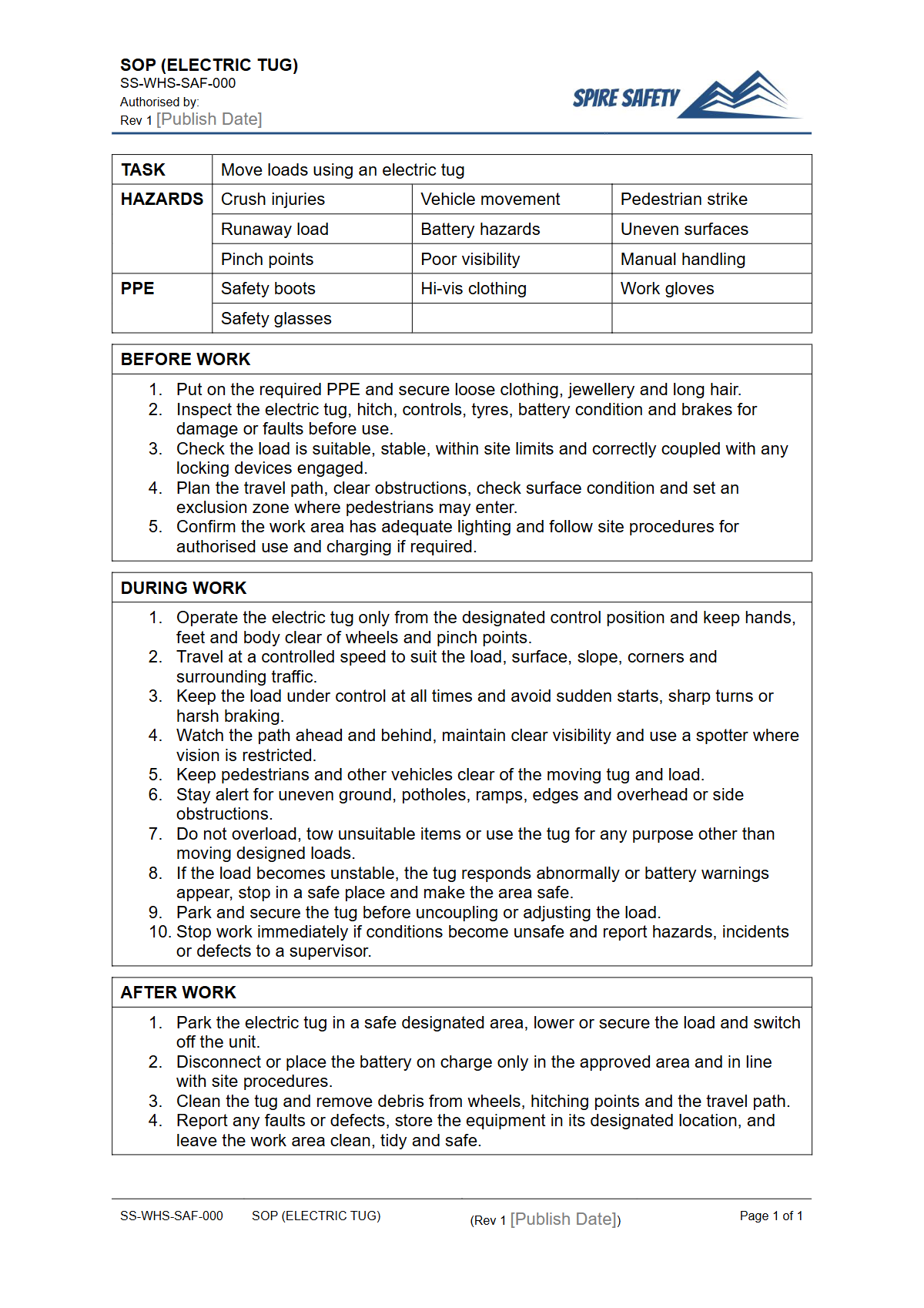
This free Safe Operating Procedure (Electric Tug) template provides a structured framework for documenting the specific steps required to operate this equipment safely, helping you control identified risks.
A well-developed SOP is a critical component of your workplace safety protocols. It formalises your risk control measures and demonstrates a commitment to operational safety, forming a key part of effective WHS management systems. By clearly defining expectations for pre-start checks, safe operation, and shutdown procedures, this template helps organisations standardise safe work practices and minimise the likelihood of incidents.
Video walkthrough
How to use the Free Safe Operating Procedure (Electric Tug) Template
This document is a starting point designed for customisation. Download the DOCX file and adapt it to reflect the specific circumstances of your workplace.
You should conduct a site-specific risk assessment to ensure all potential hazards are identified and controlled. Your customised SOP should detail your exact equipment models, the typical loads being moved, and the specific routes and environments where the tugs will operate.
Key customisations include:
- Listing the make and model of the electric tugs in use.
- Defining the required Personal Protective Equipment (PPE), such as steel-capped boots and high-visibility clothing.
- Specifying site-specific rules, such as speed limits, no-go zones, and procedures for navigating intersections or blind corners.
- Detailing emergency procedures, including contacts and the location of first aid and spill kits.
- Adding the names and contact details of authorised personnel and supervisors.
Please note: This template provides a solid foundation, but it is not a finished document. We strongly advise that you customise it with your specific equipment models, site layout, unique hazards, and company procedures. For comparison, you can see how specific details are applied in a Safe Operating Procedure for telehandler use.
When to use it
A Safe Operating Procedure for an electric tug should be a living document integrated into your daily operations. It is essential during the induction and training of new operators to ensure they understand the correct procedures from the start.
It should also be used for pre-task planning, as a reference for workers before they begin a job, and as a tool for supervisors conducting safety observations.
Furthermore, the SOP is invaluable during incident investigations to determine if procedural breaches occurred. It should be reviewed regularly—at least annually or whenever there is a change in equipment, processes, or after an incident.
This review process can be supported by regular WHS compliance auditing to verify that documented procedures are being followed effectively in practice.
Who should use it
This SOP should be used by several key roles within an organisation. WHS managers and advisors will use the template to develop and formalise the procedure as part of the overall safety system.
Supervisors and team leaders are responsible for using the finalised SOP to train their teams, enforce the procedures, and ensure competency. They act as the primary custodians of the document on the floor.
Most importantly, the operators of the electric tugs are the primary end-users. The SOP should be written in clear, simple language and be readily accessible to them at all times.
They must understand and follow it to ensure their own safety and the safety of those around them. Similar principles apply to other material handling equipment, as shown in our conveyer system SOP, where operator guidance is paramount.
For complex operations or assistance in implementing new procedures, seeking professional WHS consulting can provide valuable expert guidance. You can also explore our complete free WHS resources library for other useful templates.
Common mistakes
Common mistakes to avoid
- Failing to customise the template with site-specific hazards and traffic rules.
- Neglecting to train all operators on the contents of the finalised SOP.
- Skipping the daily pre-operational checks outlined in the procedure.
- Overloading the tug beyond its manufacturer-rated towing capacity.
Legal references
Legal considerations
The following legal requirements may be relevant to this type of work.
- Work Health and Safety Act (Harmonised) — Provides the primary duties for protecting workers and other people from work health and safety risks.
- Work Health and Safety Regulations (Harmonised) — Sets out requirements supporting the management of workplace hazards and risks.
The following codes may be relevant to this type of work.
- Managing WHS Risks Code of Practice — Provides practical guidance on identifying hazards, assessing risks and applying effective controls.
- Work Health and Safety Consultation, Cooperation and Coordination Code of Practice — Provides practical guidance on consulting workers and coordinating with other duty holders.
- Managing the Work Environment and Facilities Code of Practice — Provides practical guidance on safe work environments, workplace facilities and related controls.
Did you know
Ergonomic Benefits
Electric tugs can significantly reduce musculoskeletal disorders by eliminating the need for workers to manually push or pull heavy carts, which is a leading cause of workplace back injuries.
Battery Charging Safety
Charging lead-acid batteries can produce flammable hydrogen gas. Designated charging stations must have adequate ventilation, 'No Smoking' signs, and appropriate fire extinguishers to manage this risk.
FAQ
Frequently asked questions
01What should be included in a Safe Operating Procedure for an electric tug?
02Are operators required to be licensed to use an electric tug in Australia?
03How often should an electric tug SOP be reviewed?
04Can this electric tug SOP template be used for petrol or diesel-powered tugs?
Share this resource
Free Safe Operating Procedure (Electric Tug) Template
Browse Categories
How To Use It
- 1Download and open in Word or PDF.
- 2Replace the placeholders with your business details.
- 3Get it reviewed by a WHS specialist before rollout.
Need it customised?
Our WHS consultants can adapt this template to your site, run a gap analysis, or audit what you already have in place.
Book a Free Consultation WHS consulting servicesor call 1300 156 382
Related templates
- Free Safe Operating Procedure (Electrical Isolation) Template
- Free Safe Operating Procedure (Electrical Test Bench) Template
- Free Safe Operating Procedure (Electrode Oven) Template
- Free Safe Operating Procedure (Electroplating) Template
- Free Safe Operating Procedure (Embroidery Machine) Template
- Free Safe Operating Procedure (Emergency Beacon) Template