
Free Safe Operating Procedure (Electroplating) Template
Download our free Safe Operating Procedure (Electroplating) template to manage hazardous chemicals and electrical risks.
Free Safe Operating Procedure (Electroplating) Template
DOCX • 126 KB + PDF
Updated Oct 2026
No signup required
Purpose of the Free Safe Operating Procedure (Electroplating) Template
Electroplating involves significant workplace hazards, including exposure to corrosive chemicals, toxic fumes, and high-voltage electrical currents. Effectively managing these risks is essential for worker safety and regulatory compliance.
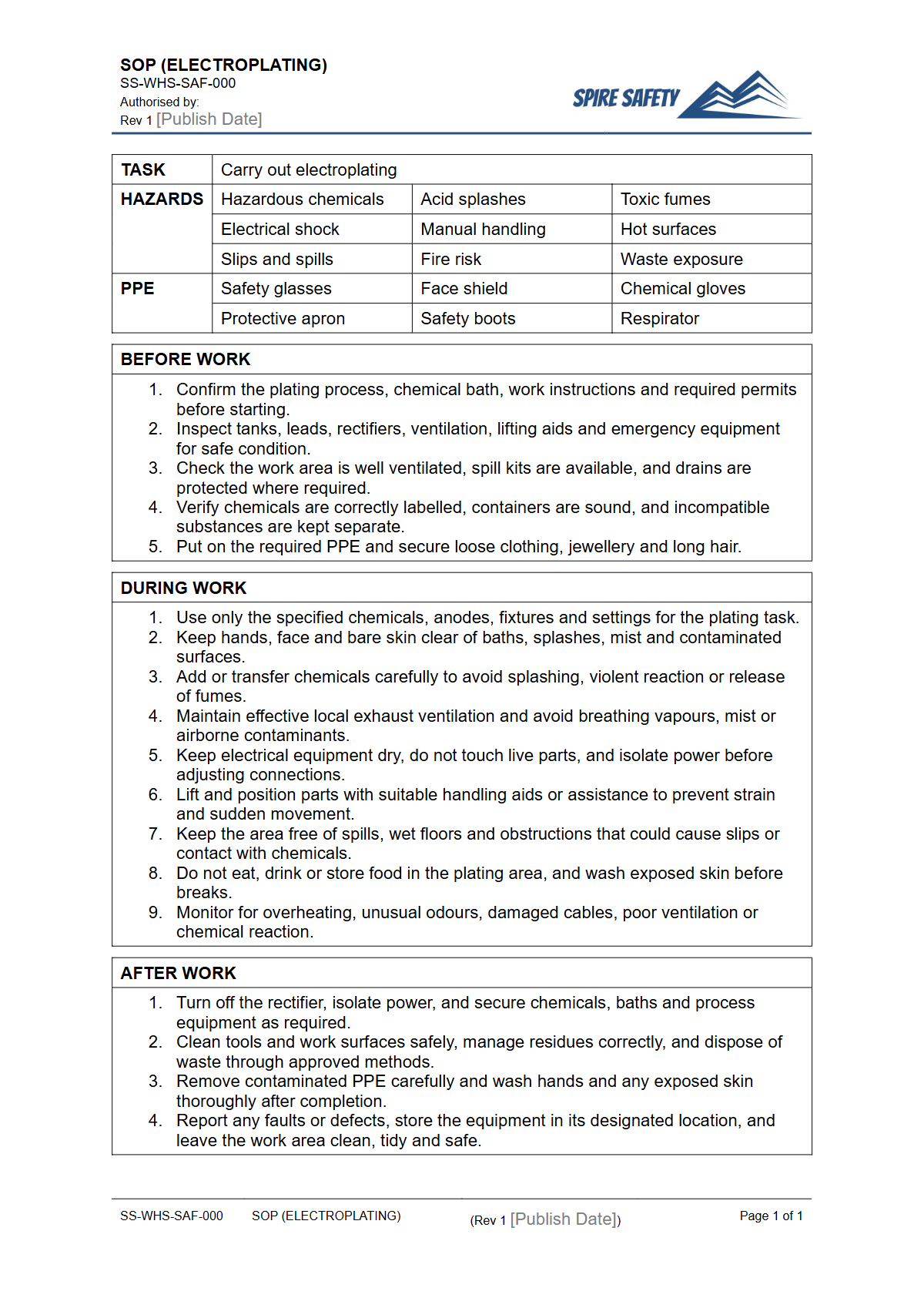
This Free Safe Operating Procedure (Electroplating) Template provides a structured framework for documenting the required steps to perform electroplating tasks safely. It guides you in outlining key safety controls, from pre-operational checks and personal protective equipment (PPE) requirements to waste disposal and emergency responses.
Using a standardised SOP helps ensure all workers follow the same safety protocols, reducing the likelihood of incidents, injuries, or long-term health effects associated with chemical exposure. The template is designed to be a comprehensive starting point, aligned with Australian Work Health and Safety (WHS) principles for managing high-risk activities.
Implementing a robust SOP is a fundamental part of a successful WHS management system, demonstrating your organisation's commitment to a safe working environment.
Video walkthrough
How to use the Free Safe Operating Procedure (Electroplating) Template
This document is provided in both DOCX and PDF formats for your convenience. The DOCX file is fully editable, allowing you to tailor the content to the specific chemicals, equipment, and processes used in your facility.
A generic template cannot account for all site-specific variables, so customisation is crucial for effectiveness.
Important: To be effective, this Safe Operating Procedure must be customised to your specific workplace. We have included prompts and sections that you must review and update with details relevant to your equipment (e.g., rectifier and tank models), chemical inventory (e.g., cyanide, acids, chromium solutions), ventilation systems, and emergency procedures.
Consultation with workers who perform the task is a critical step in developing a practical and effective SOP.
When to use this Safe Operating Procedure
An SOP for electroplating should be used consistently for all related tasks. It serves as a primary reference document for:
- Training new employees or contractors on safe work methods.
- Conducting refresher training for experienced operators.
- Supervisors monitoring work practices and reinforcing safety standards.
- Incident investigations to review whether established procedures were followed.
It should be readily accessible to all relevant personnel at or near the electroplating work area. Regular reviews and updates are necessary, especially after an incident, when new chemicals or equipment are introduced, or if legislation changes.
Periodic reviews can be integrated into your WHS compliance auditing schedule.
Who should use this Safe Operating Procedure
This SOP is intended for use by multiple groups within an organisation:
- Workers/Operators: As a step-by-step guide to performing their tasks safely.
- Supervisors and Managers: To ensure consistent implementation of safety protocols, conduct training, and perform workplace inspections.
- WHS/HSE Professionals: As a foundational document for risk assessments, training development, and compliance activities. Many workshops with electroplating lines also use compressed air for cleaning or agitation; our Free Air Compressor SOP can help detail safety protocols for that equipment.
Ultimately, anyone involved in the electroplating process, from direct operation to supervision and safety oversight, should be familiar with and adhere to the procedures outlined in the finalised document. Just as you would detail processes for other hazardous workshop equipment, like with our FREE Circular Saw SOP, this document must be specific and clear.
By thoroughly customising and implementing this template, your business can take a significant step towards managing the complex risks of electroplating. For a wider range of safety documents, browse our complete free WHS resources library.
Common mistakes
Common mistakes to avoid
- Using a generic SOP without customising it for site-specific chemicals, equipment, and controls.
- Failing to provide adequate local exhaust ventilation (LEV) to capture and remove toxic fumes at the source.
- Neglecting regular testing and maintenance of emergency showers and eyewash stations.
- Storing incompatible chemicals (e.g., acids and cyanides) close together, creating a risk of producing highly toxic hydrogen cyanide gas.
Legal references
Legal considerations
The following legal requirements may be relevant to this type of work.
- Work Health and Safety Act (Harmonised) — Provides the primary duties for protecting workers and other people from work health and safety risks.
- Work Health and Safety Regulations (Harmonised) — Sets out requirements supporting the management of workplace hazards and risks.
The following codes may be relevant to this type of work.
- Managing WHS Risks Code of Practice — Provides practical guidance on identifying hazards, assessing risks and applying effective controls.
- Work Health and Safety Consultation, Cooperation and Coordination Code of Practice — Provides practical guidance on consulting workers and coordinating with other duty holders.
- Managing the Work Environment and Facilities Code of Practice — Provides practical guidance on safe work environments, workplace facilities and related controls.
Did you know
A Toxic Past
Cyanide-based solutions have historically been popular in electroplating for their effectiveness, particularly with gold and copper. However, their extreme toxicity has led many modern facilities to seek safer, cyanide-free alternatives to reduce risks.
Chrome Six Risks
Hexavalent chromium (Chrome VI), used in chrome plating, is a known human carcinogen. Workplaces using it are subject to strict exposure standards and may have specific health monitoring requirements under Australian WHS regulations.
FAQ
Frequently asked questions
01What key hazards should an electroplating SOP cover?
02Who is responsible for writing a Safe Operating Procedure for electroplating?
03How often should an electroplating SOP be reviewed?
04Is a specific licence required to perform electroplating in Australia?
Share this resource
Free Safe Operating Procedure (Electroplating) Template
Browse Categories
How To Use It
- 1Download and open in Word or PDF.
- 2Replace the placeholders with your business details.
- 3Get it reviewed by a WHS specialist before rollout.
Need it customised?
Our WHS consultants can adapt this template to your site, run a gap analysis, or audit what you already have in place.
Book a Free Consultation WHS consulting servicesor call 1300 156 382
Related templates
- Free Safe Operating Procedure (Embroidery Machine) Template
- Free Safe Operating Procedure (Emergency Beacon) Template
- Free Safe Operating Procedure (Emergency Exit Check) Template
- Free Safe Operating Procedure (Emergency Light Test) Template
- Free Safe Operating Procedure (Emergency Shower Test) Template
- Free Safe Operating Procedure (Emergency Stop Test) Template