
Free Safe Operating Procedure (Embroidery Machine) Template
Establish safe work instructions for using embroidery machines with our structured template. Download this free Safe Operating Procedure to manage risks.
Free Safe Operating Procedure (Embroidery Machine) Template
DOCX • 126 KB + PDF
Updated Oct 2026
No signup required
Purpose of the Free Safe Operating Procedure (Embroidery Machine) Template
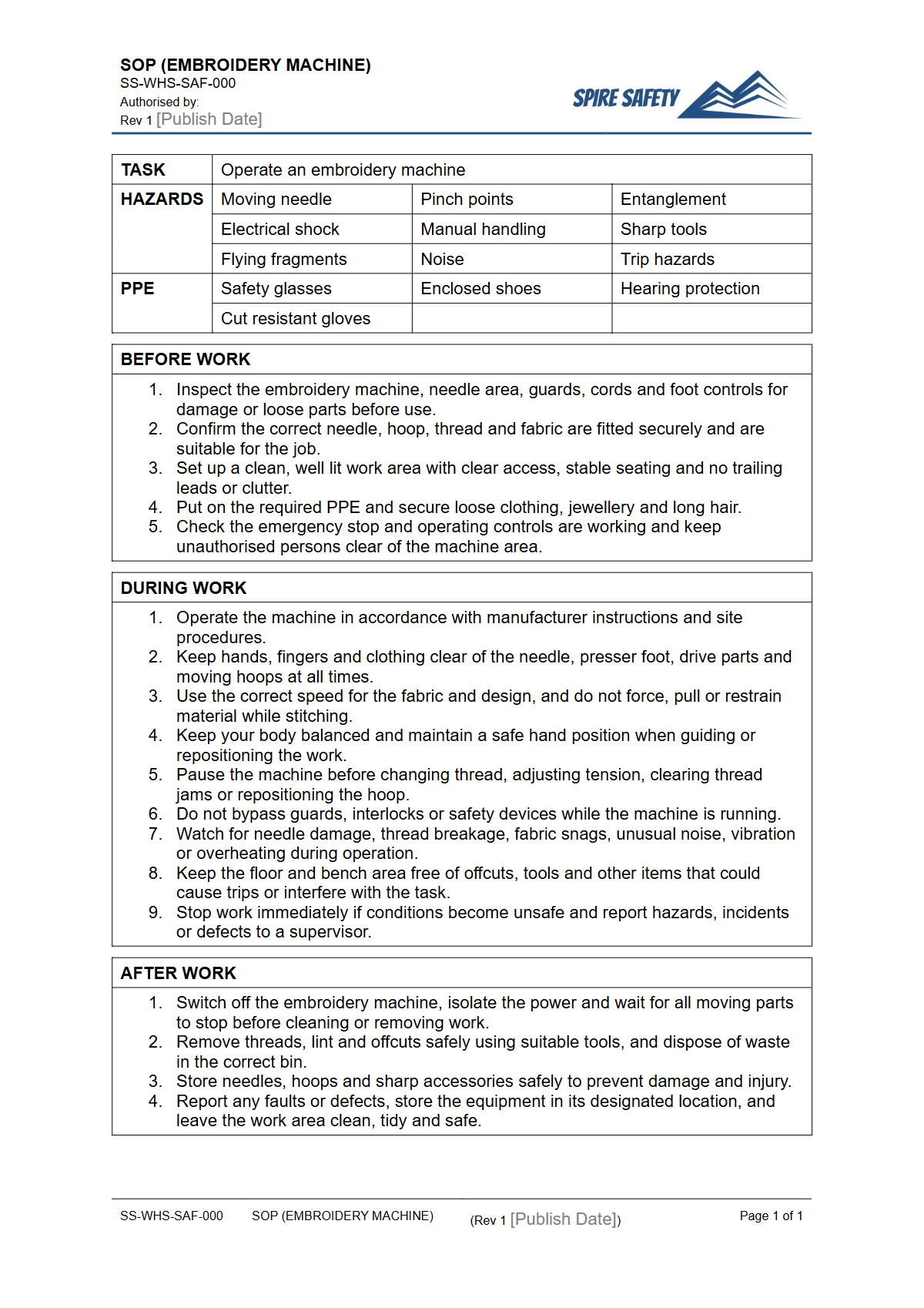
This free Safe Operating Procedure (Embroidery Machine) Template provides a structured framework for documenting the hazards and control measures associated with using industrial or commercial embroidery machines. Its purpose is to create a clear, step-by-step guide that helps workers perform tasks safely, minimising the risk of injury.
A documented SOP is a fundamental part of demonstrating a safe system of work, which is a key duty for any Person Conducting a Business or Undertaking (PCBU) under Australian WHS legislation.
Key risks addressed in a typical embroidery machine SOP include needle puncture wounds, entanglement of hair or clothing in moving parts, electrical hazards, and ergonomic strains from repetitive tasks. By formalising procedures, you ensure that safety is consistent across all operators and shifts. While this document focuses on embroidery machines, similar principles apply to other workshop equipment, as shown in our circular saw SOP.
Video walkthrough
How to use the Free Safe Operating Procedure (Embroidery Machine) Template
This template is available as a fully editable DOCX file for easy customisation and a PDF for straightforward printing and distribution. To use it effectively, download the document and adapt it to your specific operational context.
This is not a finished document; it is a starting point that must be tailored to the unique conditions of your workplace.
Important: This document must be customised to reflect your specific machinery, environment, and processes. We strongly recommend you consult with machine operators and supervisors during the drafting process to ensure the SOP is practical and accurate.
Your final SOP should form part of your overall WHS management systems, integrating with your risk assessments and training programs.
Key Elements to Customise
When customising the template, ensure you include the following site-specific information:
- Machine Details: List the specific make, model, and asset number of the embroidery machine(s).
- Required PPE: Specify all personal protective equipment required, such as safety glasses or enclosed footwear. Do not list items that are not necessary.
- Pre-Operational Checks: Detail the daily or pre-start checks operators must perform, such as inspecting needles, guards, and emergency stop functions. Many powered tools, including those detailed in this Air Compressor SOP, require similar pre-start checks.
- Step-by-Step Instructions: Write clear, simple steps for the entire process, from setting up the fabric and thread to running the job and removing the finished product.
- Emergency Procedures: Outline the exact steps for emergency shutdown, including the location of E-stop buttons and procedures for responding to entanglement or injury.
- Cleaning and Maintenance: Describe the safe procedures for routine cleaning, clearing thread jams, and changing needles, including lockout/tagout (LOTO) requirements.
When to use an Embroidery Machine SOP
A Safe Operating Procedure for an embroidery machine should be a living document used in various day-to-day activities. It is not a document to be filed away and forgotten. Use it during:
- Worker Induction and Training: New operators must be trained on the SOP before being authorised to use the machine.
- Pre-Operational Verification: Operators can use the SOP as a checklist before starting work to ensure all safety measures are in place.
- Refresher Training: Use the SOP as the basis for periodic refresher training to prevent complacency and reinforce safe work habits.
- Incident Investigations: Following an incident or near-miss, the SOP should be reviewed to determine if the procedure was followed and if it needs to be updated.
- Workplace Audits: The SOP serves as an evidence document during safety inspections and audits, demonstrating how risks are being managed. Regular reviews by an external party can provide valuable insights; our WHS compliance auditing services can help identify gaps and opportunities for improvement.
Who should use this Safe Operating Procedure
This SOP is intended for several key roles within an organisation:
- Machine Operators: As the primary users, operators must understand and follow the SOP for every task. They are the most important stakeholder in ensuring its practical application.
- Supervisors and Line Managers: Supervisors are responsible for ensuring operators are trained on the SOP and that its procedures are consistently followed. They also play a role in reviewing and updating the document.
- WHS Managers/Officers: Health and Safety personnel use the SOP as a tool for risk management, training development, and compliance monitoring. They are often responsible for facilitating its creation and review.
- PCBUs and Business Owners: For management, the SOP is a critical piece of evidence demonstrating that the business is taking reasonably practicable steps to provide a safe work environment. For guidance on developing a complete safety framework, consider engaging professional WHS consulting services.
Common mistakes
Common mistakes to avoid
- Failing to customise the template with specifics of the machine and workplace.
- Neglecting to train workers on the SOP and verify their understanding before use.
- Not reviewing or updating the SOP after an incident, near-miss, or process change.
- Storing the SOP in an office instead of making it easily accessible at the point of use.
Legal references
Legal considerations
The following legal requirements may be relevant to this type of work.
- Work Health and Safety Act (Harmonised) — Provides the primary duties for protecting workers and other people from work health and safety risks.
- Work Health and Safety Regulations (Harmonised) — Sets out requirements supporting the management of workplace hazards and risks.
The following codes may be relevant to this type of work.
- Managing WHS Risks Code of Practice — Provides practical guidance on identifying hazards, assessing risks and applying effective controls.
- Work Health and Safety Consultation, Cooperation and Coordination Code of Practice — Provides practical guidance on consulting workers and coordinating with other duty holders.
- Managing the Work Environment and Facilities Code of Practice — Provides practical guidance on safe work environments, workplace facilities and related controls.
Did you know
Ergonomic Risk
Repetitive tasks and awkward postures while operating embroidery machines can lead to Musculoskeletal Disorders (MSDs). Regular breaks and adjustable seating are key administrative and engineering controls.
Lockout/Tagout (LOTO)
Before any maintenance, cleaning, or clearing of jams, embroidery machines should be de-energised and isolated from their power source to prevent accidental start-up and serious injury.
FAQ
Frequently asked questions
01What are the main hazards of an embroidery machine?
02Does WHS law require a Safe Operating Procedure for an embroidery machine?
03How often should an embroidery machine SOP be reviewed?
04Can this template be used for any brand of embroidery machine?
Share this resource
Free Safe Operating Procedure (Embroidery Machine) Template
Browse Categories
How To Use It
- 1Download and open in Word or PDF.
- 2Replace the placeholders with your business details.
- 3Get it reviewed by a WHS specialist before rollout.
Need it customised?
Our WHS consultants can adapt this template to your site, run a gap analysis, or audit what you already have in place.
Book a Free Consultation WHS consulting servicesor call 1300 156 382
Related templates
- Free Safe Operating Procedure (Emergency Beacon) Template
- Free Safe Operating Procedure (Emergency Exit Check) Template
- Free Safe Operating Procedure (Emergency Light Test) Template
- Free Safe Operating Procedure (Emergency Shower Test) Template
- Free Safe Operating Procedure (Emergency Stop Test) Template
- Free Safe Operating Procedure (Emergency Trolley Check) Template