
Free Safe Operating Procedure (Emergency Exit Check) Template
Maintain clear and functional emergency exits with our free template. Download the customisable Safe Operating Procedure to streamline your checks today.
Free Safe Operating Procedure (Emergency Exit Check) Template
DOCX • 126 KB + PDF
Updated Oct 2026
No signup required
Purpose of the Free Safe Operating Procedure (Emergency Exit Check) Template
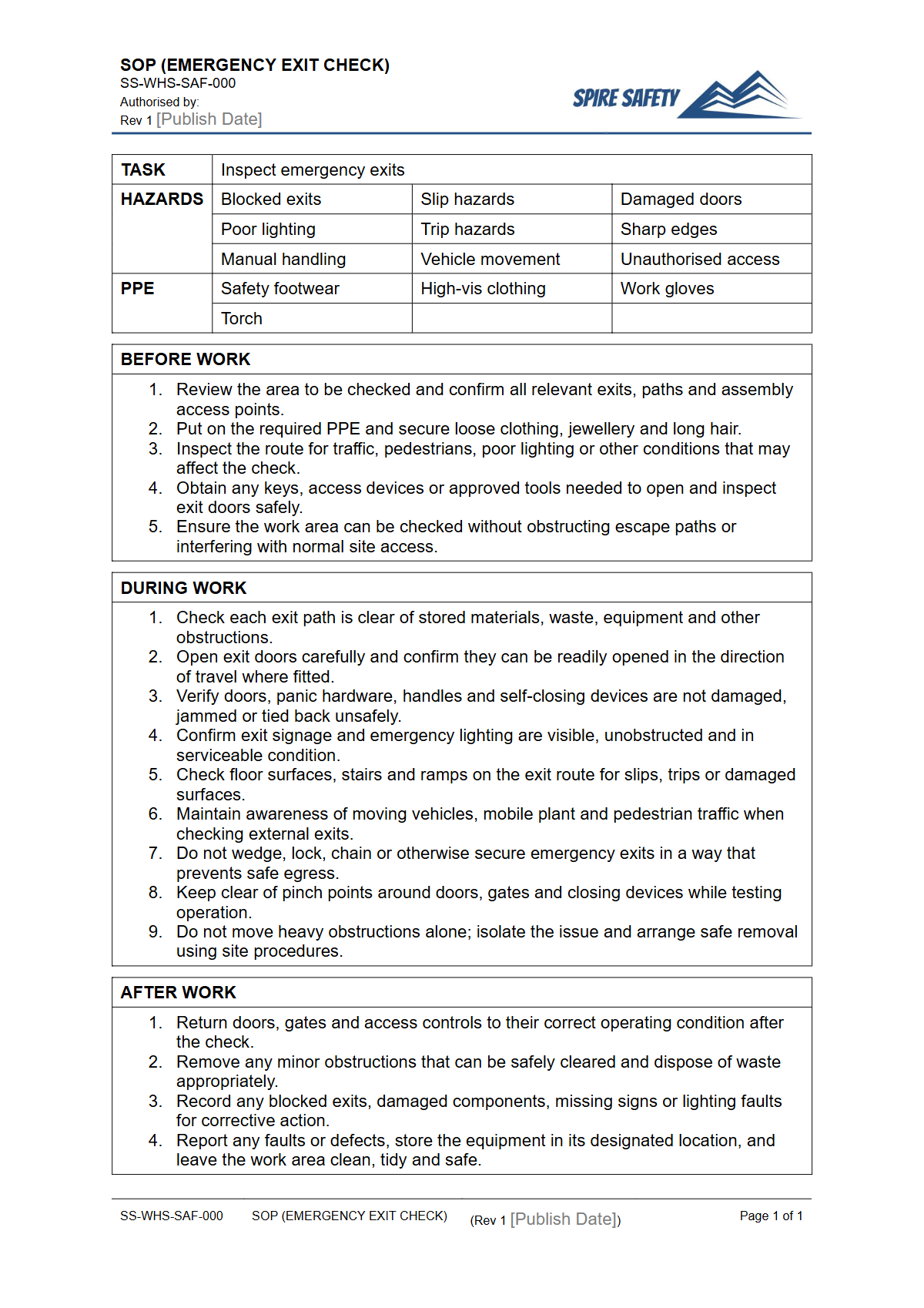
Ensuring that emergency exits are clear, accessible, and fully functional is a fundamental WHS requirement for any Australian workplace. This Free Safe Operating Procedure (Emergency Exit Check) Template provides a structured framework for conducting and documenting these critical inspections.
Using a formal SOP helps standardise the process, ensuring no steps are missed and that all checks are performed consistently, regardless of who is conducting them. It moves the task from an informal walkthrough to a documented, auditable activity that forms a key part of your safety management system.
A documented procedure demonstrates a proactive approach to safety and due diligence. In the event of a fire, power failure, or other emergency requiring immediate evacuation, a properly maintained exit route can be the difference between a safe egress and a catastrophic failure.
Formalising this process helps embed safety-first behaviour within your organisation’s culture and provides clear instructions for personnel. These procedures are vital components of comprehensive WHS management systems, linking daily tasks to overarching safety objectives.
Video walkthrough
How to use the Free Safe Operating Procedure (Emergency Exit Check) Template
This resource is available as a DOCX file, which is fully editable in Microsoft Word or other compatible programs, and a PDF for easy printing and distribution. To begin, download the template and open the DOCX version.
The document is structured to guide you through the essential elements of an SOP, including identifying responsibilities, required personal protective equipment (PPE), and a logical, step-by-step procedure for the check itself. It also includes sections for risk control and recording findings.
Important: This template provides a strong foundation based on Australian WHS principles, but it must be customised for your specific workplace. We have provided a solid framework, but you must adapt the content to reflect the unique layout, exit hardware, potential obstructions, and specific risks present at your site.
Just as a Free Air Compressor SOP needs to be tailored to the specific model and location of the equipment, this procedure must detail your building's unique exit paths and systems.
Customising Your Safe Operating Procedure
Effective customisation involves more than just adding your company logo. You should walk through each emergency exit path, from the starting point to the final exit door and assembly area.
Note the types of doors, locks (e.g., panic bars, electronic releases), lighting, and signage at each point. Update the procedure steps in the template to reflect these specific details. This site-specific detail is crucial for the procedure’s effectiveness and is a key focus during any professional WHS compliance auditing.
When to use it
Regularity is key to ensuring emergency preparedness. This Safe Operating Procedure should be used as the basis for a recurring inspection schedule.
The frequency of checks may vary based on your workplace's risk profile, foot traffic, and any specific state or territory regulations. A best-practice approach often includes:
- Daily Visual Checks: A quick inspection to ensure exit paths are not obstructed by stock, equipment, or rubbish.
- Monthly Functional Checks: A more detailed inspection involving testing exit lighting, checking door hardware, and verifying that signage is visible and illuminated.
- Post-Incident or Drill Reviews: Using the SOP to check all elements of the egress system after an emergency drill or a minor incident to identify any failures.
- After Workplace Changes: Whenever the layout of the workplace is altered, a full check should be conducted to ensure new furniture or structures do not impede exit routes.
In a busy environment like a commercial kitchen, this procedural discipline is just as important as task-specific safety guides like a deep fryer SOP. Both contribute to a holistic culture of safety.
Who should use it
This Safe Operating Procedure is designed for any person or role responsible for workplace safety and facility maintenance. This typically includes:
- WHS Managers and Safety Officers
- Facility or Building Managers
- Team Leaders and Supervisors
- Designated Fire Wardens
- Maintenance Personnel
It is essential that anyone assigned to perform these checks is provided with training on this specific SOP. They must understand not only how to perform the steps but also why each step is important and how to properly document and report any faults or non-conformities they discover.
If you need assistance defining safety roles and responsibilities within your organisation, engaging expert WHS consulting can provide valuable clarity and direction.
By implementing this SOP, you create a clear, accountable process for managing one of the most critical safety features of your workplace. To discover other valuable tools for your safety toolkit, browse our complete free WHS resources library for a wide range of templates, checklists, and guides.
Common mistakes
Common mistakes to avoid
- Blocking exits or access paths, even temporarily, with stock, equipment, or rubbish.
- Assuming exit lights and signs are working without performing and documenting regular tests.
- Propping open designated fire doors, which compromises the building's fire compartmentation strategy.
- Failing to document checks, which leaves no verifiable record of due diligence.
Legal references
Legal considerations
The following legal requirements may be relevant to this type of work.
- Work Health and Safety Act (Harmonised) — Provides the primary duties for protecting workers and other people from work health and safety risks.
- Work Health and Safety Regulations (Harmonised) — Sets out requirements supporting the management of workplace hazards and risks.
The following codes may be relevant to this type of work.
- Managing WHS Risks Code of Practice — Provides practical guidance on identifying hazards, assessing risks and applying effective controls.
- Work Health and Safety Consultation, Cooperation and Coordination Code of Practice — Provides practical guidance on consulting workers and coordinating with other duty holders.
- Managing the Work Environment and Facilities Code of Practice — Provides practical guidance on safe work environments, workplace facilities and related controls.
Did you know
Path of Travel
Australian building codes specify that not just the exit door, but the entire 'path of travel' to the exit must be kept clear. This includes all corridors, aisles, and open spaces leading to the final door.
Push Bars
Panic bars or push bars on emergency exit doors are designed to allow fast egress without needing fine motor skills to turn a handle, which can be difficult in a smoke-filled or panic situation.
FAQ
Frequently asked questions
01What should be included in an emergency exit check?
02How often should emergency exits be checked in Australia?
03Is this SOP template suitable for all types of workplaces?
04What's the difference between a Safe Operating Procedure and an emergency plan?
Share this resource
Free Safe Operating Procedure (Emergency Exit Check) Template
Browse Categories
How To Use It
- 1Download and open in Word or PDF.
- 2Replace the placeholders with your business details.
- 3Get it reviewed by a WHS specialist before rollout.
Need it customised?
Our WHS consultants can adapt this template to your site, run a gap analysis, or audit what you already have in place.
Book a Free Consultation WHS consulting servicesor call 1300 156 382
Related templates
- Free Safe Operating Procedure (Emergency Light Test) Template
- Free Safe Operating Procedure (Emergency Shower Test) Template
- Free Safe Operating Procedure (Emergency Stop Test) Template
- Free Safe Operating Procedure (Emergency Trolley Check) Template
- Free Safe Operating Procedure (Engine Crane) Template
- Free Safe Operating Procedure (Engine Oil Change) Template