
Free Safe Operating Procedure (Engine Crane) Template
Download our free Safe Operating Procedure (Engine Crane) Template to establish clear, safe work instructions for your team. Get your DOCX and PDF now.
Free Safe Operating Procedure (Engine Crane) Template
DOCX • 126 KB + PDF
Updated Oct 2026
No signup required
Purpose of the Free Safe Operating Procedure (Engine Crane) Template
This Free Safe Operating Procedure (Engine Crane) Template provides a structured framework for documenting the safe use of engine cranes in your workshop or facility. An engine crane, also known as an engine hoist or cherry picker, presents significant risks if used incorrectly, including crushing injuries, musculoskeletal disorders, and damage from dropped loads.
A documented SOP helps a Person Conducting a Business or Undertaking (PCBU) fulfil their primary duty of care by providing clear, step-by-step instructions to workers, minimising risk and ensuring tasks are performed consistently and safely.
Using a standardised procedure ensures all operators are aware of the required pre-operational checks, load capacity limits, and correct lifting techniques. This document is a foundational component of a safe system of work, aligned with Australian WHS principles.
It helps control hazards associated with lifting operations, such as equipment failure, instability, and uncontrolled movement of the load. Implementing a robust SOP promotes a proactive safety culture and demonstrates a commitment to workplace health and safety.
Video walkthrough
How to use the Free Safe Operating Procedure (Engine Crane) Template
Our template is available for download in both DOCX and PDF formats. The DOCX version is fully editable, allowing you to adapt the content to the specific make and model of engine crane used at your site, as well as your unique operational environment and existing safety protocols.
It is essential that you customise this document to reflect your workplace's specific risks and control measures.
Note: This template is a starting point. We have populated it with common steps and considerations, but you must conduct your own risk assessment and tailor the content to ensure it is effective for your business.
This may involve adding site-specific emergency procedures, detailing personal protective equipment (PPE) requirements, and referencing internal policies. Similar to our free Air Compressor SOP template, this document becomes truly effective only after careful customisation.
When to use it
An SOP for an engine crane should be a core part of your operational process. It must be consulted during the training and induction of new operators to establish a baseline of competency.
It should also be used as a reference tool for experienced workers to reinforce correct procedures and for supervisors conducting safety observations or performance reviews. The SOP is a live document that should be reviewed and updated regularly, especially after an incident, when new equipment is introduced, or when work processes change.
Furthermore, this procedure forms a crucial part of your overall WHS management system, linking directly to risk assessments, training records, and maintenance schedules. It provides clear, documented evidence of the steps taken to manage the risks associated with plant and equipment in the workplace, which is fundamental to demonstrating WHS compliance.
Who should use it
This Safe Operating Procedure is intended for several key groups within an organisation:
- Operators: Workers who physically use the engine crane must be trained on and follow the SOP to ensure their own safety and the safety of others around them.
- Supervisors and Managers: Responsible for ensuring operators are competent and adhering to the documented procedure. They use the SOP as a tool for training, monitoring, and enforcing safe work practices.
- WHS Personnel: Health and safety advisors and managers use the SOP as part of the risk management framework, for incident investigations, and during safety audits.
- Maintenance Staff: The pre-operational and post-operational checks outlined in the SOP can inform maintenance schedules and help identify potential equipment faults before they lead to failure.
Regular reviews and verification activities, such as those performed during WHS compliance auditing, will confirm that the SOP is being correctly implemented and remains effective. This ensures the procedures documented on paper translate to safe behaviours in practice.
Key Sections in the SOP Template
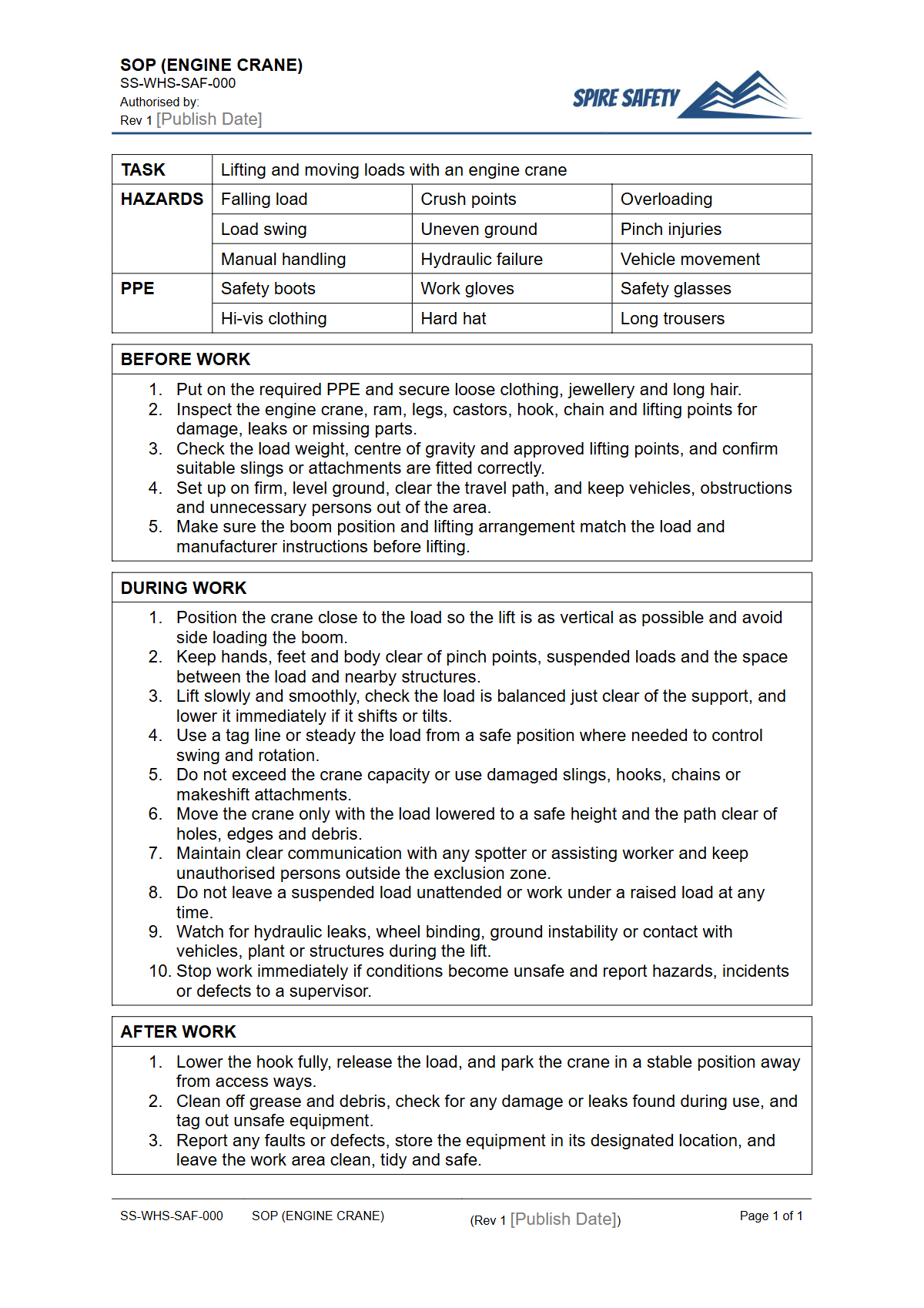
Our template provides a logical flow covering the entire lifecycle of an engine crane task. Key sections include:
- Required PPE: Lists necessary personal protective equipment such as steel-capped boots and gloves.
- Pre-Operational Checks: A detailed checklist to inspect the crane before use, covering the frame, hydraulic system, casters, boom, and lifting chain/hook.
- Operating Steps: A sequential guide to positioning the crane, attaching the load, performing the lift, moving the load, and lowering it safely. This section, like the procedures in our FREE Telehandler SOP Template, emphasises stability and controlled movements.
- Post-Operational Checks & Shutdown: Instructions for cleaning, storing, and securing the crane after use, including reporting any faults or damage.
Integrating the SOP into Your WHS System
A single document is not enough; it must be embedded within your broader safety framework. Use this SOP to support your hazard identification and risk assessment processes for lifting operations.
Ensure it is readily accessible to all relevant workers, either as a hard copy in the work area or digitally. Training records should reference this SOP to confirm that workers have been instructed on its contents.
If you need assistance integrating this procedure or developing a more comprehensive safety system, our WHS consulting services can provide expert guidance tailored to your business needs. For more templates and safety guides, feel free to browse our complete free WHS resources library.
Common mistakes
Common mistakes to avoid
- Exceeding the Safe Working Load (SWL) specified for the boom's extension length.
- Using the crane on soft, uneven, or sloped surfaces, leading to instability.
- Failing to conduct and document pre-operational checks before each use.
- Moving the crane with a suspended load raised higher than necessary.
Legal references
Legal considerations
The following legal requirements may be relevant to this type of work.
- Work Health and Safety Act (Harmonised) — Provides the primary duties for protecting workers and other people from work health and safety risks.
- Work Health and Safety Regulations (Harmonised) — Sets out requirements supporting the management of workplace hazards and risks.
The following codes may be relevant to this type of work.
- Managing WHS Risks Code of Practice — Provides practical guidance on identifying hazards, assessing risks and applying effective controls.
- Work Health and Safety Consultation, Cooperation and Coordination Code of Practice — Provides practical guidance on consulting workers and coordinating with other duty holders.
- Managing the Work Environment and Facilities Code of Practice — Provides practical guidance on safe work environments, workplace facilities and related controls.
Did you know
Pascal's Principle at Work
The lifting power of an engine crane's hydraulic ram is an application of Pascal's Principle. It states that pressure applied to an enclosed fluid is transmitted undiminished to every portion of the fluid and the walls of the containing vessel, multiplying the force.
De-rating for Reach
Most engine cranes have a telescopic boom. The crane's Safe Working Load (SWL) decreases as the boom is extended, as the load creates a longer and more powerful lever. Always check the capacity rating for the specific boom position you are using.
FAQ
Frequently asked questions
01What is a Safe Operating Procedure for an engine crane?
02Is a licence required to operate an engine crane in Australia?
03How often should an engine crane be inspected?
04What are the main hazards of using an engine crane?
Share this resource
Free Safe Operating Procedure (Engine Crane) Template
Browse Categories
How To Use It
- 1Download and open in Word or PDF.
- 2Replace the placeholders with your business details.
- 3Get it reviewed by a WHS specialist before rollout.
Need it customised?
Our WHS consultants can adapt this template to your site, run a gap analysis, or audit what you already have in place.
Book a Free Consultation WHS consulting servicesor call 1300 156 382
Related templates
- Free Safe Operating Procedure (Engine Oil Change) Template
- Free Safe Operating Procedure (Engine Stand) Template
- Free Safe Operating Procedure (Entry Door Cleaning) Template
- Free Safe Operating Procedure (Epoxy Mixing) Template
- Free Safe Operating Procedure (Equipment Tag Cleaning) Template
- Free Safe Operating Procedure (Escalator Cleaning) Template