
Free Safe Operating Procedure (Escalator Cleaning) Template
Download our free Safe Operating Procedure for escalator cleaning to formalise your safety processes.
Free Safe Operating Procedure (Escalator Cleaning) Template
DOCX • 126 KB + PDF
Updated Oct 2026
No signup required
Purpose of the Free Safe Operating Procedure (Escalator Cleaning) Template
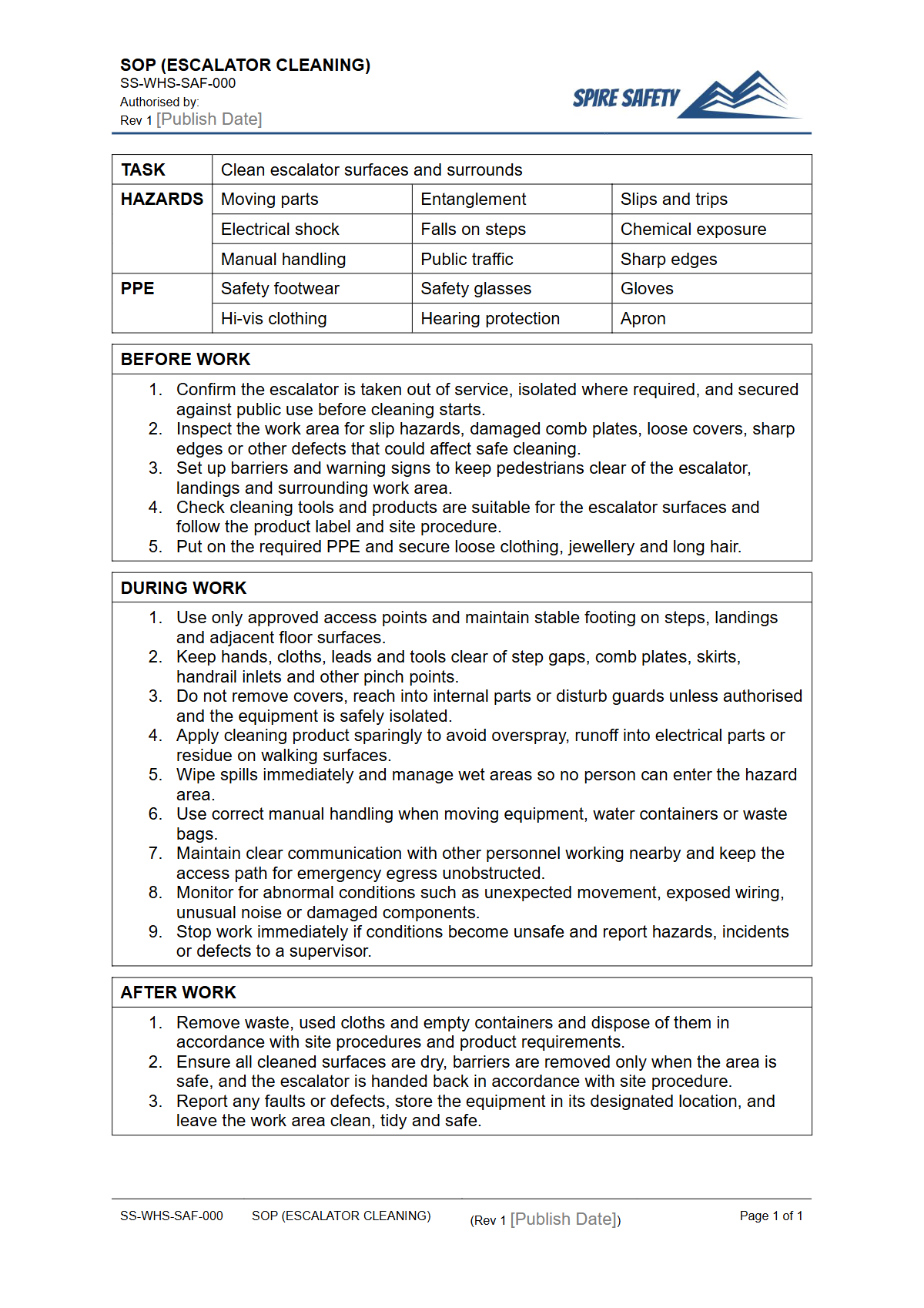
This Safe Operating Procedure (SOP) provides a structured framework for safely cleaning escalators in commercial, retail, and public transport environments. Escalator cleaning presents a unique combination of hazards, including mechanical entanglement, electrical risks, slip and trip hazards, and exposure to cleaning chemicals.
Using a formalised procedure helps any Person Conducting a Business or Undertaking (PCBU) meet their primary duty of care under Australian WHS laws.
A well-documented SOP is a critical administrative control measure. It outlines the required steps for task preparation, execution, and completion, ensuring workers follow a consistent, low-risk process every time.
By downloading our free Safe Operating Procedure (Escalator Cleaning) Template, you gain a solid starting point for managing the specific risks associated with this task. The document prompts you to identify hazards such as moving parts, pinch points, and electrical components, and to implement necessary control measures like lockout-tagout procedures, correct personal protective equipment (PPE), and appropriate signage. This process is similar to managing risks for other machinery, such as those detailed in our FREE Conveyer System SOP.
Video walkthrough
How to use the Free Safe Operating Procedure (Escalator Cleaning) Template
Our template is provided in both DOCX and PDF formats for your convenience. The DOCX version is fully editable, allowing you to tailor the content directly to your operational needs.
To use the template effectively, you should systematically work through each section, replacing the placeholder text with information specific to your site, equipment, and chosen cleaning agents.
This includes specifying the exact make and model of the escalator, the approved cleaning chemicals (referencing their Safety Data Sheets), the required PPE, and the step-by-step procedure for isolating, cleaning, and recommissioning the unit. It is vital to consult with the workers who perform the task, as their direct experience is invaluable for identifying practical hazards and effective controls.
Once completed, the SOP should be used as a key document for training and competency assessments.
Please note: this document is a template and must be customised to reflect the specific equipment, chemicals, and environmental conditions of your workplace. We cannot guarantee its suitability for your specific circumstances without a thorough on-site assessment.
A comprehensive WHS compliance auditing process can help verify the effectiveness of your implemented procedures.
When to use it
An SOP for escalator cleaning should be developed and implemented before any worker is permitted to undertake the task. It forms the basis of safe work training for new employees and serves as a critical refresher for existing staff.
The document should be readily accessible to all relevant personnel at the point of work.
Beyond initial training, the SOP should be reviewed and referenced regularly. This includes during toolbox talks before a cleaning shift, as part of an incident investigation should one occur, and during scheduled procedural reviews.
Any change in equipment, cleaning chemicals, or the work environment must trigger an immediate review and update of the SOP to ensure it remains current and effective. Integrating this SOP into your broader WHS management systems ensures it is part of a continuous cycle of risk assessment and improvement.
Who should use it
This template is designed for use by a range of personnel within an organisation to ensure a collaborative approach to safety:
- WHS Managers and Safety Professionals: To establish a baseline procedure aligned with Australian WHS principles and to integrate it into the organisation's overall safety framework.
- Facility and Building Managers: To ensure maintenance and cleaning operations are conducted safely, minimising risk to staff and the public while protecting valuable assets.
- Supervisors: To train their teams, oversee the safe execution of cleaning tasks, and enforce the documented procedures on a day-to-day basis.
- Cleaning Operatives: As a practical, step-by-step guide to follow during their work, and as a tool to help them identify and report new or uncontrolled hazards.
For organisations requiring expert guidance on tailoring this or other procedures, engaging external WHS consulting services can provide valuable insight and ensure your documentation is robust and practical. Proper documentation is a key part of ensuring workplace safety for all types of equipment, from escalators to the machinery covered in our Free Air Compressor SOP.
By establishing clear roles and responsibilities around the use of the SOP, you create a culture of safety and accountability. This template is one of many resources available; browse our complete free WHS resources library for more templates to support your safety management system.
Common mistakes
Common mistakes to avoid
- Failing to electrically isolate and lock out the escalator before starting work.
- Using excessive cleaning solution, which can damage internal components and create severe slip hazards.
- Not erecting adequate barriers and warning signs to prevent public access during cleaning.
- Neglecting to inspect cleaning equipment, such as automatic scrubbers, for faults before use.
Legal references
Legal considerations
The following legal requirements may be relevant to this type of work.
- Work Health and Safety Act (Harmonised) — Provides the primary duties for protecting workers and other people from work health and safety risks.
- Work Health and Safety Regulations (Harmonised) — Sets out requirements supporting the management of workplace hazards and risks.
The following codes may be relevant to this type of work.
- Managing WHS Risks Code of Practice — Provides practical guidance on identifying hazards, assessing risks and applying effective controls.
- Work Health and Safety Consultation, Cooperation and Coordination Code of Practice — Provides practical guidance on consulting workers and coordinating with other duty holders.
- Managing the Work Environment and Facilities Code of Practice — Provides practical guidance on safe work environments, workplace facilities and related controls.
Did you know
Escalator Evolution
The first working escalator, created by Jesse W. Reno, was installed not for transport but as an amusement ride at Coney Island, New York, in 1896.
Slip, Trip, and Fall Risks
Slips, trips, and falls are a leading cause of serious workplace injuries in Australia, making documented procedures for tasks like cleaning potentially wet surfaces a critical risk control measure.
FAQ
Frequently asked questions
01What are the main hazards when cleaning an escalator?
02Does this SOP template cover specific cleaning chemicals?
03Who is responsible for implementing an SOP for escalator cleaning?
04How often should an Escalator Cleaning SOP be reviewed?
Share this resource
Free Safe Operating Procedure (Escalator Cleaning) Template
Browse Categories
How To Use It
- 1Download and open in Word or PDF.
- 2Replace the placeholders with your business details.
- 3Get it reviewed by a WHS specialist before rollout.
Need it customised?
Our WHS consultants can adapt this template to your site, run a gap analysis, or audit what you already have in place.
Book a Free Consultation WHS consulting servicesor call 1300 156 382
Related templates
- Free Safe Operating Procedure (Escalator Isolation) Template
- Free Safe Operating Procedure (Espresso Machine Clean) Template
- Free Safe Operating Procedure (EV Charging) Template
- Free Safe Operating Procedure (Evacuation Chair Check) Template
- Free Safe Operating Procedure (Event Barrier Setup) Template
- Free Safe Operating Procedure (Event Cable Cover Setup) Template