
Free Safe Operating Procedure (Espresso Machine Clean) Template
Download our free Safe Operating Procedure (Espresso Machine Clean) Template to formalise your cleaning processes and manage workplace risks. Get your DOCX now.
Free Safe Operating Procedure (Espresso Machine Clean) Template
DOCX • 126 KB + PDF
Updated Oct 2026
No signup required
Purpose of the Free Safe Operating Procedure (Espresso Machine Clean) Template
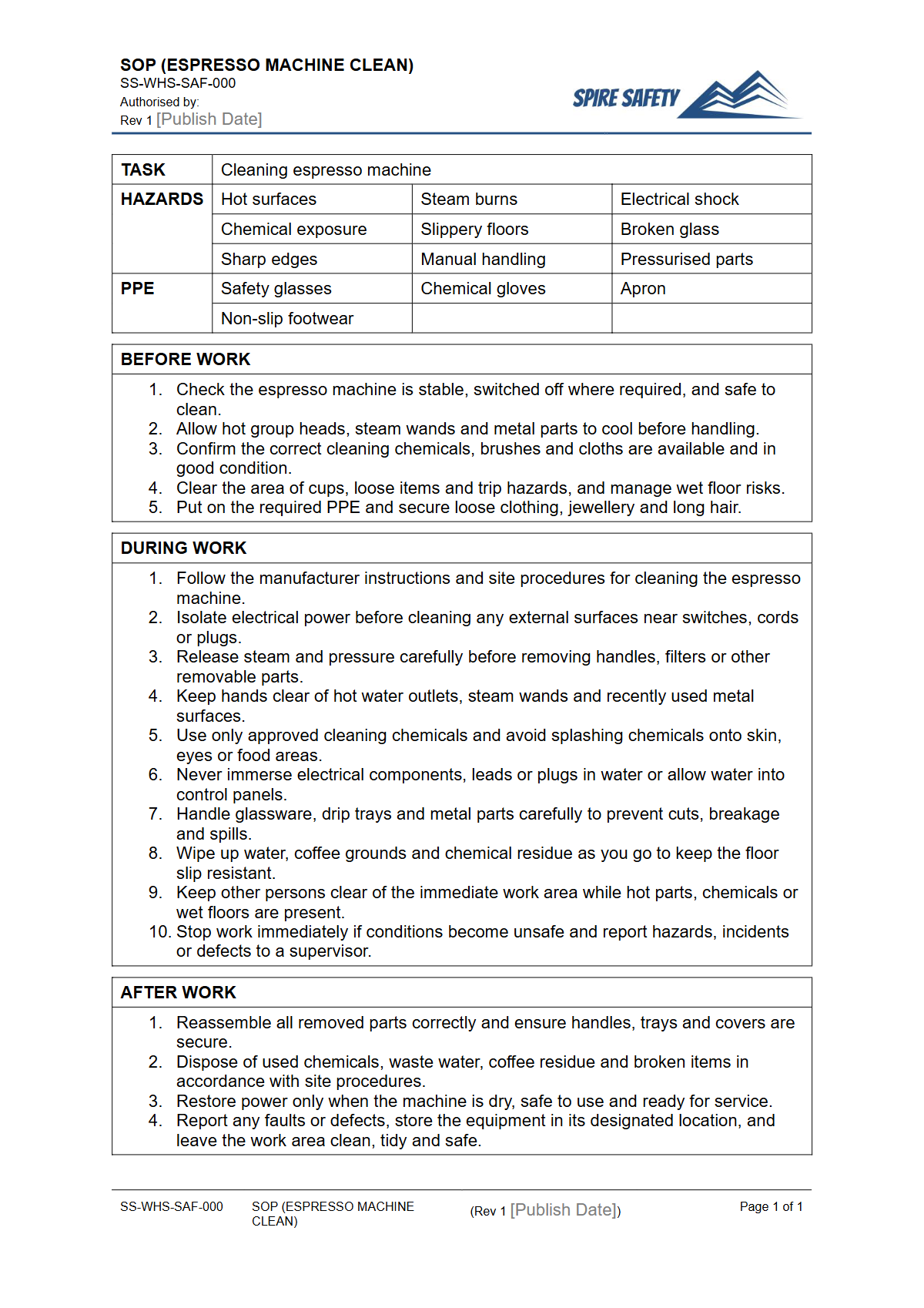
This free Safe Operating Procedure (Espresso Machine Clean) Template provides a structured framework for documenting the steps to safely clean commercial espresso machines. The process involves significant hazards, including scalding from hot water and steam, chemical exposure from cleaning agents, and electrical risks.
Using a standardised SOP helps to ensure that every worker follows the same safe, step-by-step process, minimising the risk of injury and equipment damage. It serves as a critical training tool for new staff and a reference for experienced baristas, promoting a consistent safety culture.
A well-drafted SOP is a fundamental component of a proactive safety strategy. It demonstrates a commitment to risk management and forms an integral part of your broader safety framework.
Integrating specific procedures like this one into your overall WHS management systems ensures that operational tasks are directly linked to your organisation's health and safety objectives.
What's included in the template?
- A section for listing required Personal Protective Equipment (PPE), such as heat-resistant gloves and safety glasses.
- Pre-operational checks to perform before starting the cleaning process.
- A step-by-step procedure for tasks like backflushing, group head cleaning, and steam wand purging.
- Post-cleaning checks and waste disposal instructions.
- A field for emergency procedures, including first aid for burns or chemical exposure.
Video walkthrough
How to Use the Free Safe Operating Procedure (Espresso Machine Clean) Template
This resource is provided in both DOCX and PDF formats. The DOCX file is fully editable, allowing you to tailor it to your specific operational context.
It is vital to incorporate details unique to your equipment and workplace, such as the exact model of your espresso machine, the specific names of your approved cleaning chemicals, and your site-specific emergency contacts.
Important: This document is a template and must be customised to reflect the specific hazards and controls in your workplace. We recommend consulting your espresso machine's manufacturer manual and Safety Data Sheets (SDS) for your cleaning chemicals.
Spire Safety assumes no liability for incidents arising from the use of this template; its effectiveness depends on its correct customisation and implementation by your organisation.
The principles outlined in an SOP, such as risk assessment and defining a sequential process, are transferable to other kitchen equipment. For example, similar documentation is essential for managing the risks of other high-temperature appliances.
You can reference our Free Safe Operating Procedure (Deep Fryer - Standard Operation) template for guidance on another common hospitality task.
A core principle in any equipment maintenance SOP is the control of hazardous energy (lockout/tagout). While cleaning an espresso machine might involve leaving it on for certain steps, the process must clearly define when the machine should be de-energised and isolated from power.
This same principle of energy isolation is critical for power tools, as shown in our FREE Circular Saw SOP, highlighting a universal safety concept.
When to Use It
A Safe Operating Procedure for cleaning an espresso machine should be used consistently as part of your daily, weekly, and monthly maintenance schedule. It should be readily accessible near the machine for easy reference. Use this SOP for:
- Training new employees: Provide it as part of their induction to ensure they learn the correct, safe procedure from day one.
- Routine cleaning tasks: Guide workers through daily backflushing, weekly chemical cleans, and periodic descaling.
- Refresher training: Use it to conduct periodic reviews with existing staff to prevent complacency and bad habits from forming.
- Risk assessments: The SOP serves as a record of established control measures when you are reviewing or conducting a risk assessment for your cafe or kitchen area.
The structured approach of this SOP is a best-practice example that can be applied across your business. Documenting procedures is equally important for other ancillary equipment that presents hazards. For instance, creating a procedure for tasks like using an air compressor to clean grinders or other equipment can be guided by a similar format, as seen in our Free Air Compressor SOP.
Who Should Use It
This template is designed for anyone responsible for workplace safety in a hospitality environment. Key users include:
- Business Owners and Managers: To meet their duty of care under WHS legislation by implementing a formal system for managing safety.
- Supervisors and Team Leaders: To train their staff, monitor cleaning procedures, and supports your compliance efforts with the established safe method.
- Workers and Baristas: As a clear, step-by-step guide to performing their cleaning duties safely and effectively.
- WHS Professionals: As a starting point for developing comprehensive safety systems for clients in the food and beverage industry. For businesses that lack in-house expertise, engaging external WHS consulting can help ensure procedures are robust and properly integrated.
Supervisors can also use the SOP as a checklist to conduct informal observations or formal performance reviews, ensuring the documented safe practices are being followed correctly. This verification process is a key part of maintaining safety standards and can be an input for more comprehensive WHS compliance auditing.
Common mistakes
Common mistakes to avoid
- Forgetting to disconnect the machine from the power source during certain maintenance steps.
- Using incorrect, unapproved chemicals or the wrong dilution ratios, which can damage the machine or pose a health risk.
- Not wearing appropriate PPE, especially heat-resistant gloves and eye protection, leading to burns or chemical splashes.
- Skipping daily cleaning routines like backflushing, which causes a buildup of coffee oils and leads to poor taste and equipment malfunction.
Legal references
Legal considerations
The following legal requirements may be relevant to this type of work.
- Work Health and Safety Act (Harmonised) — Provides the primary duties for protecting workers and other people from work health and safety risks.
- Work Health and Safety Regulations (Harmonised) — Sets out requirements supporting the management of workplace hazards and risks.
The following codes may be relevant to this type of work.
- Managing WHS Risks Code of Practice — Provides practical guidance on identifying hazards, assessing risks and applying effective controls.
- Work Health and Safety Consultation, Cooperation and Coordination Code of Practice — Provides practical guidance on consulting workers and coordinating with other duty holders.
- Managing the Work Environment and Facilities Code of Practice — Provides practical guidance on safe work environments, workplace facilities and related controls.
Did you know
Coffee's Hidden Cost
According to Safe Work Australia data, the accommodation and food services industry has one of the highest rates of serious workers' compensation claims, with burns and cuts being common injuries.
FAQ
Frequently asked questions
01What are the main hazards when cleaning an espresso machine?
02Is a Safe Operating Procedure legally required for cleaning an espresso machine in Australia?
03What's the difference between backflushing and deep cleaning in an SOP?
04How often should you follow the SOP for cleaning a commercial espresso machine?
Share this resource
Free Safe Operating Procedure (Espresso Machine Clean) Template
Browse Categories
How To Use It
- 1Download and open in Word or PDF.
- 2Replace the placeholders with your business details.
- 3Get it reviewed by a WHS specialist before rollout.
Need it customised?
Our WHS consultants can adapt this template to your site, run a gap analysis, or audit what you already have in place.
Book a Free Consultation WHS consulting servicesor call 1300 156 382
Related templates
- Free Safe Operating Procedure (EV Charging) Template
- Free Safe Operating Procedure (Evacuation Chair Check) Template
- Free Safe Operating Procedure (Event Barrier Setup) Template
- Free Safe Operating Procedure (Event Cable Cover Setup) Template
- Free Safe Operating Procedure (Event Chair Handling) Template
- Free Safe Operating Procedure (Event Equipment Packdown) Template