
Free Safe Operating Procedure (Evacuation Chair Check) Template
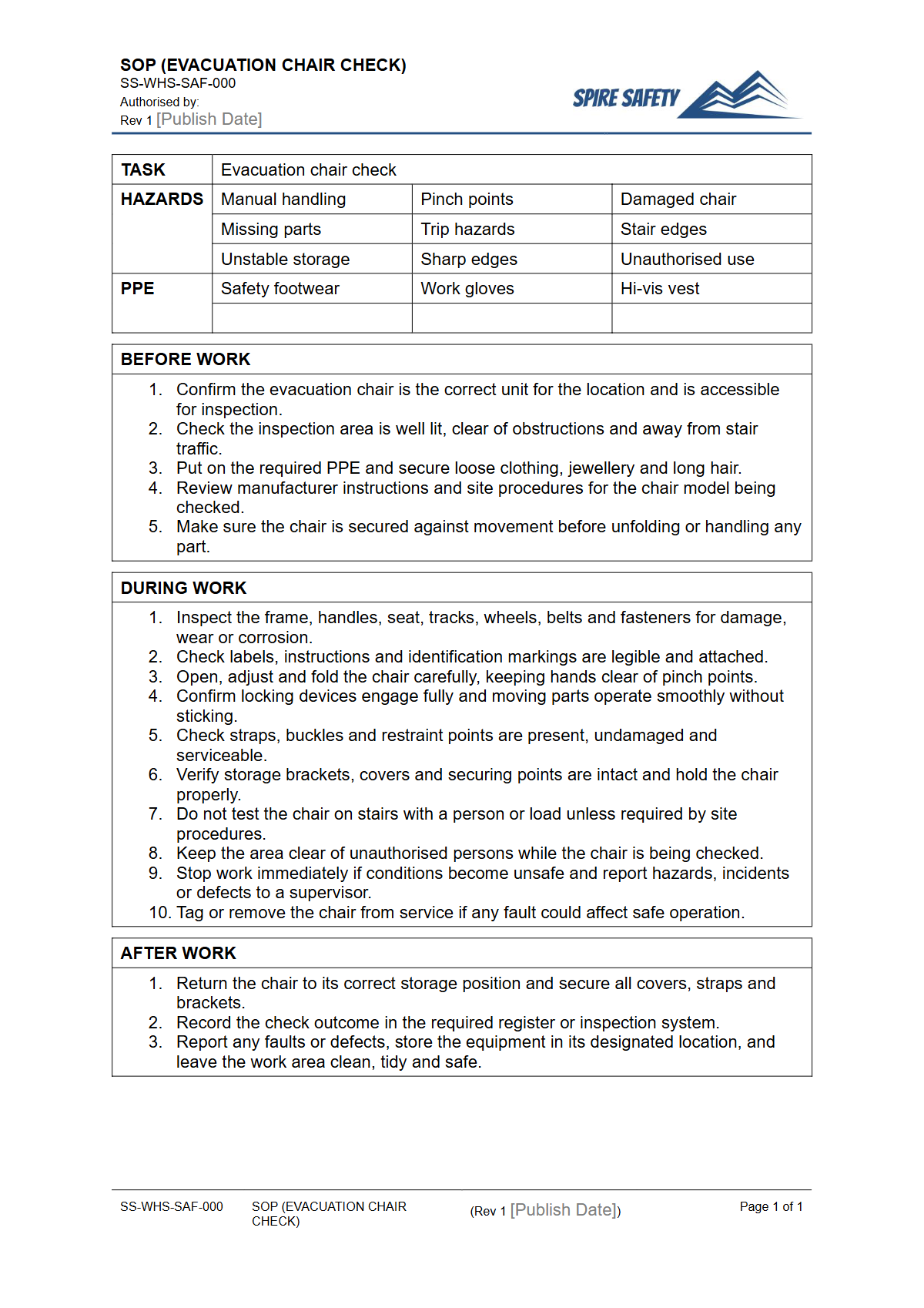
Ensure your evacuation chairs are ready for an emergency with our free Safe Operating Procedure. Download this customisable template to formalise your checks.
Free Safe Operating Procedure (Evacuation Chair Check) Template
DOCX • 126 KB + PDF
Updated Oct 2026
No signup required
Purpose of the Free Safe Operating Procedure (Evacuation Chair Check) Template
An evacuation chair is critical for safely moving people with mobility impairments during an emergency. This Free Safe Operating Procedure (Evacuation Chair Check) Template provides a structured framework for conducting and recording regular inspections of this vital equipment.
Using a formal SOP ensures that checks are performed consistently and thoroughly, confirming the chair is in good working order and ready for immediate use. It helps a Person Conducting a Business or Undertaking (PCBU) meet their primary duty of care by maintaining emergency equipment and planning for the safety of all occupants, including those requiring assistance.
Implementing this procedure is a key part of an effective emergency plan, demonstrating proactive safety management. A documented check history provides a clear audit trail, showing diligence in maintaining safety apparatus.
Formalising this process helps embed safety-conscious behaviour within your organisation's culture. Integrating this document into broader comprehensive WHS management systems ensures that all aspects of workplace safety, from emergency response to daily operations, are managed cohesively and effectively.
Video walkthrough
How to use the Free Safe Operating Procedure (Evacuation Chair Check) Template
This Safe Operating Procedure template is provided as a starting point in both DOCX and PDF formats. Download the file and adapt it to your specific circumstances.
Key customisation steps include adding your company name and logo, identifying the specific makes and models of evacuation chairs at your facility, and detailing their exact storage locations. You must review and modify the checklist items to align with the manufacturer's inspection requirements for your particular equipment.
The frequency of checks should be determined by a site-specific risk assessment, manufacturer recommendations, and relevant Australian Standards.
Important: This is a template only. We are not WHS consultants providing advice.
You must customise this document to reflect the specific equipment, hazards, and control measures relevant to your workplace. Your procedure should be reviewed by key stakeholders, including management and Health and Safety Representatives (HSRs). While this SOP focuses on emergency equipment, a complete safety system also documents operational risks from machinery, which can be documented using resources like our free Air Compressor SOP template.
When to use this Safe Operating Procedure
This SOP should be used to schedule and guide regular, planned inspections of all evacuation chairs. The ideal frequency is determined by your risk assessment but typically includes:
- Monthly or quarterly checks: Routine inspections to ensure the chair remains in its designated location, is unobstructed, and shows no obvious signs of damage or wear.
- Annual detailed inspections: A more thorough check, potentially carried out by a competent person or third-party service, to inspect all mechanical parts, straps, wheels, and locking mechanisms as per the manufacturer's guide.
- Before scheduled drills: A quick pre-use check is good practice before conducting an emergency drill to ensure the equipment functions as expected during the simulation.
- After each use: Following any use, whether in a real emergency or a drill, the chair must be thoroughly inspected, cleaned, and properly stowed to ensure it is ready for the next event. Regular checks can be verified during WHS compliance audits.
Who should use this Safe Operating Procedure
This procedure is designed for personnel responsible for workplace safety and facility management. This typically includes roles such as:
- Emergency Wardens or Chief Wardens: As part of their responsibility for overseeing emergency equipment and procedures.
- Facility Managers: Who are often tasked with the maintenance and upkeep of building assets, including safety equipment.
- WHS/OHS Officers or Managers: Responsible for developing, implementing, and monitoring safety procedures across the organisation.
- Designated Maintenance Staff: Competent individuals assigned to carry out the physical inspection and record-keeping.
Personnel using this SOP should be trained and competent in what they are looking for, understanding the function of each part of the evacuation chair. If in-house expertise is limited, engaging external WHS consulting services can help establish robust inspection and maintenance programs. These personnel are often responsible for a range of safety documentation, from emergency plans to procedures for using specialised equipment like a conveyer system SOP.
Common mistakes
Common mistakes to avoid
- Performing the check but failing to complete the record, leaving no audit trail of the inspection.
- Focusing only on the chair itself and neglecting to check its storage location for accessibility, correct signage, and obstructions.
- Overlooking expiry dates on components like batteries (on powered models) or restraint straps.
- Confusing a pre-use equipment check with the separate requirement for practical, hands-on operator training.
Legal references
Legal considerations
The following legal requirements may be relevant to this type of work.
- Work Health and Safety Act (Harmonised) — Provides the primary duties for protecting workers and other people from work health and safety risks.
- Work Health and Safety Regulations (Harmonised) — Sets out requirements supporting the management of workplace hazards and risks.
The following codes may be relevant to this type of work.
- Managing WHS Risks Code of Practice — Provides practical guidance on identifying hazards, assessing risks and applying effective controls.
- Work Health and Safety Consultation, Cooperation and Coordination Code of Practice — Provides practical guidance on consulting workers and coordinating with other duty holders.
- Managing the Work Environment and Facilities Code of Practice — Provides practical guidance on safe work environments, workplace facilities and related controls.
Did you know
A Key Part of PEEPs
Evacuation chairs are a critical control measure within Personal Emergency Evacuation Plans (PEEPs), which are individualised plans for workers or occupants who may need assistance to evacuate.
Emergency Planning Standards
Australian Standard AS 3745-2010 'Planning for emergencies in facilities' provides a framework for emergency planning committees to consider the needs of all occupants, including those with disabilities, guiding decisions on equipment like evacuation chairs.
FAQ
Frequently asked questions
01How often should an evacuation chair be checked?
02What happens if a fault is found during an evacuation chair check?
03Is training required to use an evacuation chair?
04Does this SOP template cover all legal requirements for emergency equipment?
Share this resource
Free Safe Operating Procedure (Evacuation Chair Check) Template
Browse Categories
How To Use It
- 1Download and open in Word or PDF.
- 2Replace the placeholders with your business details.
- 3Get it reviewed by a WHS specialist before rollout.
Need it customised?
Our WHS consultants can adapt this template to your site, run a gap analysis, or audit what you already have in place.
Book a Free Consultation WHS consulting servicesor call 1300 156 382
Related templates
- Free Safe Operating Procedure (Event Barrier Setup) Template
- Free Safe Operating Procedure (Event Cable Cover Setup) Template
- Free Safe Operating Procedure (Event Chair Handling) Template
- Free Safe Operating Procedure (Event Equipment Packdown) Template
- Free Safe Operating Procedure (Event Equipment Setup) Template
- Free Safe Operating Procedure (Event Floor Cleaning) Template