
Free Safe Operating Procedure (Event Cable Cover Setup) Template
Managing trip hazards from cables at events is critical. Download our free Event Cable Cover Setup SOP template to document your safety procedures.
Free Safe Operating Procedure (Event Cable Cover Setup) Template
DOCX • 126 KB + PDF
Updated Oct 2026
No signup required
Purpose of the Free Safe Operating Procedure (Event Cable Cover Setup) Template
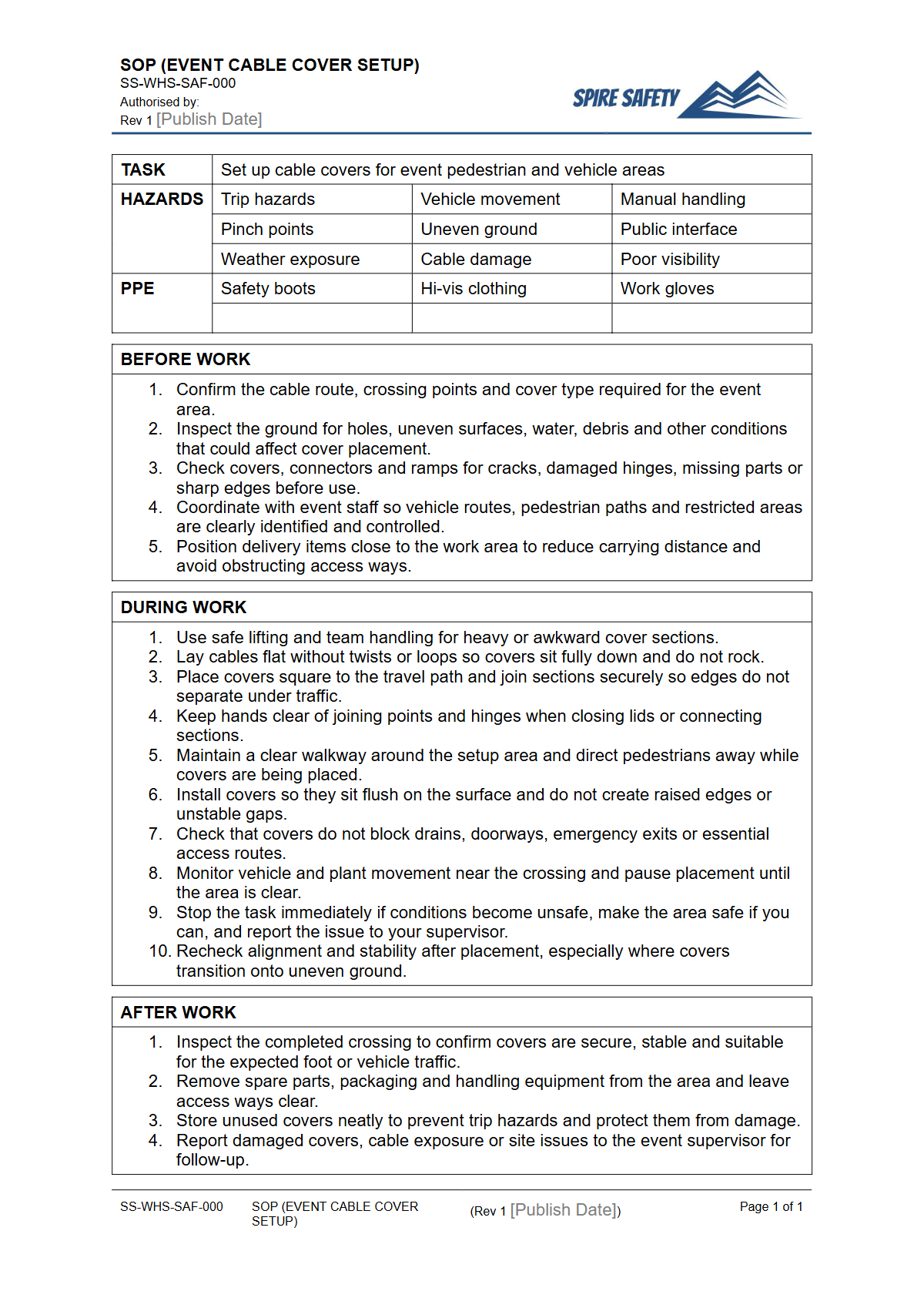
This Free Safe Operating Procedure (Event Cable Cover Setup) Template provides a structured framework for documenting the steps required to safely install, maintain, and remove cable covers at events, construction sites, and public spaces. Its primary purpose is to control the risks associated with loose cables, such as trips, slips, falls, and electrical hazards.
By establishing a clear, repeatable process, organisations can ensure workers understand their responsibilities, use equipment correctly, and follow a consistent method for hazard management. A well-drafted SOP is a key component of effective WHS management systems, demonstrating a commitment to proactive safety and due diligence.
Using this template helps formalise your approach to a common but high-risk activity. It guides you in identifying the necessary personal protective equipment (PPE), pre-operational checks, and step-by-step instructions for deploying covers over pedestrian and vehicle pathways.
This documentation is vital for worker training, incident investigations, and ensuring operational consistency across different teams and locations.
Video walkthrough
How to use the Free Safe Operating Procedure (Event Cable Cover Setup) Template
This document is a template and is not a complete Safe Operating Procedure. To be effective, it must be customised to reflect the specific equipment, environment, and tasks at your workplace.
Download the DOCX file and consult with your team—including event managers, technicians, and safety officers—to add site-specific details. You should detail the exact types of cable covers used, the surfaces they will be placed on (e.g., grass, concrete, asphalt), and the expected traffic loads.
If other heavy machinery is used during event setup, you will need separate procedures, such as a Telehandler SOP, to manage those specific risks.
Important: We have provided this template as a guide based on common WHS principles. You must adapt it to your own operations.
Spire Safety accepts no liability for any incidents or issues that may arise from the use of this document. It is your responsibility to ensure your procedures are safe, relevant, and comprehensive for your specific needs.
When to use it
A Safe Operating Procedure for event cable cover setup should be used whenever temporary cables, hoses, or leads are run across floors, pathways, or areas accessible to workers or the public. This applies to a wide range of situations, including concerts, festivals, trade shows, sporting events, construction sites, and film sets.
The SOP should be referenced during the planning phase to ensure the right equipment is sourced, during setup to guide installation, and during the event for inspection and maintenance checks. For example, if portable generators and tools are required, you may also need to consult your Free Air Compressor SOP (Safe Operating Procedure) Template to ensure all activities are covered.
Who should use it
This SOP is intended for use by multiple roles within an organisation. Event staff, roadies, technicians, and site crew responsible for the physical installation and removal of cable covers must be trained in and follow the procedure.
Site supervisors and event managers are responsible for ensuring the SOP is implemented correctly, that workers are competent, and that regular inspections are carried out as defined in the document. Furthermore, a Person Conducting a Business or Undertaking (PCBU) can use the finalised SOP as evidence of risk management during WHS compliance auditing. If your team lacks experience in developing these documents, engaging external WHS consulting can help bridge knowledge gaps.
You can find many more templates like this in our free WHS resources library to build out your safety documentation.
Common mistakes
Common mistakes to avoid
- Using indoor-rated covers for outdoor events where they can be damaged by UV light and weather.
- Failing to secure interlocking sections, allowing them to separate and create gaps that are a trip hazard.
- Overloading a cover's channels with too many cables, which can damage the cable insulation and prevent the lid from closing securely.
- Placing covers at sharp angles to the direction of foot traffic, which can increase the likelihood of tripping.
Legal references
Legal considerations
The following legal requirements may be relevant to this type of work.
- Work Health and Safety Act (Harmonised) — Provides the primary duties for protecting workers and other people from work health and safety risks.
- Work Health and Safety Regulations (Harmonised) — Sets out requirements supporting the management of workplace hazards and risks.
The following codes may be relevant to this type of work.
- Managing WHS Risks Code of Practice — Provides practical guidance on identifying hazards, assessing risks and applying effective controls.
- Work Health and Safety Consultation, Cooperation and Coordination Code of Practice — Provides practical guidance on consulting workers and coordinating with other duty holders.
- Managing the Work Environment and Facilities Code of Practice — Provides practical guidance on safe work environments, workplace facilities and related controls.
Did you know
A Major Hazard
Slips, trips, and falls are a leading cause of serious injuries in Australian workplaces, with thousands of claims made each year. Properly managed cables are a critical step in mitigating this common risk.
Load Ratings Matter
Pedestrian-grade cable covers are not designed to withstand the weight of even a light vehicle. Using an underrated cover in a vehicle pathway can lead to equipment failure, creating a significant trip and electrical hazard.
FAQ
Frequently asked questions
01What should be included in an event cable cover SOP?
02Who is responsible for implementing the cable cover SOP at an event?
03Are cable ramps the same as cable covers?
04How often should I review my Event Cable Cover Setup SOP?
Share this resource
Free Safe Operating Procedure (Event Cable Cover Setup) Template
Browse Categories
How To Use It
- 1Download and open in Word or PDF.
- 2Replace the placeholders with your business details.
- 3Get it reviewed by a WHS specialist before rollout.
Need it customised?
Our WHS consultants can adapt this template to your site, run a gap analysis, or audit what you already have in place.
Book a Free Consultation WHS consulting servicesor call 1300 156 382
Related templates
- Free Safe Operating Procedure (Event Chair Handling) Template
- Free Safe Operating Procedure (Event Equipment Packdown) Template
- Free Safe Operating Procedure (Event Equipment Setup) Template
- Free Safe Operating Procedure (Event Floor Cleaning) Template
- Free Safe Operating Procedure (Event Signage Setup) Template
- Free Safe Operating Procedure (Event Waste Cleanup) Template