
Free Safe Operating Procedure (Event Signage Setup) Template
Establish clear safety protocols for installing and dismantling event signage with our customisable template.
Free Safe Operating Procedure (Event Signage Setup) Template
DOCX • 126 KB + PDF
Updated Oct 2026
No signup required
Purpose of the Free Safe Operating Procedure (Event Signage Setup) Template
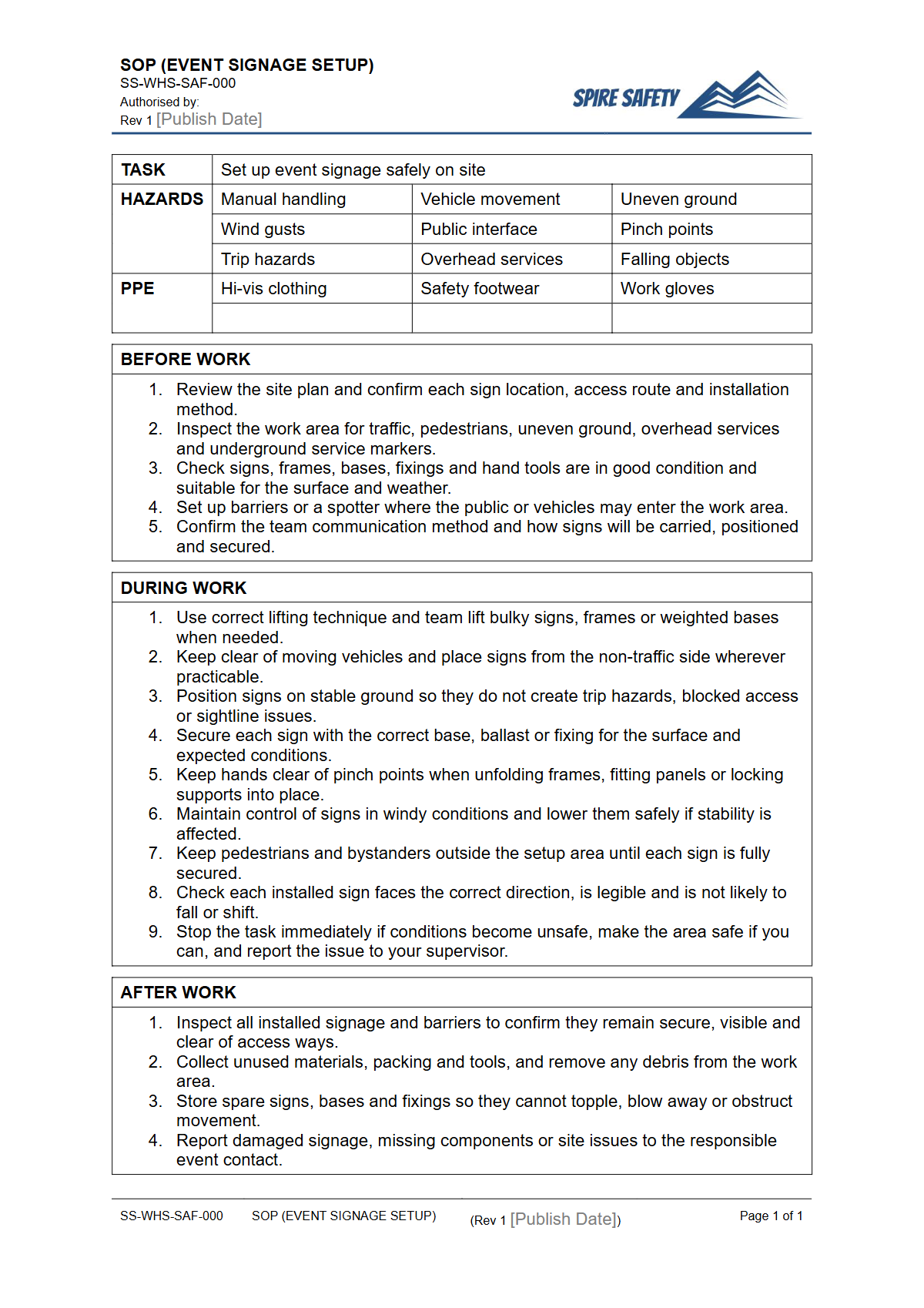
Managing the setup and removal of signage for events, festivals, or conferences involves significant workplace health and safety risks. This Free Safe Operating Procedure (Event Signage Setup) Template provides a structured framework to document the step-by-step process for these tasks.
It helps organisations identify hazards such as manual handling injuries, falls from height, public interaction, and electrical risks associated with illuminated signs. By systematically outlining control measures, this SOP forms a critical component of a safe system of work, ensuring tasks are performed consistently and safely by all personnel.
Using a standardised procedure helps demonstrate due diligence and operational control. This template serves as a foundational document that can be integrated into your broader WHS management system, providing clarity for workers and supervisors alike.
It prompts consideration of site-specific conditions, equipment requirements, and emergency protocols, formalising your commitment to a safe event environment.
Video walkthrough
How to use the Free Safe Operating Procedure (Event Signage Setup) Template
To effectively use this document, download the DOCX version and thoroughly review each section. It is designed to be adapted to your unique operational context.
This involves detailing the specific types of signage being used (e.g., A-frames, pull-up banners, large-scale truss banners, marquees), the tools required, and the environment where the work will occur. Be sure to incorporate details from your own risk assessments.
Please note: This is a template, not a finished document. We have provided a solid foundation based on Australian WHS practice, but you must customise it to reflect the unique hazards and control measures of your specific workplace and tasks.
Consultation with the workers performing the job is a critical part of this customisation process. If you are unsure how to complete a risk assessment or adapt this document, engaging professional WHS consulting services can provide essential guidance.
When to use a Safe Operating Procedure
An SOP for event signage setup should be developed and finalised during the event planning phase, well before any physical work begins. It should be used as a key training and induction tool for all staff and contractors involved in the setup and pack-down process.
Referencing the SOP during pre-start meetings or toolbox talks helps reinforce safe work practices immediately before the task commences. It also serves as an official record of the prescribed safe work method, which can be reviewed after an incident or as part of regular safety audits.
Regularly reviewing your SOPs is a key activity verified during a WHS compliance auditing process. This ensures they remain current and effective as equipment, processes, or regulations change.
The procedure should be readily accessible to all relevant workers on-site throughout the event's duration.
Who should use this document
This Safe Operating Procedure is intended for a range of personnel within an organisation responsible for event execution and safety. This includes:
- Event Managers and Coordinators: To plan and oversee the safe implementation of event infrastructure.
- Work Health and Safety (WHS) Officers: To develop, review, and integrate the SOP into the organisation’s safety management system.
- Site Supervisors and Team Leaders: To induct workers, conduct toolbox talks, and actively supervise the task to ensure the procedure is followed correctly.
- Workers and Contractors: As a direct, step-by-step guide on how to perform their duties safely.
The document facilitates clear communication of safety expectations across all levels. For particularly complex setups, such as those requiring heavy machinery to lift large signs, other specific procedures may also be necessary.
For example, you may need to supplement this document with a FREE Telehandler SOP Template if one is being used on-site. You can find many other useful documents in our free WHS resources library to support your operations.
Common mistakes
Common mistakes to avoid
- Ignoring environmental factors like wind loading on large banners or rain making surfaces slippery.
- Using incorrect equipment, such as domestic-grade ladders for commercial tasks or not using certified lifting gear.
- Failing to adequately secure the work area from public access during setup and pack-down.
- Not customising the generic SOP, leading to procedures that don't match the actual task or equipment used.
Legal references
Legal considerations
The following legal requirements may be relevant to this type of work.
- Work Health and Safety Act (Harmonised) — Provides the primary duties for protecting workers and other people from work health and safety risks.
- Work Health and Safety Regulations (Harmonised) — Sets out requirements supporting the management of workplace hazards and risks.
The following codes may be relevant to this type of work.
- Managing WHS Risks Code of Practice — Provides practical guidance on identifying hazards, assessing risks and applying effective controls.
- Work Health and Safety Consultation, Cooperation and Coordination Code of Practice — Provides practical guidance on consulting workers and coordinating with other duty holders.
- Managing the Work Environment and Facilities Code of Practice — Provides practical guidance on safe work environments, workplace facilities and related controls.
Did you know
Trip Hazard Hotspots
According to Safe Work Australia data, slips, trips and falls are a leading cause of serious injury claims. Temporary signage bases, unsecured cables, and tools left on the ground are common culprits in busy event environments.
The Consultation Duty
Under Australian WHS law, PCBUs have a mandatory duty to consult with workers who are, or are likely to be, directly affected by a health and safety matter. This includes the development of Safe Operating Procedures.
FAQ
Frequently asked questions
01What is a Safe Operating Procedure (SOP) for event signage?
02Do I need an SOP just for setting up signs?
03Can I use this template for any type of event?
04Who is responsible for creating the SOP for signage setup?
Share this resource
Free Safe Operating Procedure (Event Signage Setup) Template
Browse Categories
How To Use It
- 1Download and open in Word or PDF.
- 2Replace the placeholders with your business details.
- 3Get it reviewed by a WHS specialist before rollout.
Need it customised?
Our WHS consultants can adapt this template to your site, run a gap analysis, or audit what you already have in place.
Book a Free Consultation WHS consulting servicesor call 1300 156 382
Related templates
- Free Safe Operating Procedure (Event Waste Cleanup) Template
- Free Safe Operating Procedure (Excavator Grapple) Template
- Free Safe Operating Procedure (Excavator Ripper) Template
- Free Safe Operating Procedure (Excavator Tilt Bucket) Template
- Free Safe Operating Procedure (Exhaust Grille Cleaning) Template
- Free Safe Operating Procedure (Exhaust Removal) Template