
Free Safe Operating Procedure (Excavator Ripper) Template
Download our free Safe Operating Procedure for an excavator ripper. This structured template helps you document safe work methods and control measures.
Free Safe Operating Procedure (Excavator Ripper) Template
DOCX • 126 KB + PDF
Updated Oct 2026
No signup required
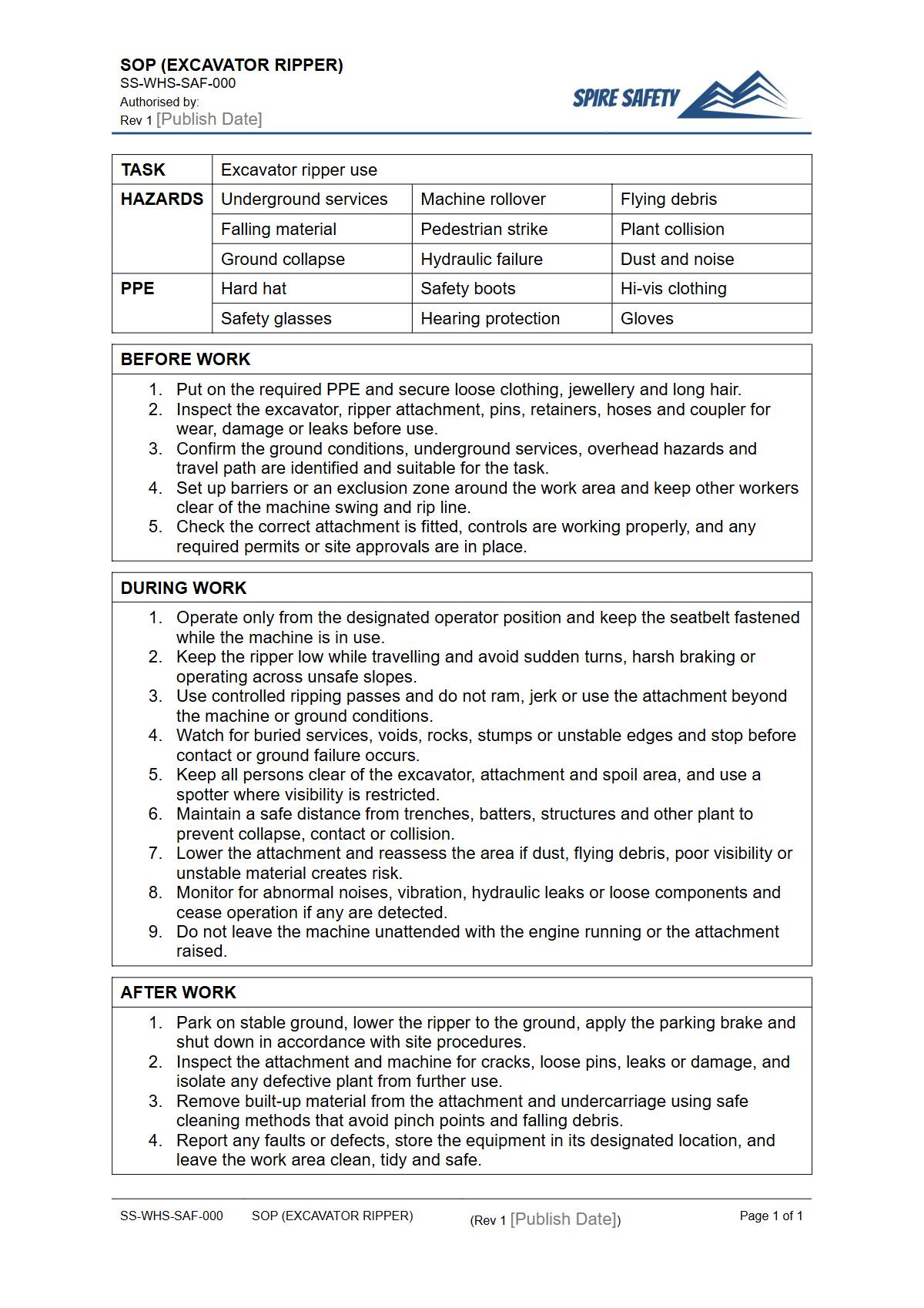
Purpose of the Free Safe Operating Procedure (Excavator Ripper) Template
Operating heavy machinery like an excavator fitted with a ripper attachment involves significant risks. This Free Safe Operating Procedure (Excavator Ripper) Template provides a structured framework for documenting the required steps to perform this task safely.
Its purpose is to help Persons Conducting a Business or Undertaking (PCBUs) identify hazards, assess risks, and implement effective control measures. A well-drafted SOP is a critical tool for operator training, ensuring consistent safe work practices, and demonstrating a commitment to workplace health and safety.
It formalises the sequence of actions required for pre-start checks, operation, and shutdown, minimising the chance of incidents involving personnel or property.
By clearly defining expectations and safety protocols, the SOP helps reduce the likelihood of uncontrolled ground collapse, striking underground services, or machine instability. It serves as a practical guide for operators and a reference for supervisors to monitor performance.
Similar to specific guides like our free Trencher SOP template, this document focuses on the unique hazards associated with a particular piece of equipment and its attachments. It is designed to be integrated into your broader safety management framework, supporting your organisation's WHS duties.
Video walkthrough
How to use the Free Safe Operating Procedure (Excavator Ripper) Template
This template is provided in both DOCX and PDF formats for your convenience. The DOCX version is fully editable, allowing you to tailor the content to the specific make and model of your excavator and ripper, the ground conditions of your site, and your organisation's internal procedures.
It is essential to customise this document; it is not a complete, out-of-the-box solution. We recommend a competent person, such as a site supervisor or safety manager, leads the customisation process in consultation with experienced operators.
To use the template effectively, download the DOCX file and systematically work through each section. Replace the placeholder text with information specific to your workplace.
This includes adding your company branding, specifying the exact personal protective equipment (PPE) required, detailing site-specific emergency procedures, and listing the relevant operator qualifications. This process of customisation ensures the final SOP is a practical and relevant document that forms a key part of your WHS management system, rather than a generic checklist.
Implementing the Customised SOP
Once customised, the SOP should be formally approved and communicated to all relevant personnel. Ensure operators are trained on the procedure's contents and understand their responsibilities.
Keep a copy readily accessible in the work area, either in the excavator's cabin or at the site office. The SOP should be a living document, subject to regular review and updates, especially after an incident, when new equipment is introduced, or when work practices change.
When to use this Safe Operating Procedure
A Safe Operating Procedure for an excavator ripper should be used at all stages of the task. It begins before the engine is started, with comprehensive pre-operational checks of the excavator, the ripper attachment, and the hydraulic systems.
During operation, it guides the operator on safe ripping techniques, managing stability on uneven terrain, and maintaining awareness of exclusion zones. It is particularly crucial when working near existing structures, underground services, or other personnel.
It should also be referenced for shutdown procedures, including correct parking, lowering the attachment, and securing the machine. In addition to a ripper, many sites coordinate different types of plant, making equipment-specific procedures like our Scraper SOP template essential for overall site safety.
Who should use this Safe Operating Procedure
This SOP is primarily for trained and competent excavator operators who are authorised to use a ripper attachment. It provides them with a clear, step-by-step guide to performing their work safely.
Site supervisors and forepersons should also use the document to conduct pre-start meetings, toolbox talks, and to verify that work is being carried out in accordance with the established procedure. They can use it as a tool for on-the-job training and competency assessments.
Safety managers and WHS officers will use the SOP as part of their safety management system, using it as a benchmark when undertaking regular WHS compliance audits and incident investigations.
Developing and reviewing this document should be a collaborative effort. Involving experienced operators ensures the procedure reflects the practical realities of the task, while management input ensures it aligns with organisational and legislative requirements.
This collaborative approach also fosters a stronger safety culture, as workers are directly involved in creating the standards they are expected to follow. Whether for ripping rock or coordinating with other machinery detailed in documents like our Telehandler SOP Template, the principles of consultation and clear documentation remain paramount.
You can find more templates and guidance in our free WHS resources library to support your safety efforts.
Common mistakes
Common mistakes to avoid
- Failing to conduct a thorough pre-start inspection of the ripper attachment for cracks, wear, or damage.
- Neglecting to establish and maintain clear exclusion zones around the operating area.
- Using the ripper for tasks it's not designed for, such as lifting or side-loading, which can destabilise the excavator.
- Operating on unstable or excessively sloped ground without proper risk assessment.
Legal references
Legal considerations
The following legal requirements may be relevant to this type of work.
- Work Health and Safety Act (Harmonised) — Provides the primary duties for protecting workers and other people from work health and safety risks.
- Work Health and Safety Regulations (Harmonised) — Sets out requirements supporting the management of workplace hazards and risks.
The following codes may be relevant to this type of work.
- Managing WHS Risks Code of Practice — Provides practical guidance on identifying hazards, assessing risks and applying effective controls.
- Work Health and Safety Consultation, Cooperation and Coordination Code of Practice — Provides practical guidance on consulting workers and coordinating with other duty holders.
- Managing the Work Environment and Facilities Code of Practice — Provides practical guidance on safe work environments, workplace facilities and related controls.
Did you know
Ground Penetration
The force exerted by a large excavator's ripper can be immense, often exceeding 30 tonnes at the tip. This power is essential for fracturing rock but also poses a significant risk if it strikes buried utilities like gas lines or electrical cables.
FAQ
Frequently asked questions
01What is an excavator ripper used for?
02Is an SOP a legal requirement for using an excavator ripper?
03Who is responsible for writing a Safe Operating Procedure?
04How often should an SOP for an excavator ripper be reviewed?
Share this resource
Free Safe Operating Procedure (Excavator Ripper) Template
Browse Categories
How To Use It
- 1Download and open in Word or PDF.
- 2Replace the placeholders with your business details.
- 3Get it reviewed by a WHS specialist before rollout.
Need it customised?
Our WHS consultants can adapt this template to your site, run a gap analysis, or audit what you already have in place.
Book a Free Consultation WHS consulting servicesor call 1300 156 382
Related templates
- Free Safe Operating Procedure (Excavator Tilt Bucket) Template
- Free Safe Operating Procedure (Exhaust Grille Cleaning) Template
- Free Safe Operating Procedure (Exhaust Removal) Template
- Free Safe Operating Procedure (Exit Sign Test) Template
- Free Safe Operating Procedure (Extensometer) Template
- Free Safe Operating Procedure (Eye Wash Test) Template