
Free Safe Operating Procedure (Extensometer) Template
Download our free Safe Operating Procedure (Extensometer) Template to formalise safe work practices. Get started with our customisable DOCX and PDF.
Free Safe Operating Procedure (Extensometer) Template
DOCX • 126 KB + PDF
Updated Oct 2026
No signup required
Purpose of the Free Safe Operating Procedure (Extensometer) Template
An extensometer is a precise instrument used in geotechnical engineering, structural monitoring, and materials testing to measure changes in length or displacement. Correct handling and operation are critical to ensure data accuracy and prevent damage to the device or injury to personnel.
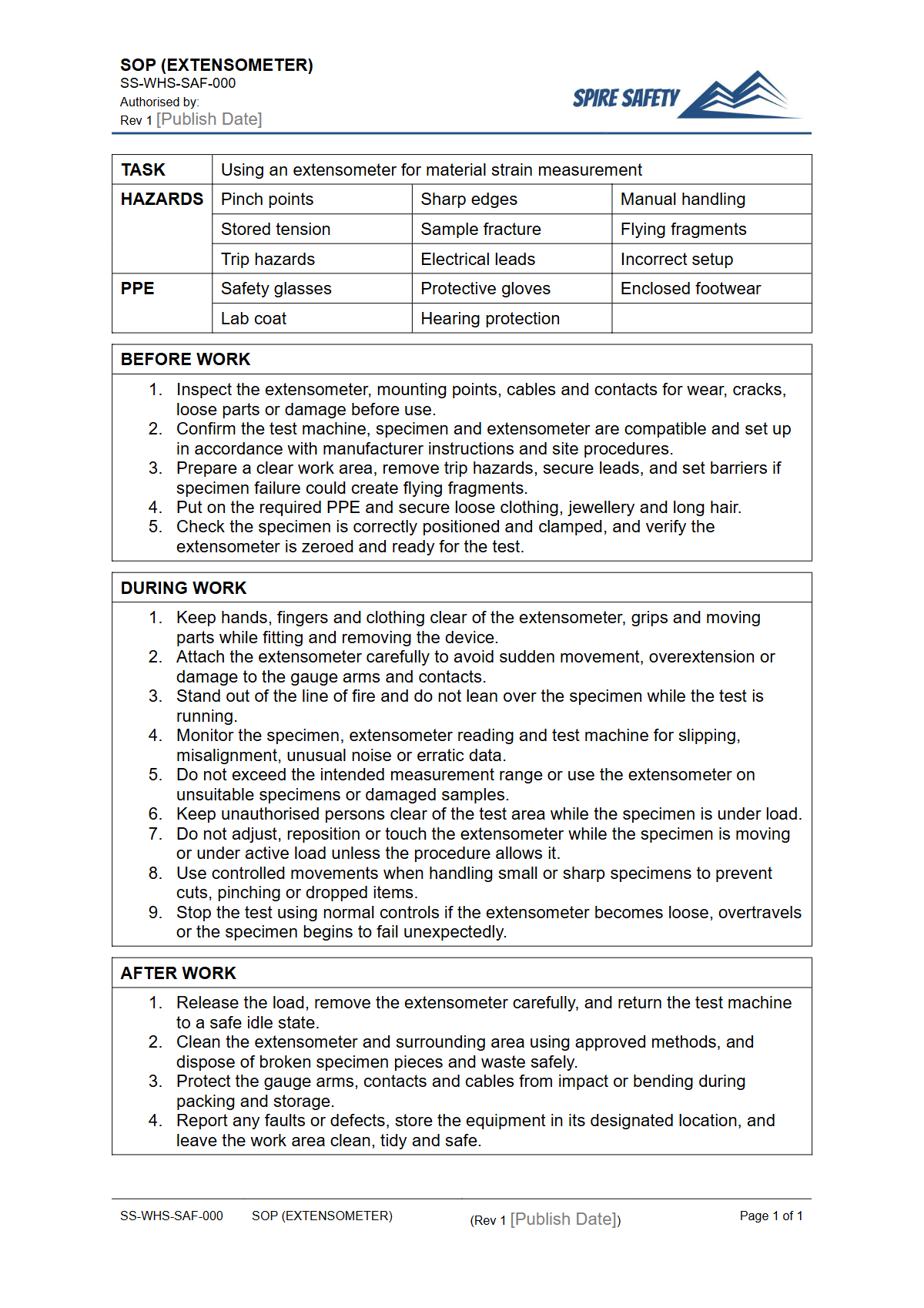
This free Safe Operating Procedure (Extensometer) Template provides a structured starting point for developing a documented process for your workplace. It helps you outline step-by-step instructions for pre-operational checks, safe operation, and post-use maintenance, ensuring a consistent and safe approach every time.
Using a formalised SOP helps meet your primary duty of care under WHS legislation by managing risks associated with equipment use. It standardises the procedure, reduces the likelihood of operational errors, and serves as a vital training tool for new and existing workers.
Documenting these processes is a fundamental component of effective WHS management systems, demonstrating a commitment to proactive safety management.
Video walkthrough
How to use the Free Safe Operating Procedure (Extensometer) Template
This template is designed for easy customisation to reflect the specific equipment and environment at your worksite. Simply download the DOCX or PDF and populate the required fields.
Your procedure should detail the specific make and model of the extensometer, the hazards unique to your site (such as working at heights, electrical risks, or environmental factors), and the corresponding control measures.
Customisation is Essential
Please note: This document is a template only. You must adapt it to the unique conditions, equipment, and risks of your workplace.
We are not responsible for the outcomes of the procedure you develop. Consult relevant technical specifications, conduct a site-specific risk assessment, and ensure the final document is reviewed and approved by a competent person before implementation.
Where installation may require working at height, procedures for associated plant, such as those covered in our FREE Telehandler SOP Template, must also be considered.
When to use an Extensometer Safe Operating Procedure
An SOP for an extensometer should be used whenever the equipment is handled, installed, calibrated, operated, or maintained. This is particularly crucial in environments like construction sites, mines, and civil engineering projects where ground movement, structural stability, or material stress is being monitored.
Having a documented procedure is vital for tasks such as monitoring excavations, assessing the stability of slopes and embankments, or checking the performance of structural elements like beams and bridges. For related earthmoving equipment, you might also need our Grader SOP (Safe Operating Procedure) Template to ensure comprehensive safety coverage on site.
Who should use this Safe Operating Procedure
This SOP should be used by all personnel involved with the extensometer. This includes, but is not limited to:
- Geotechnical Engineers and Technicians: Those responsible for installing, calibrating, and collecting data from the instrument.
- Site Forepersons and Supervisors: To oversee the work, ensure procedures are followed, and integrate the task with other site activities.
- Construction and Maintenance Workers: Any worker who may be assisting with installation or working in the vicinity of the monitoring equipment.
- WHS Managers and Officers: To use as part of risk assessments, training programs, and incident investigations.
Ensuring all relevant workers are trained and competent in the procedure is a key responsibility for the Person Conducting a Business or Undertaking (PCBU). This includes understanding the risks associated with ancillary tasks, such as creating access for monitoring points, which might involve machinery covered by our FREE Trencher SOP Template. You can find more templates and checklists in our free WHS resources library to support your safety management efforts.
Common mistakes
Common mistakes to avoid
- Failing to perform pre-use calibration, leading to inaccurate data.
- Using a generic SOP without customising it for site-specific hazards and equipment models.
- Neglecting to inspect mounting points, anchors, and wiring for damage or corrosion before taking readings.
- Inadequate training for personnel on how to correctly interpret the data provided by the instrument.
Legal references
Legal considerations
The following legal requirements may be relevant to this type of work.
- Work Health and Safety Act (Harmonised) — Provides the primary duties for protecting workers and other people from work health and safety risks.
- Work Health and Safety Regulations (Harmonised) — Sets out requirements supporting the management of workplace hazards and risks.
The following codes may be relevant to this type of work.
- Managing WHS Risks Code of Practice — Provides practical guidance on identifying hazards, assessing risks and applying effective controls.
- Work Health and Safety Consultation, Cooperation and Coordination Code of Practice — Provides practical guidance on consulting workers and coordinating with other duty holders.
- Managing the Work Environment and Facilities Code of Practice — Provides practical guidance on safe work environments, workplace facilities and related controls.
Did you know
Precision Measurement
Modern extensometers are incredibly sensitive, capable of detecting changes in displacement as small as one micrometre (0.001 mm), making them essential tools in structural and geotechnical monitoring.
Historical Roots
The concept of the extensometer dates back to the 19th century, with early versions developed to test the properties of steel used in bridge and building construction during the Industrial Revolution.
FAQ
Frequently asked questions
01What is an extensometer and why does its use require an SOP?
02How specific do the steps in the extensometer SOP need to be?
03Is this template suitable for all types of extensometers?
04Who is responsible for reviewing and approving a Safe Operating Procedure?
Share this resource
Free Safe Operating Procedure (Extensometer) Template
Browse Categories
How To Use It
- 1Download and open in Word or PDF.
- 2Replace the placeholders with your business details.
- 3Get it reviewed by a WHS specialist before rollout.
Need it customised?
Our WHS consultants can adapt this template to your site, run a gap analysis, or audit what you already have in place.
Book a Free Consultation WHS consulting servicesor call 1300 156 382
Related templates
- Free Safe Operating Procedure (Eye Wash Test) Template
- Free Safe Operating Procedure (Eyelet Press) Template
- Free Safe Operating Procedure (Fabric Cutter) Template
- Free Safe Operating Procedure (Facade Anchor Inspection) Template
- Free Safe Operating Procedure (Facade Glass Cleaning) Template
- Free Safe Operating Procedure (Facade Washdown) Template