
Free Safe Operating Procedure (Facade Anchor Inspection) Template
Download our free Safe Operating Procedure template for facade anchor inspections. This structured document helps you outline key safety steps and controls.
Free Safe Operating Procedure (Facade Anchor Inspection) Template
DOCX • 126 KB + PDF
Updated Oct 2026
No signup required
Purpose of the Free Safe Operating Procedure (Facade Anchor Inspection) Template
The primary purpose of this Safe Operating Procedure is to provide a clear, documented method for inspecting facade anchor points, ensuring they are fit for purpose before use. A documented procedure standardises the inspection process across all personnel and sites, reducing the risk of human error and equipment failure.
It forms a crucial component of your overall safety management system, demonstrating a commitment to proactively managing fall hazards. Properly implemented, this SOP helps your organisation meet its duty of care under WHS legislation. Integrating such procedures into your company-wide framework is a key part of building robust WHS management systems.
Video walkthrough
How to use the Free Safe Operating Procedure (Facade Anchor Inspection) Template
This document is a template, not a finished procedure. It must be customised to reflect the specific context of your workplace. To use it effectively:
- Download the template in your preferred format (DOCX for easy editing or PDF).
- Review each section and adapt the content to match the types of anchor systems at your facility (e.g., cast-in, drilled-in, surface-mounted), the specific equipment used for inspection, and your site conditions.
- Incorporate manufacturer's instructions and the requirements of relevant Australian Standards.
- Consult with workers and other stakeholders during the customisation process to ensure the procedure is practical and understood by those performing the task.
- Once finalised, use the SOP for training and as a reference tool for competent persons conducting inspections.
Important: This template is a starting point. We have designed it to be comprehensive, but you are responsible for ensuring the final document is specific and adequate for your workplace's unique risks and legal obligations.
If you require assistance, engaging with safety experts can provide clarity and ensure your documentation is robust. Professional WHS consulting can help tailor this template to your precise needs.
What's covered in this template?
To provide a comprehensive framework, this SOP template is structured into key sections that guide the inspector through the entire process. It includes fields for:
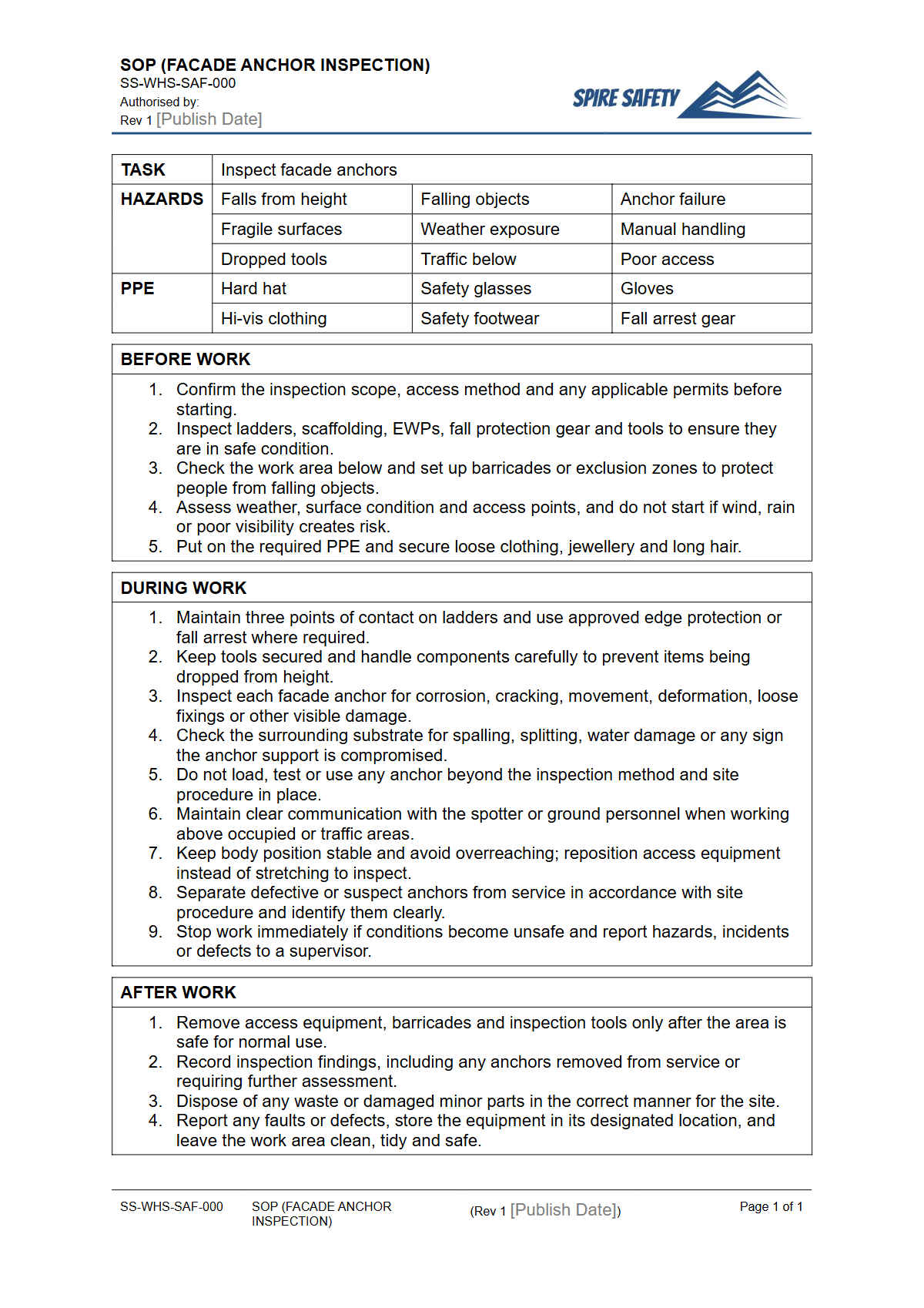
- Hazard Identification: Prompts for identifying potential risks such as fall hazards, weather conditions, and structural instability.
- Required PPE: A checklist for personal protective equipment specific to working at heights and conducting inspections.
- Pre-Inspection Checks: Steps to take before commencing, including reviewing previous inspection records and securing the work area.
- Inspection Procedure: A detailed sequence of checks, covering visual, tactile, and functional assessments of the anchor, its base, and its fixings.
- Equipment: A section to list tools required for the inspection, such as torque wrenches or cleaning equipment. If specific machinery is needed to access the anchors, you must also have a procedure for its safe use, similar to our Telehandler SOP Template.
- Post-Inspection Actions: Instructions for tagging anchors (pass/fail), completing records, and reporting defects.
Cleaning anchors of debris or residue is often a prerequisite for a thorough inspection. Where compressed air is used, ensure workers follow safe procedures as outlined in a relevant document like an Air Compressor SOP.
When should a Facade Anchor Inspection SOP be used?
This SOP should be used every time a periodic inspection of facade anchor points is due. These inspections are typically required:
- At regular intervals specified by the manufacturer or an engineer, commonly every 12 months.
- Before the first use of a newly installed anchor system.
- Following any event that may have affected the anchor's integrity, such as a major storm, seismic activity, or structural modification to the building.
Regularly reviewing and verifying the consistent application of this SOP is just as important as the inspection itself. Periodic assessments, such as those performed during WHS compliance auditing, can confirm that procedures are being followed correctly and that records are maintained.
Who should use this procedure?
This Safe Operating Procedure is intended for use by 'competent persons' tasked with inspecting facade anchor systems. A competent person is someone who has acquired the knowledge and skills to carry out the task safely through training, qualification, or experience. Additionally, the following roles will find this template valuable:
- WHS Managers and Safety Officers: For developing and implementing safety protocols.
- Building and Facility Managers: For ensuring maintenance schedules and compliance obligations are met.
- Persons Conducting a Business or Undertaking (PCBUs): To help fulfil their primary duty of care to provide a safe workplace.
This document, along with many others, is part of our commitment to providing valuable safety information. You can explore our full free WHS resources library for more templates and guides.
Common mistakes
Common mistakes to avoid
- Using the template without customising it for specific building anchor types and site conditions.
- Assigning inspection tasks to personnel who are not deemed 'competent' through relevant training or experience.
- Failing to properly document inspection results, including clear tagging of anchors as 'safe to use' or 'do not use'.
- Ignoring environmental factors, such as accelerated corrosion in coastal or industrial zones, which can degrade anchor integrity.
Legal references
Legal considerations
The following legal requirements may be relevant to this type of work.
- Work Health and Safety Act (Harmonised) — Provides the primary duties for protecting workers and other people from work health and safety risks.
- Work Health and Safety Regulations (Harmonised) — Sets out requirements supporting the management of workplace hazards and risks.
The following codes may be relevant to this type of work.
- Managing WHS Risks Code of Practice — Provides practical guidance on identifying hazards, assessing risks and applying effective controls.
- Work Health and Safety Consultation, Cooperation and Coordination Code of Practice — Provides practical guidance on consulting workers and coordinating with other duty holders.
- Managing the Work Environment and Facilities Code of Practice — Provides practical guidance on safe work environments, workplace facilities and related controls.
Did you know
Standards Australia
Australian Standard AS/NZS 5532 sets out the design, manufacturing, and testing requirements for single-point anchor devices used for harness-based work at height.
Fall Hazards
Falls from height remain a leading cause of traumatic workplace fatalities in Australia. Proper inspection and use of equipment like facade anchors are critical controls.
FAQ
Frequently asked questions
01What is a facade anchor point?
02How often do facade anchor points need to be inspected in Australia?
03Who is considered a 'competent person' for anchor inspection?
04Can I use this SOP for all types of fall protection anchors?
Share this resource
Free Safe Operating Procedure (Facade Anchor Inspection) Template
Browse Categories
How To Use It
- 1Download and open in Word or PDF.
- 2Replace the placeholders with your business details.
- 3Get it reviewed by a WHS specialist before rollout.
Need it customised?
Our WHS consultants can adapt this template to your site, run a gap analysis, or audit what you already have in place.
Book a Free Consultation WHS consulting servicesor call 1300 156 382
Related templates
- Free Safe Operating Procedure (Facade Glass Cleaning) Template
- Free Safe Operating Procedure (Facade Washdown) Template
- Free Safe Operating Procedure (Fall Arrest Harness) Template
- Free Safe Operating Procedure (Falls Mat Cleaning) Template
- Free Safe Operating Procedure (Falls Mat Placement) Template
- Free Safe Operating Procedure (Fan Coil Unit Cleaning) Template