
Free Safe Operating Procedure (Fan Coil Unit Cleaning) Template
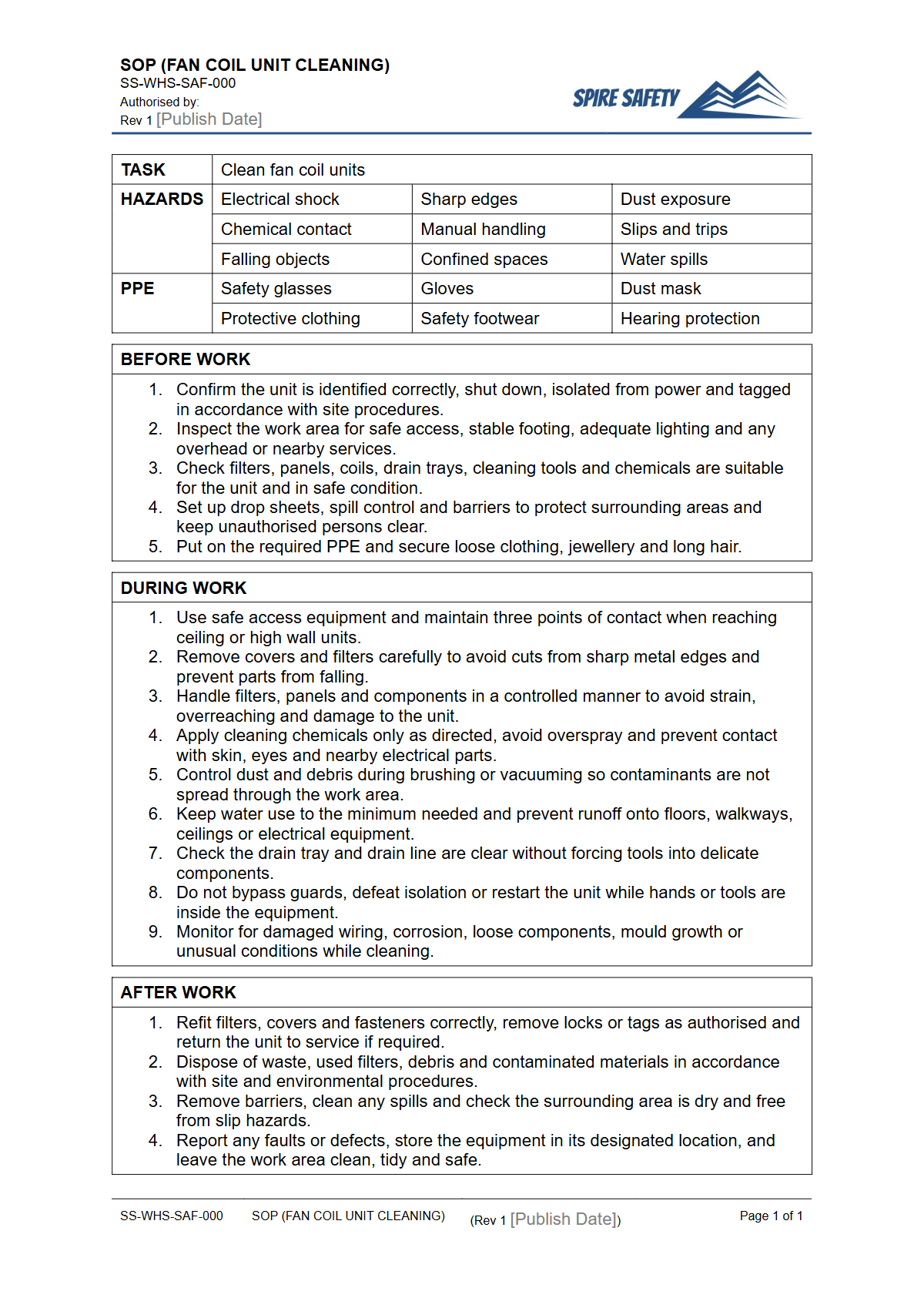
Download our free Safe Operating Procedure for fan coil unit cleaning. This template helps you document the step-by-step process for safe maintenance.
Free Safe Operating Procedure (Fan Coil Unit Cleaning) Template
DOCX • 126 KB + PDF
Updated Oct 2026
No signup required
Purpose of the Free Safe Operating Procedure (Fan Coil Unit Cleaning) Template
This template provides a structured starting point for developing a comprehensive guide to cleaning fan coil units (FCUs) safely. This Free Safe Operating Procedure (Fan Coil Unit Cleaning) Template is designed to help organisations document critical safety steps, identify hazards, and implement control measures.
Proper FCU maintenance is essential for indoor air quality and system efficiency, but it involves risks such as electrical hazards, exposure to cleaning chemicals, manual handling, and potentially working at heights. Using a formalised SOP ensures that all workers follow a consistent, safe method, reducing the likelihood of incidents and injuries.
A well-drafted SOP is a key component of effective WHS management systems, demonstrating due diligence and a commitment to worker safety. This document outlines the pre-operational checks, step-by-step cleaning process, and post-operational tasks required to complete the job without harm to people or property.
It serves as a vital tool for training, supervision, and incident investigation.
Video walkthrough
How to use the Free Safe Operating Procedure (Fan Coil Unit Cleaning) Template
To get started, download the template in your preferred format—DOCX for easy editing or PDF for reference. The document is structured logically, covering PPE requirements, potential hazards, risk controls, and a sequential procedure.
The DOCX version is fully editable, allowing you to add your company branding and specific details about the fan coil units and cleaning agents used at your facility.
Note: This is a template, not a finished document. It is critical that you customise this procedure for your specific equipment, chemicals, and workplace environment. We provide the framework, but you must fill in the site-specific details to ensure it is relevant and effective. A generic SOP is insufficient for managing your unique risks. Your procedure might specify using compressed air to clear dust from coils; if so, workers must also follow the steps outlined in a document like our Free Air Compressor SOP (Safe Operating Procedure) Template.
When to use it
This Safe Operating Procedure should be used and readily available whenever fan coil unit cleaning is performed. It is particularly important during:
- Scheduled preventative maintenance cycles to ensure consistency and safety.
- Responsive cleaning following a breakdown or noticeable drop in performance.
- Training and induction for new maintenance personnel or contractors to establish clear safety expectations.
- Annual reviews of your workplace's risk assessments and safety procedures, using the SOP as a benchmark for current practices.
For tasks involving ceiling-mounted or hard-to-reach units, the SOP should also integrate procedures for safe access, which may require specific training detailed in resources like a FREE Telehandler SOP Template.
Who should use it
This SOP is intended for all personnel involved in the maintenance and supervision of HVAC systems. This includes:
- HVAC Technicians
- Facilities Maintenance Staff
- Building Managers
- WHS/OHS Managers and Officers
- Contractors engaged for maintenance work
WHS managers can use this template as a baseline for developing and reviewing safety documentation as part of their broader safety responsibilities, often benefiting from expert guidance through WHS consulting to ensure best practice. The document should be made accessible to all relevant workers and used as a practical tool on the job, not just a file in a cabinet.
By implementing a clear SOP for fan coil unit cleaning, your organisation can significantly improve safety outcomes and operational efficiency. For more templates and safety guides, browse our complete free WHS resources library.
Common mistakes
Common mistakes to avoid
- Forgetting to perform a full electrical lockout/tagout before starting work.
- Using incorrect or unapproved cleaning chemicals that can damage coils or create toxic fumes.
- Neglecting to check for and address biological growth (mould) or pest infestations inside the unit.
- Failing to clean up spills adequately, leaving slippery floors or chemical residue behind.
Legal references
Legal considerations
The following legal requirements may be relevant to this type of work.
- Work Health and Safety Act (Harmonised) — Provides the primary duties for protecting workers and other people from work health and safety risks.
- Work Health and Safety Regulations (Harmonised) — Sets out requirements supporting the management of workplace hazards and risks.
The following codes may be relevant to this type of work.
- Managing WHS Risks Code of Practice — Provides practical guidance on identifying hazards, assessing risks and applying effective controls.
- Work Health and Safety Consultation, Cooperation and Coordination Code of Practice — Provides practical guidance on consulting workers and coordinating with other duty holders.
- Managing the Work Environment and Facilities Code of Practice — Provides practical guidance on safe work environments, workplace facilities and related controls.
Did you know
Indoor Air Quality
Regularly cleaning fan coil units can significantly improve a building's Indoor Air Quality (IAQ) by removing mould, bacteria, and dust that would otherwise circulate through the ventilation system.
Energy Efficiency
A clean fan coil is an efficient one. Clogged coils and dirty fans force the system to work harder, and studies show that cleaning can improve HVAC energy efficiency by 10-25%.
FAQ
Frequently asked questions
01What hazards are involved in cleaning a fan coil unit?
02Is a Safe Operating Procedure legally required for FCU cleaning in Australia?
03How often should an SOP for fan coil unit cleaning be reviewed?
04Can this template be used for other HVAC equipment?
Share this resource
Free Safe Operating Procedure (Fan Coil Unit Cleaning) Template
Browse Categories
How To Use It
- 1Download and open in Word or PDF.
- 2Replace the placeholders with your business details.
- 3Get it reviewed by a WHS specialist before rollout.
Need it customised?
Our WHS consultants can adapt this template to your site, run a gap analysis, or audit what you already have in place.
Book a Free Consultation WHS consulting servicesor call 1300 156 382
Related templates
- Free Safe Operating Procedure (Feed Mill) Template
- Free Safe Operating Procedure (Feed Mixer) Template
- Free Safe Operating Procedure (Feeder Breaker) Template
- Free Safe Operating Procedure (Fence Cleaning) Template
- Free Safe Operating Procedure (Fence Line Clearing) Template
- Free Safe Operating Procedure (Fence Post Replacement) Template