
Free Safe Operating Procedure (Feed Mixer) Template
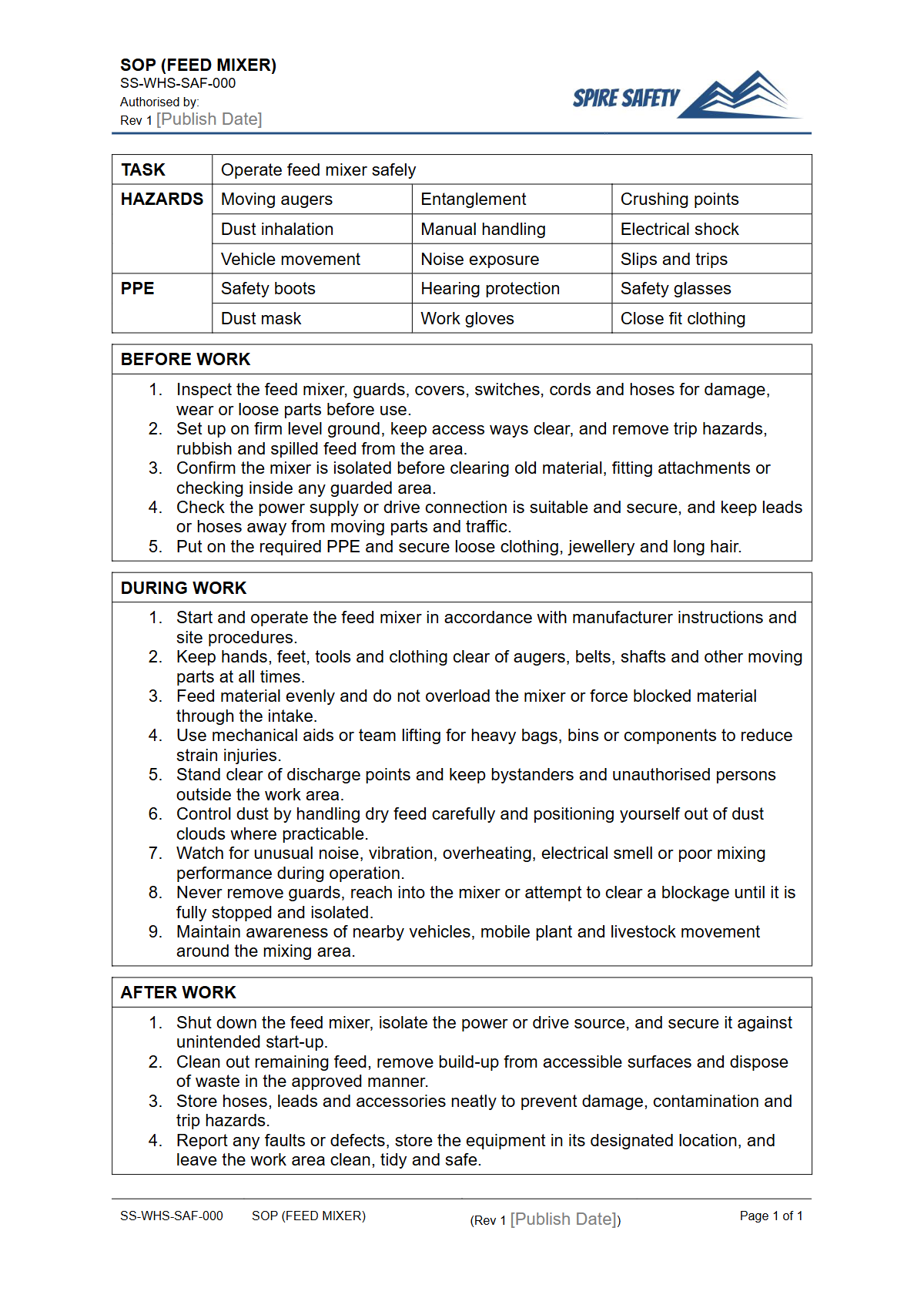
Clearly outline the steps for operating a feed mixer safely. Our free template helps you document hazards, controls, and procedures to protect workers.
Free Safe Operating Procedure (Feed Mixer) Template
DOCX • 126 KB + PDF
Updated Oct 2026
No signup required
Purpose of the Free Safe Operating Procedure (Feed Mixer) Template
Operating a feed mixer presents significant risks, including entanglement in moving parts, exposure to hazardous dust, and manual handling injuries. This Free Safe Operating Procedure (Feed Mixer) Template provides a structured framework for documenting the key steps, hazards, and safety controls required to operate this machinery safely.
By establishing a clear, documented process, your organisation can standardise safe work practices, minimise the risk of incidents, and demonstrate a commitment to workplace health and safety. The template is designed to be a foundational document, guiding supervisors and workers through pre-operational checks, safe operation steps, and shutdown procedures.
Video walkthrough
How to use the Free Safe Operating Procedure (Feed Mixer) Template
This document is a starting point, not a finished product. To make it effective for your workplace, you must customise it to reflect your specific feed mixer model, work environment, and types of materials being mixed.
After downloading the DOCX or PDF file, consult with the workers who actually operate the machinery. Their direct experience is invaluable for identifying specific hazards and practical control measures. This process is a critical component of a comprehensive WHS management system.
Important Customisation Note:
This is a template only. You must adapt it to your specific equipment, tasks, and operational environment. We are not liable for any incidents that may occur from the use of this document.
It is your responsibility as the Person Conducting a Business or Undertaking (PCBU) to ensure it is suitable for your workplace and that all workers are trained in its contents.
- Step 1: Download the template in your preferred format.
- Step 2: Identify the specific make and model of your feed mixer.
- Step 3: Conduct a risk assessment for all tasks involving the mixer, from loading to cleaning, involving operators and supervisors.
- Step 4: Edit the document to include site-specific details, such as PPE requirements, emergency stop locations, and lockout/tagout procedures.
- Step 5: Use the completed Safe Operating Procedure as a core part of your operator training and competency verification process.
When to use a Feed Mixer Safe Operating Procedure
A Safe Operating Procedure for a feed mixer should be a readily accessible document used in several key situations. It is essential during the induction and training of new operators to ensure they understand the approved method of operation from the very beginning.
The SOP should also be used as a reference for refresher training and routine competency assessments. It serves as a practical checklist for pre-operational inspections and a guide for performing maintenance tasks safely. Furthermore, the document should be reviewed and potentially updated following any incident or near-miss, or when changes are made to the equipment or work process, similar to the process for developing a safe operating procedure for a grain drill.
Who should use this SOP Template
This template is intended for anyone with health and safety responsibilities in an agricultural or farming environment. This includes Farm Managers, Work Health and Safety (WHS) Officers, and Supervisors who are responsible for implementing safe systems of work.
They can use the template to create a formal procedure that aligns with their safety management system. Most importantly, the final, customised SOP is for the machinery operators themselves.
It should be a clear, practical guide they can refer to, ensuring they perform their tasks consistently and safely every time. The principles in this document are also applicable to other agricultural machinery, such as that covered in our SOP for spreaders.
Integrating the SOP into Your Safety System
A standalone SOP has limited value if it isn't integrated into your broader safety framework. The procedure should be a living document, referenced in your training matrix, risk register, and maintenance schedules.
Regular toolbox talks can reinforce the key safety messages contained within the SOP. For equipment that is part of a larger production line, it’s important to consider how it interacts with other machinery, which may require a dedicated conveyor system SOP to manage associated risks.
Effective integration ensures that safety is not just a document, but a practised behaviour throughout your organisation.
Maintenance and Review Procedures
Regular maintenance is critical for the safe operation of any feed mixer. Your SOP should include a section detailing the schedule for inspections, lubrication, and replacement of wear parts, always following the manufacturer's recommendations.
All maintenance must be conducted with the machine de-energised and locked out to prevent accidental start-up. The SOP itself should be reviewed periodically—at least annually, or whenever there is a change in legislation, equipment, or after an incident.
This ensures the document remains relevant and effective. The same review cycle is best practice for all plant procedures, including a thresher SOP or any other high-risk equipment on site. Auditing these procedures is a key part of maintaining compliance, a process that can be supported by specialist WHS compliance auditing.
Next Steps
Download the template to begin creating a safer work environment today. By documenting and standardising your procedures for feed mixers and other machinery like those requiring a planter SOP template, you take a significant step towards preventing workplace injuries.
Remember to browse our complete free WHS resources library for other helpful templates and guides to support your safety goals.
Common mistakes
Common mistakes to avoid
- Using the generic template without customising it for the specific feed mixer model and worksite.
- Failing to train all operators on the finalised SOP and verify their competency.
- Neglecting to install or maintain guards on augers, drive shafts, and other moving parts.
- Attempting to clear blockages or perform maintenance while the machine is still energised.
Legal references
Legal considerations
The following legal requirements may be relevant to this type of work.
- Work Health and Safety Act (Harmonised) — Provides the primary duties for protecting workers and other people from work health and safety risks.
- Work Health and Safety Regulations (Harmonised) — Sets out requirements supporting the management of workplace hazards and risks.
The following codes may be relevant to this type of work.
- Managing WHS Risks Code of Practice — Provides practical guidance on identifying hazards, assessing risks and applying effective controls.
- Work Health and Safety Consultation, Cooperation and Coordination Code of Practice — Provides practical guidance on consulting workers and coordinating with other duty holders.
- Managing the Work Environment and Facilities Code of Practice — Provides practical guidance on safe work environments, workplace facilities and related controls.
Did you know
Entanglement Speed
A standard Power Take-Off (PTO) shaft rotates at 540 rpm, which is nine times per second. It can wrap a person's entire body around the shaft in less than a second, making guarding essential.
Agricultural Injuries
According to Safe Work Australia, machinery is the leading cause of fatalities on Australian farms. Many of these incidents involve entanglement with unguarded moving parts of equipment like feed mixers.
FAQ
Frequently asked questions
01What are the main hazards when operating a feed mixer?
02Does this SOP template cover all types of feed mixers?
03Who is responsible for developing a Safe Operating Procedure for a feed mixer?
04How often should a Feed Mixer SOP be reviewed?
Share this resource
Free Safe Operating Procedure (Feed Mixer) Template
Browse Categories
How To Use It
- 1Download and open in Word or PDF.
- 2Replace the placeholders with your business details.
- 3Get it reviewed by a WHS specialist before rollout.
Need it customised?
Our WHS consultants can adapt this template to your site, run a gap analysis, or audit what you already have in place.
Book a Free Consultation WHS consulting servicesor call 1300 156 382
Related templates
- Free Safe Operating Procedure (Feeder Breaker) Template
- Free Safe Operating Procedure (Fence Cleaning) Template
- Free Safe Operating Procedure (Fence Line Clearing) Template
- Free Safe Operating Procedure (Fence Post Replacement) Template
- Free Safe Operating Procedure (Fence Vegetation Clear) Template
- Free Safe Operating Procedure (Fence Wire Strainer) Template