
Free Safe Operating Procedure (Fence Line Clearing) Template
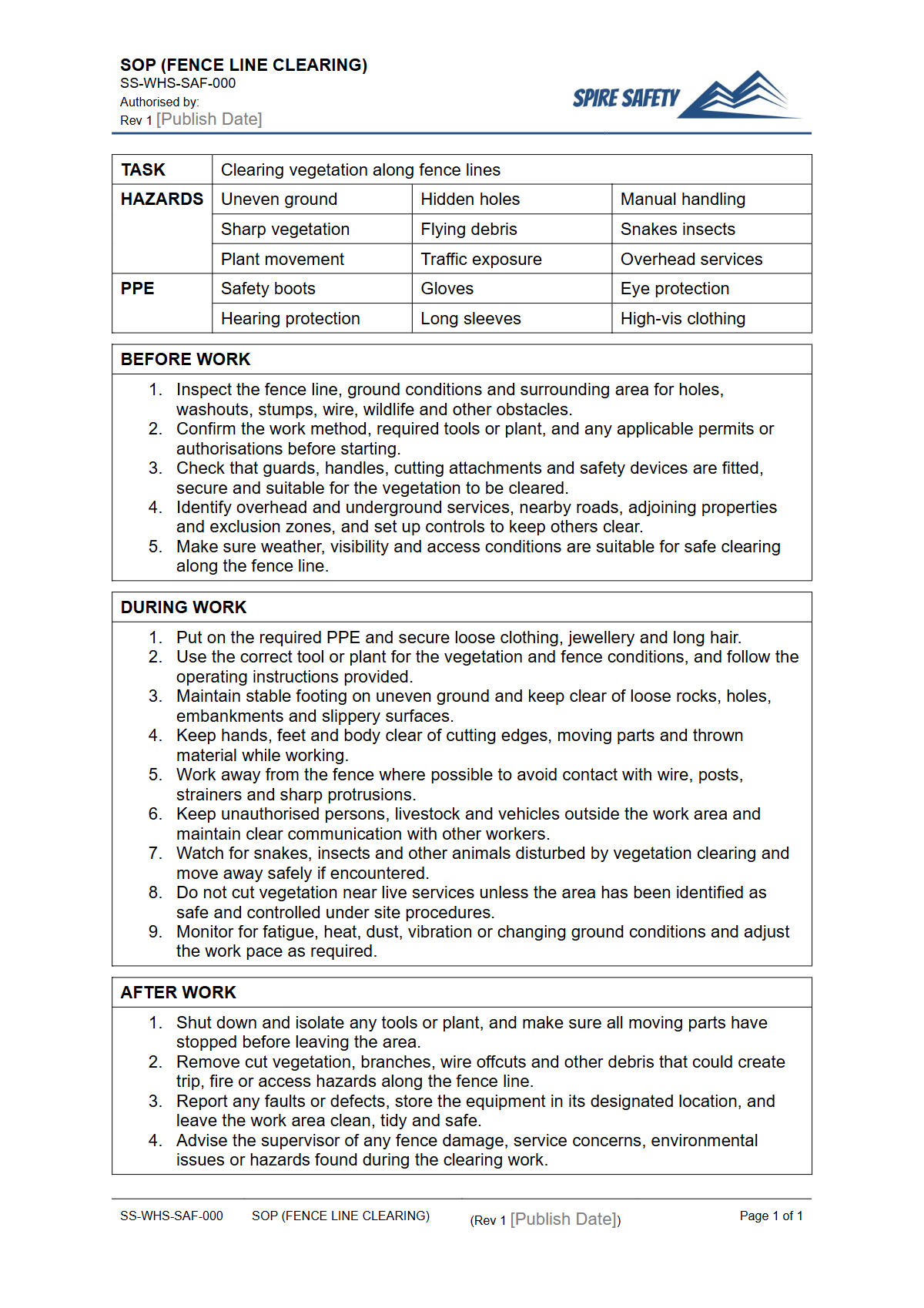
Download our free Safe Operating Procedure for fence line clearing. This customisable template helps you document safety controls for this rural and civil task.
Free Safe Operating Procedure (Fence Line Clearing) Template
DOCX • 126 KB + PDF
Updated Oct 2026
No signup required
Purpose of the Free Safe Operating Procedure (Fence Line Clearing) Template
Managing safety during fence line clearing is critical for preventing injuries and property damage. Our Free Safe Operating Procedure (Fence Line Clearing) Template provides a structured framework to help you identify hazards and implement effective controls.
This task can involve a range of equipment and manual methods, from using chainsaws for thick vegetation to operating heavy machinery for earthworks. To ensure specific tools are used safely, you might also require a dedicated circular saw SOP for tasks like trimming posts or clearing fallen timber.
The primary purpose of this Safe Operating Procedure is to provide a clear, step-by-step guide for performing fence line clearing safely. This task, common in agriculture, civil construction, and property maintenance, presents numerous risks.
These can include machinery rollovers on uneven ground, contact with overhead or underground services, hazardous manual tasks, exposure to dust and noise, and encounters with wildlife like snakes or spiders. By documenting the process, required equipment, and safety controls, this template helps your organisation meet its WHS duties to provide a safe system of work.
Video walkthrough
How to use the Free Safe Operating Procedure (Fence Line Clearing) Template
This template is provided in both DOCX and PDF formats for your convenience. The DOCX file is fully editable, allowing you to tailor the content to your specific operational needs.
To use it effectively, a competent person should review each section and modify it to reflect the actual machinery (e.g., tractors, dozers, excavators), environment, and personnel involved in your workplace. A robust SOP is a cornerstone of an effective safety framework, which is why integrating it into your broader WHS management systems is crucial for consistent safety performance.
Customisation is Essential
Please Note: This document is a template and not a complete Safe Operating Procedure. We provide it as a starting point.
You must customise this document to reflect the specific hazards, equipment, control measures, and legal requirements applicable to your workplace and state or territory. Responsibility for the accuracy and adequacy of the final SOP rests with the user.
When to use a Fence Line Clearing SOP
A Safe Operating Procedure for fence line clearing should be used as a core part of your risk management process. It should be consulted before any clearing work begins, especially on new or unfamiliar sites.
It is an essential tool for worker training, inductions for new team members, and for 'toolbox talks' to refresh knowledge before a shift. The SOP should also be reviewed regularly, after any incident or near-miss, or when new equipment or techniques are introduced, such as using specialised machinery documented in a FREE Trencher SOP Template if trenching is part of the clearing process.
Who should use this SOP template
This template is designed for a range of personnel within an organisation. Persons Conducting a Business or Undertaking (PCBUs), farm owners, and project managers can use it to fulfil their primary duty of care.
Site supervisors and team leaders should use it to induct, train, and supervise workers. The workers carrying out the clearing are the end-users, and they must understand and follow the procedures outlined.
If you need assistance developing or implementing site-specific procedures, our WHS consulting services can provide expert guidance.
Beyond the immediate task, consider the broader site preparation. Large-scale clearing may require re-grading access tracks or levelling areas.
For these activities, having documented procedures is equally important. Many organisations find value in complementing this SOP with others, such as our FREE Grader SOP Template, to cover all phases of the project safely.
By systematically addressing risks, you create a safer environment for everyone. This template is just one of many tools available to help you build a strong safety culture.
Explore our complete free WHS resources library for more templates, checklists, and guides to support your safety management efforts.
Common mistakes
Common mistakes to avoid
- Failing to physically locate and mark all identified overhead and underground services before starting.
- Using inappropriate machinery, such as a tractor without a ROPS (Roll-Over Protective Structure) on sloping ground.
- Neglecting to conduct a pre-start site inspection for hidden hazards like logs, stumps, or wildlife.
- Poor communication protocols, particularly when multiple machines or personnel are working in the same area.
Legal references
Legal considerations
The following legal requirements may be relevant to this type of work.
- Work Health and Safety Act (Harmonised) — Provides the primary duties for protecting workers and other people from work health and safety risks.
- Work Health and Safety Regulations (Harmonised) — Sets out requirements supporting the management of workplace hazards and risks.
The following codes may be relevant to this type of work.
- Managing WHS Risks Code of Practice — Provides practical guidance on identifying hazards, assessing risks and applying effective controls.
- Work Health and Safety Consultation, Cooperation and Coordination Code of Practice — Provides practical guidance on consulting workers and coordinating with other duty holders.
- Managing the Work Environment and Facilities Code of Practice — Provides practical guidance on safe work environments, workplace facilities and related controls.
Did you know
Check Before You Dig
In Australia, a report is lodged with Dial Before You Dig every minute. Striking underground infrastructure like gas pipes or electrical cables during clearing can have catastrophic consequences.
Rural Machinery Risks
Tractor-related incidents are a leading cause of death on Australian farms. A significant portion of these involve rollovers, highlighting the importance of using SOPs on uneven terrain like fence lines.
FAQ
Frequently asked questions
01What are the main hazards associated with fence line clearing?
02Does this Safe Operating Procedure template cover the use of chemical herbicides?
03Who is responsible for creating and implementing a Safe Operating Procedure?
04How often should a fence line clearing SOP be reviewed?
Share this resource
Free Safe Operating Procedure (Fence Line Clearing) Template
Browse Categories
How To Use It
- 1Download and open in Word or PDF.
- 2Replace the placeholders with your business details.
- 3Get it reviewed by a WHS specialist before rollout.
Need it customised?
Our WHS consultants can adapt this template to your site, run a gap analysis, or audit what you already have in place.
Book a Free Consultation WHS consulting servicesor call 1300 156 382
Related templates
- Free Safe Operating Procedure (Fence Post Replacement) Template
- Free Safe Operating Procedure (Fence Vegetation Clear) Template
- Free Safe Operating Procedure (Fence Wire Strainer) Template
- Free Safe Operating Procedure (Fertiliser Loading) Template
- Free Safe Operating Procedure (Fertiliser Mixing) Template
- Free Safe Operating Procedure (Fertiliser Spreading) Template