
Free Safe Operating Procedure (Fertiliser Spreading) Template
Streamline your agricultural safety protocols with our free Safe Operating Procedure (Fertiliser Spreading) template. Download the customisable DOCX now.
Free Safe Operating Procedure (Fertiliser Spreading) Template
DOCX • 126 KB + PDF
Updated Oct 2026
No signup required
Purpose of the Free Safe Operating Procedure (Fertiliser Spreading) Template
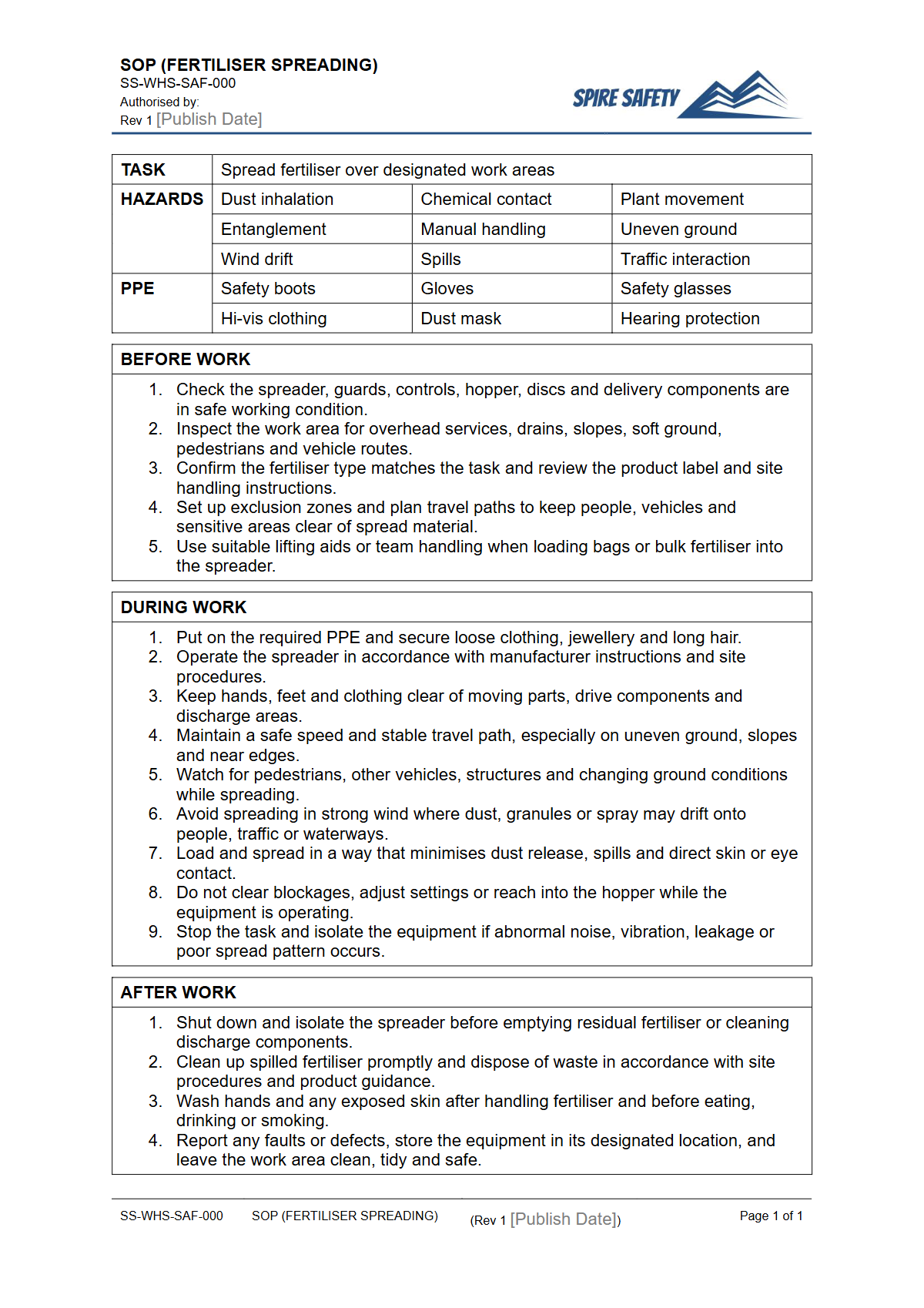
Operating fertiliser spreading equipment involves significant risks, including chemical exposure, machinery entanglement, and manual handling injuries. This Free Safe Operating Procedure (Fertiliser Spreading) Template provides a structured framework for documenting the required steps to perform this task safely.
It is designed to help persons conducting a business or undertaking (PCBUs) identify potential hazards, assess risks, and implement effective control measures. A well-drafted SOP is a critical tool for ensuring workers understand the established safety protocols, from pre-start checks to shutdown procedures, minimising the likelihood of incidents and injuries on site.
The primary goal is to create a clear, actionable guide that standardises the work method for all operators. This not only enhances safety but also improves operational consistency and efficiency.
By formally documenting the process, you create a vital resource for training, competency assessments, and incident investigations. Using this template helps build a proactive safety culture where known risks are systematically managed. This process is similar for other agricultural machinery, as outlined in our free Grain Drill SOP template.
Video walkthrough
How to use the Free Safe Operating Procedure (Fertiliser Spreading) Template
This document is a starting point. To make it effective, you must customise it to your specific workplace.
Download the DOCX file and adapt the content to reflect the exact make and model of your spreader, the types of fertilisers used, your site conditions, and your organisation's existing safety policies. Consultation is key; involve the operators who use the equipment daily.
Their practical experience is invaluable for identifying real-world hazards and developing workable controls. A collaborative approach ensures the final SOP is both practical and robust, leading to greater acceptance and adherence.
Please note: this document is a template and must be customised to reflect the specific equipment, chemicals, and work environment at your site. We recommend a consultation process with your team to ensure it is practical and effective.
Integrating these documents into broader WHS management systems ensures they are part of a continuous improvement cycle, subject to regular review and updates.
When to use it
A Safe Operating Procedure for fertiliser spreading should be a core part of your operational workflow. It must be used during the induction and training of new operators to ensure they are competent before using the equipment unsupervised.
It should also be readily available in the work area as a reference guide for all workers performing the task. Furthermore, the SOP serves as a checklist during pre-start inspections and should be reviewed as part of any pre-task risk assessment, especially if conditions change (e.g., adverse weather, different terrain, or a new type of fertiliser).
Regular toolbox talks are a great opportunity to refresh workers' knowledge of the SOP's key points.
Who should use it
This SOP is intended for a range of personnel within an agricultural or horticultural business. Equipment operators are the primary users, as it directs their actions to ensure safe operation.
Supervisors and farm managers must use the SOP to oversee work, enforce safety standards, and deliver training. WHS advisors or officers will use it as a component of the overall safety management system, assisting in risk assessments and compliance activities.
Even workers involved in adjacent tasks, such as loading materials with other machinery, should be aware of the procedure; our FREE Telehandler SOP Template can be adapted for those tasks.
Review and Auditing
Safe Operating Procedures are not static documents. They must be reviewed regularly (at least annually), or whenever there is a change in equipment, substances, or work practices.
They should also be reviewed immediately following any incident or near-miss to identify and rectify any shortcomings in the procedure. A formal review process helps ensure the SOP remains relevant and effective.
Undertaking periodic WHS compliance auditing can verify that SOPs are being correctly implemented and are achieving their intended safety outcomes.
Key Hazards in Fertiliser Spreading
Understanding the specific hazards is fundamental to writing an effective SOP. Key risks include:
- Chemical Exposure: Inhalation of dust, skin contact, or eye contact with corrosive or toxic fertilisers. The Safety Data Sheet (SDS) for each product is a critical source of information for PPE and first aid requirements.
- Machinery Hazards: Entanglement in moving parts such as power take-off (PTO) shafts, augers, and spinners. Other risks include being crushed or struck by the equipment.
- Manual Tasks: Lifting heavy bags of fertiliser can lead to musculoskeletal injuries. The SOP should specify mechanical aids or team lifting procedures where appropriate.
- Environmental Factors: Operating on uneven or sloping ground increases the risk of the tractor and spreader rolling over. Wind can cause uneven application and increase operator exposure to chemical drift.
Each of these hazards requires specific controls that must be detailed in your customised SOP. Much like procedures for planting equipment, a thorough risk assessment is non-negotiable. You can see a similar approach in our FREE Planter SOP Template.
Developing comprehensive safety documentation can be complex. If you need assistance tailoring this template or developing other elements of your safety system, our WHS consulting team can provide expert guidance.
You can also explore our complete free WHS resources library for more templates and guides to support your safety efforts.
Common mistakes
Common mistakes to avoid
- Failing to customise the template for the specific equipment and chemicals used.
- Not involving experienced operators in the drafting and review process.
- Neglecting to provide practical training on the finalised SOP to all relevant workers.
- Forgetting to review and update the SOP after an incident, near-miss, or change in process.
Legal references
Legal considerations
The following legal requirements may be relevant to this type of work.
- Work Health and Safety Act (Harmonised) — Provides the primary duties for protecting workers and other people from work health and safety risks.
- Work Health and Safety Regulations (Harmonised) — Sets out requirements supporting the management of workplace hazards and risks.
The following codes may be relevant to this type of work.
- Managing WHS Risks Code of Practice — Provides practical guidance on identifying hazards, assessing risks and applying effective controls.
- Work Health and Safety Consultation, Cooperation and Coordination Code of Practice — Provides practical guidance on consulting workers and coordinating with other duty holders.
- Managing the Work Environment and Facilities Code of Practice — Provides practical guidance on safe work environments, workplace facilities and related controls.
Did you know
Dust Explosion Risk
Certain types of fertiliser dust, like ammonium nitrate, can be explosive under specific conditions. Proper ventilation and control of ignition sources are critical safety measures during storage and handling.
Agricultural Injury Rates
According to Safe Work Australia, the agriculture, forestry, and fishing industry consistently has one of the highest rates of work-related fatalities and serious injuries, highlighting the need for robust safety procedures.
FAQ
Frequently asked questions
01What should be included in a fertiliser spreading SOP?
02How often should a Safe Operating Procedure be reviewed?
03Are SOPs a legal requirement in Australia?
04Can a generic SOP be used for all types of fertiliser spreaders?
Share this resource
Free Safe Operating Procedure (Fertiliser Spreading) Template
Browse Categories
How To Use It
- 1Download and open in Word or PDF.
- 2Replace the placeholders with your business details.
- 3Get it reviewed by a WHS specialist before rollout.
Need it customised?
Our WHS consultants can adapt this template to your site, run a gap analysis, or audit what you already have in place.
Book a Free Consultation WHS consulting servicesor call 1300 156 382
Related templates
- Free Safe Operating Procedure (Fiber Opener) Template
- Free Safe Operating Procedure (Field Bin Handling) Template
- Free Safe Operating Procedure (Field Boundary Marking) Template
- Free Safe Operating Procedure (Field Drain Clearing) Template
- Free Safe Operating Procedure (Field Gate Maintenance) Template
- Free Safe Operating Procedure (Filling Machine) Template