
Free Safe Operating Procedure (Fiber Opener) Template
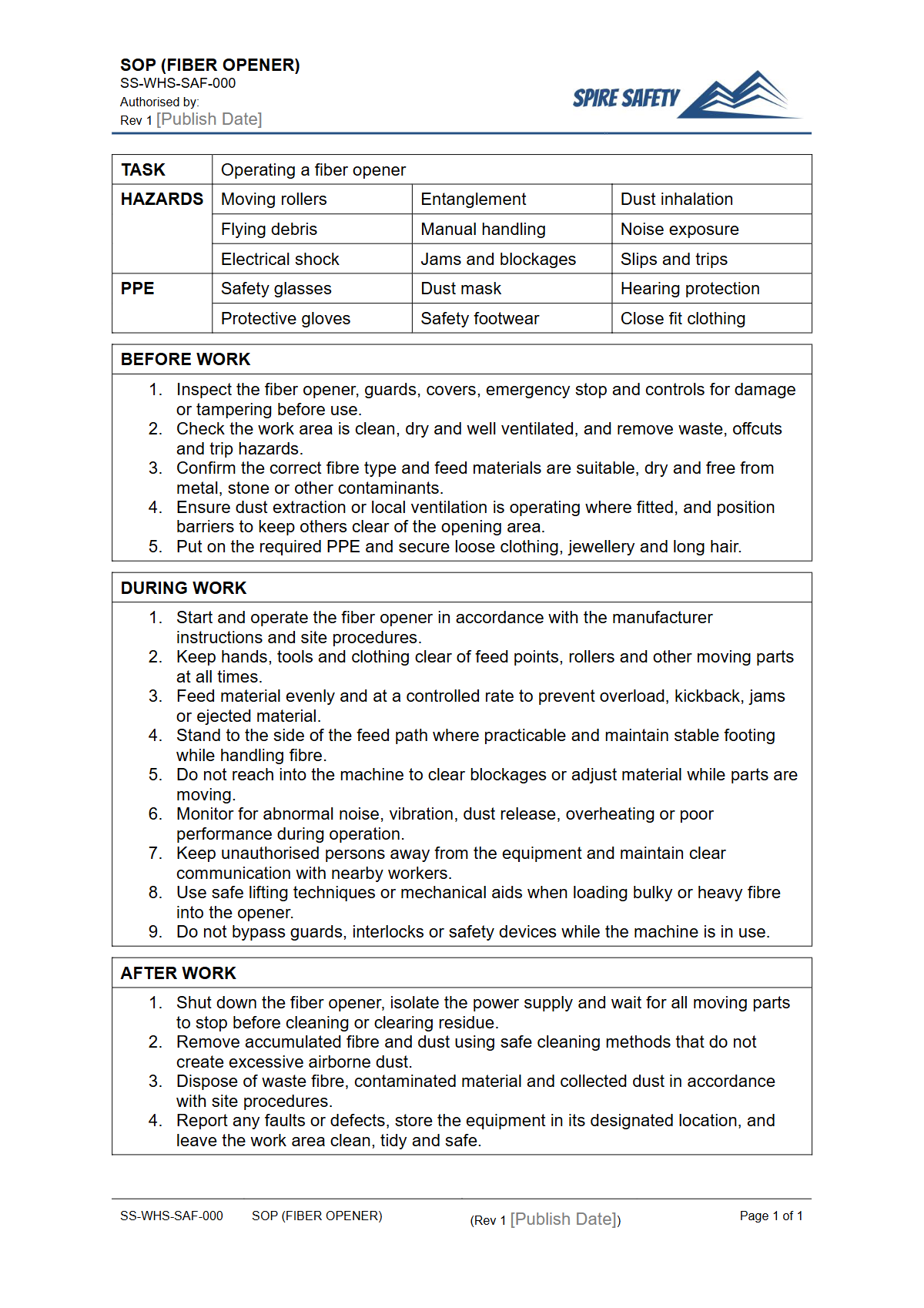
Effectively manage hazards associated with fiber opening machinery with our structured template. Download this free Safe Operating Procedure to get started.
Free Safe Operating Procedure (Fiber Opener) Template
DOCX • 126 KB + PDF
Updated Oct 2026
No signup required
Purpose of the Free Safe Operating Procedure (Fiber Opener) Template
Operating a fiber opener involves significant risks, including entanglement, dust exposure, and noise. A Safe Operating Procedure (SOP) is a critical administrative control that outlines a step-by-step method for performing a task safely.
This free Safe Operating Procedure (Fiber Opener) Template provides a solid foundation for documenting the process required to operate this type of machinery safely, helping your organisation meet its WHS obligations. By clearly defining pre-operational checks, operational steps, and shutdown procedures, this document helps standardise safe work practices and reduce the likelihood of incidents.
A well-drafted SOP is more than a procedural document; it is a key component of a risk management strategy. It serves as a vital training tool for new operators and a reference for experienced staff, reinforcing safe behaviour.
Implementing documented procedures for high-risk plant is a fundamental part of a proactive safety culture. It demonstrates a commitment to worker safety and provides a clear framework for supervision and accountability. For machinery that is often part of a larger production line, it's also wise to document procedures for connected equipment, such as with our FREE Conveyer System SOP.
Video walkthrough
How to use the Free Safe Operating Procedure (Fiber Opener) Template
This template is designed as a starting point, structured in line with Australian WHS best practices. To make it effective, you must customise it to reflect the specific make and model of the fiber opener in your workplace, as well as the unique environment and materials being processed.
Download the DOCX file and consult with machine operators, supervisors, and maintenance personnel to fill in the specific details.
Important: This is a template only. We are not WHS consultants for your business, and this document must be customised to your specific workplace, equipment, and processes.
It should be reviewed and approved by a competent person before implementation. Integrating this SOP into your broader WHS management systems ensures it doesn't exist in isolation, but is part of a holistic approach to safety.
When to use a Safe Operating Procedure
An SOP for a fiber opener should be developed and implemented before any worker is permitted to operate the machinery. It is an essential document for any workplace in the textile, recycling, or manufacturing industries that uses this type of plant.
It should be used during operator induction and training, for refresher training sessions, and as a reference before starting a non-routine task involving the machine. The SOP should also be reviewed and updated whenever there is a change to the machinery, the process, the materials used, or following any incident or near miss.
Regular reviews ensure the procedure remains relevant and effective.
Furthermore, an SOP is a key document to have on hand during safety inspections or audits. It provides clear evidence of the control measures your organisation has implemented to manage the risks associated with the plant.
Regular assessments through services like WHS compliance auditing can help verify that documented procedures are being followed correctly on the floor.
Who should use it
This Safe Operating Procedure template is intended for use by Persons Conducting a Business or Undertaking (PCBUs), WHS managers, supervisors, and team leaders. These individuals are responsible for ensuring that safe systems of work are developed, implemented, and maintained.
They will use the template to create a workplace-specific document. Once finalised, the SOP must be used by:
- Machine Operators: To understand and follow the safe steps for operating the fiber opener.
- Supervisors: To train workers, monitor compliance, and enforce safe work practices.
- Maintenance Personnel: To understand the correct shutdown, isolation, and lockout/tagout procedures before performing maintenance or repairs.
- WHS Representatives: To participate in the development and review of the procedure as part of the consultation process.
Creating SOPs for all key plant is a foundational WHS task. Similar to this document, our Free Air Compressor SOP provides a template for another common piece of industrial equipment.
You can find many more templates in our free WHS resources library to build out your documentation.
Key Elements of a Fiber Opener SOP
A comprehensive SOP for a fiber opener should detail several key areas to be effective. These include a clear list of potential hazards like entanglement points, sharp edges, electrical risks, and hazardous dust.
It must also specify the required Personal Protective Equipment (PPE), such as safety glasses, hearing protection, respiratory protection, and appropriate gloves. The core of the document is the step-by-step procedure, covering pre-start checks, startup, operation, shutdown, and cleaning.
Critically, it must include detailed emergency and lockout/tagout procedures to ensure the machine is de-energised and cannot be started during maintenance or when clearing a blockage. Many agricultural machines share similar high-risk features, and our Free Thresher SOP is another example of a procedure for managing entanglement hazards.
Effective implementation goes beyond just writing the document. It requires robust training programs to ensure every operator understands not just what to do, but why each step is important for their safety.
This practical training and verification of competency are just as crucial as the written procedure itself. For complex safety challenges, engaging external expertise through WHS consulting can provide valuable insights and help ensure your safety systems are robust and effective.
Common mistakes
Common mistakes to avoid
- Using a generic template without customising it for the specific machine model and workplace.
- Failing to include detailed, machine-specific lockout/tagout procedures for cleaning and maintenance.
- Not providing practical, hands-on training to operators based on the finalised SOP.
- Forgetting to review and update the SOP after a near miss, incident, or change in process.
Legal references
Legal considerations
The following legal requirements may be relevant to this type of work.
- Work Health and Safety Act (Harmonised) — Provides the primary duties for protecting workers and other people from work health and safety risks.
- Work Health and Safety Regulations (Harmonised) — Sets out requirements supporting the management of workplace hazards and risks.
The following codes may be relevant to this type of work.
- Managing WHS Risks Code of Practice — Provides practical guidance on identifying hazards, assessing risks and applying effective controls.
- Work Health and Safety Consultation, Cooperation and Coordination Code of Practice — Provides practical guidance on consulting workers and coordinating with other duty holders.
- Managing the Work Environment and Facilities Code of Practice — Provides practical guidance on safe work environments, workplace facilities and related controls.
Did you know
A Hidden Hazard
Byssinosis, or "brown lung disease," is a serious occupational illness caused by inhaling cotton, flax, or hemp dust, common in textile processing environments using machinery like fiber openers.
Energy Control is Critical
Failure to control hazardous energy (lockout/tagout) consistently ranks among the top causes of serious and fatal injuries in manufacturing and maintenance activities.
FAQ
Frequently asked questions
01What are the main hazards of a fiber opener machine?
02Is a Safe Operating Procedure a legal requirement in Australia for a fiber opener?
03How often should a Fiber Opener SOP be reviewed?
04What should be included in training for operating a fiber opener?
Share this resource
Free Safe Operating Procedure (Fiber Opener) Template
Browse Categories
How To Use It
- 1Download and open in Word or PDF.
- 2Replace the placeholders with your business details.
- 3Get it reviewed by a WHS specialist before rollout.
Need it customised?
Our WHS consultants can adapt this template to your site, run a gap analysis, or audit what you already have in place.
Book a Free Consultation WHS consulting servicesor call 1300 156 382
Related templates
- Free Safe Operating Procedure (Field Bin Handling) Template
- Free Safe Operating Procedure (Field Boundary Marking) Template
- Free Safe Operating Procedure (Field Drain Clearing) Template
- Free Safe Operating Procedure (Field Gate Maintenance) Template
- Free Safe Operating Procedure (Filling Machine) Template
- Free Safe Operating Procedure (Filter Replacement) Template