
Free Safe Operating Procedure (Filter Replacement) Template
Streamline safety with our free Safe Operating Procedure for filter replacement. Download the customisable DOCX and PDF to formalise your maintenance tasks.
Free Safe Operating Procedure (Filter Replacement) Template
DOCX • 126 KB + PDF
Updated Oct 2026
No signup required
Purpose of the Free Safe Operating Procedure (Filter Replacement) Template
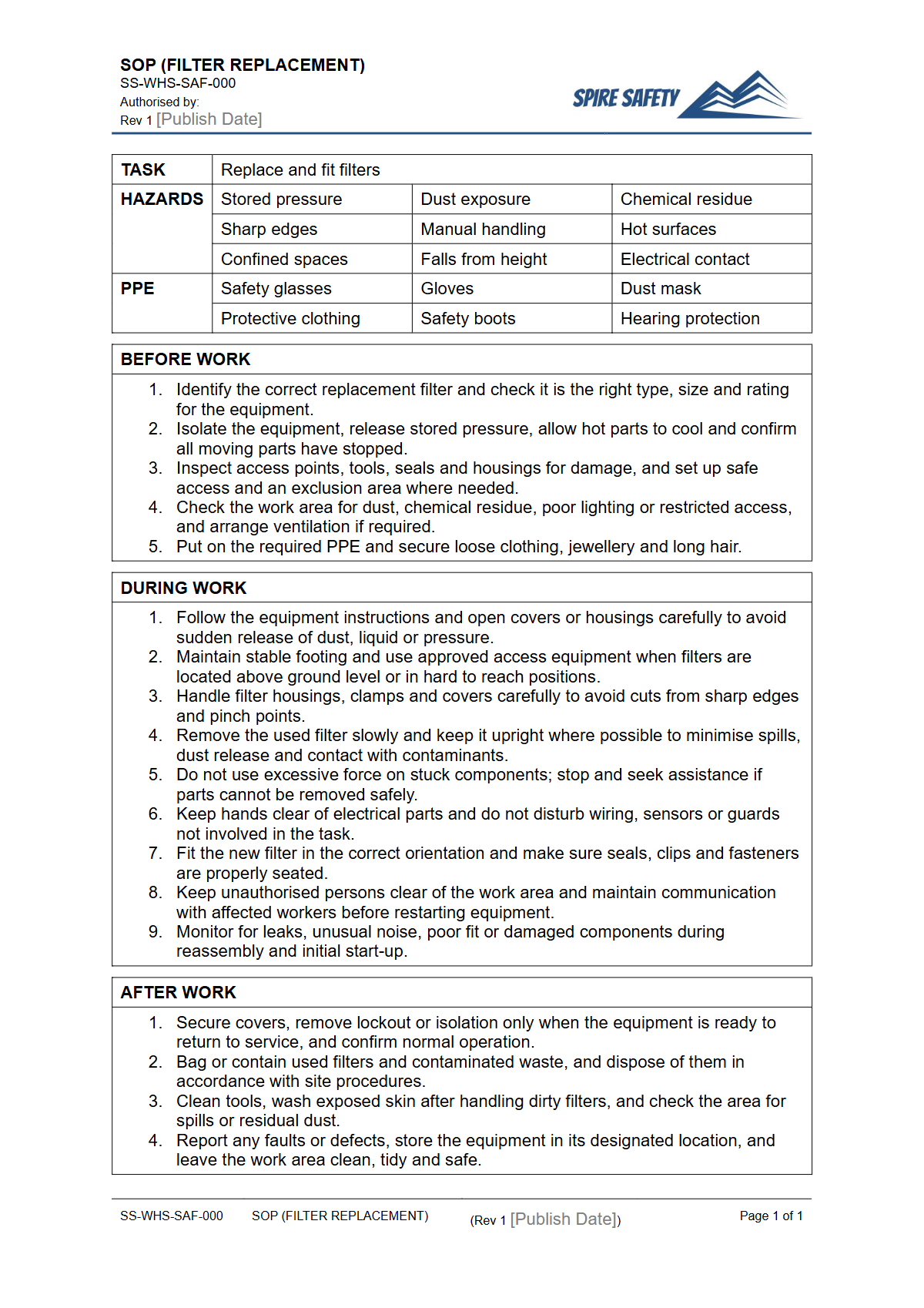
This Free Safe Operating Procedure (Filter Replacement) Template provides a structured framework for documenting the steps to safely perform filter replacement tasks on various types of plant and equipment. Replacing filters, whether for air, fluid, or dust extraction systems, can expose workers to risks such as hazardous substances, stored energy, awkward postures, and unexpected equipment activation.
Using a formal SOP helps standardise the procedure across your organisation, ensuring every step is considered and controlled.
A documented Safe Operating Procedure is a vital tool for worker training, competency assessments, and demonstrating due diligence in managing workplace risks. It translates your risk assessment findings into practical, repeatable instructions.
For example, maintaining equipment often involves multiple documented steps, similar to how our Free Air Compressor SOP details its specific maintenance procedures.
Video walkthrough
How to use the Free Safe Operating Procedure (Filter Replacement) Template
This document is a template and must be customised to suit the specific requirements of your workplace. Before use, you must consult with your workers and other relevant parties to ensure it reflects the unique hazards of your equipment and environment.
The effectiveness of this Safe Operating Procedure (SOP) relies on its accurate customisation to your site.
To adapt the template:
- Identify the specific plant or equipment requiring the filter change.
- Detail the type of filter and the potential contaminants it contains (e.g., chemical residues, fine dust, biological matter).
- Outline the specific isolation and lockout/tagout (LOTO) procedure required to de-energise the equipment safely.
- List the mandatory Personal Protective Equipment (PPE) needed, such as gloves, safety glasses, or respiratory protection.
- Incorporate steps for spill control and the correct disposal of used filters and contaminated materials.
- Add site-specific emergency procedures.
Implementing robust documentation like this SOP is a core component of effective WHS management systems, creating a foundation for consistent safety performance.
When to use it
A Safe Operating Procedure for filter replacement should be developed and implemented before any worker undertakes the task. It serves as a primary training document for new employees or for workers assigned to new maintenance responsibilities.
The completed SOP should be readily accessible near the equipment or in a central location for easy reference during pre-start checks and task execution. It should also be a key document referenced during incident investigations or when reviewing and improving work processes.
Even in non-industrial settings, routine maintenance requires documented steps. For instance, tasks in a commercial kitchen often involve changing filters, similar to the process-driven approach detailed in our free Safe Operating Procedure for deep fryer operation.
Who should use it
This template is designed for use by Persons Conducting a Business or Undertaking (PCBUs), managers, supervisors, and WHS professionals responsible for developing safe systems of work. They will lead the customisation process in consultation with workers.
Once finalised and approved, the completed SOP is used by all personnel authorised to perform filter replacement tasks. It ensures that everyone, regardless of experience level, follows the same verified, safe methodology.
Supervisors should use the SOP to conduct observations and verify that the documented procedure is being followed correctly.
Regularly reviewing and updating your SOPs is a key activity that helps maintain safety standards and is often verified during a WHS compliance auditing process. You can find this and many other templates to support your safety system in our extensive free WHS resources library. This systematic approach is also applicable to other complex machinery, where a document like our FREE Conveyer System SOP is adapted to match unique site configurations.
Common mistakes
Common mistakes to avoid
- Failing to de-pressurise systems (e.g., hydraulic or pneumatic lines) before starting work.
- Using a generic SOP without customising it for the specific machine, filter type, and contaminants.
- Not using the correct type of PPE for the specific hazard, such as using the wrong gloves for a chemical.
- Skipping or incorrectly performing lockout/tagout (LOTO) procedures before commencing maintenance.
Legal references
Legal considerations
The following legal requirements may be relevant to this type of work.
- Work Health and Safety Act (Harmonised) — Provides the primary duties for protecting workers and other people from work health and safety risks.
- Work Health and Safety Regulations (Harmonised) — Sets out requirements supporting the management of workplace hazards and risks.
The following codes may be relevant to this type of work.
- Managing WHS Risks Code of Practice — Provides practical guidance on identifying hazards, assessing risks and applying effective controls.
- Work Health and Safety Consultation, Cooperation and Coordination Code of Practice — Provides practical guidance on consulting workers and coordinating with other duty holders.
- Managing the Work Environment and Facilities Code of Practice — Provides practical guidance on safe work environments, workplace facilities and related controls.
Did you know
Hazardous Waste
Depending on the substances they have collected, used industrial filters for oil, chemicals, or certain dusts may be classified as controlled or hazardous waste, requiring specialised disposal procedures.
Lockout/Tagout (LOTO)
A significant percentage of serious maintenance-related injuries occur because equipment was not properly isolated from its energy sources before work began. LOTO is a critical, non-negotiable safety step.
FAQ
Frequently asked questions
01What are the common hazards associated with filter replacement?
02Is this filter replacement SOP ready to use after downloading?
03How often should a Safe Operating Procedure be reviewed?
04Who needs to be trained on this Safe Operating Procedure?
Share this resource
Free Safe Operating Procedure (Filter Replacement) Template
Browse Categories
How To Use It
- 1Download and open in Word or PDF.
- 2Replace the placeholders with your business details.
- 3Get it reviewed by a WHS specialist before rollout.
Need it customised?
Our WHS consultants can adapt this template to your site, run a gap analysis, or audit what you already have in place.
Book a Free Consultation WHS consulting servicesor call 1300 156 382
Related templates
- Free Safe Operating Procedure (Fire Alarm Panel) Template
- Free Safe Operating Procedure (Fire Blanket Use) Template
- Free Safe Operating Procedure (Fire Damper Test) Template
- Free Safe Operating Procedure (Fire Door Adjustment) Template
- Free Safe Operating Procedure (Fire Extinguisher Use) Template
- Free Safe Operating Procedure (Fire Hose Reel) Template