
Free Safe Operating Procedure (Fire Hose Reel) Template
Download our free Safe Operating Procedure (Fire Hose Reel) template to outline clear, step-by-step instructions for emergency use. Get your DOCX and PDF now.
Free Safe Operating Procedure (Fire Hose Reel) Template
DOCX • 126 KB + PDF
Updated Oct 2026
No signup required
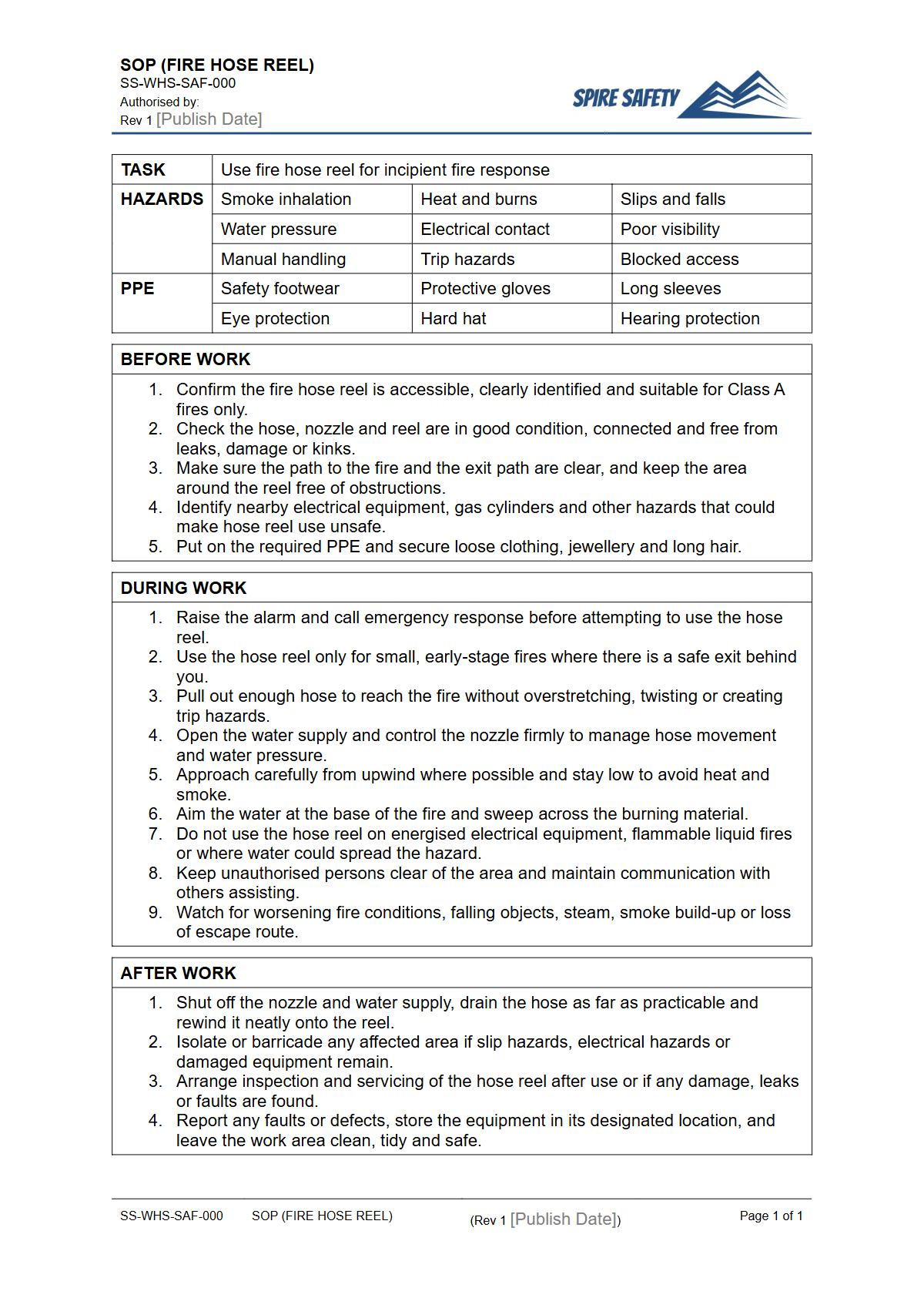
Purpose of the Free Safe Operating Procedure (Fire Hose Reel) Template
In an emergency, clear and immediate action is critical. This Free Safe Operating Procedure (Fire Hose Reel) Template provides a structured framework for documenting the correct, step-by-step use of fire hose reels in your workplace.
Having a formalised SOP ensures that all personnel, from fire wardens to general staff, understand how to respond effectively and safely to a Class A fire, minimising panic and potential for injury or property damage. It serves as a vital training tool and a key component of your emergency preparedness plan.
A well-defined SOP for emergency equipment is a fundamental part of robust WHS management systems. It demonstrates a commitment to proactive risk management by standardising emergency responses, clarifying responsibilities, and establishing a clear benchmark for training and competency. This template helps your organisation formalise these crucial procedures, ensuring a consistent and rehearsed approach to fire safety.
Video walkthrough
How to use the Free Safe Operating Procedure (Fire Hose Reel) Template
This document is a starting point designed for customisation. After downloading the DOCX file, you must adapt it to reflect the specific realities of your workplace.
This is not a generic, one-size-fits-all solution. We have provided a comprehensive structure, but it is your responsibility to populate it with site-specific information.
Key customisation steps include:
- Location Details: Clearly identify the locations of all fire hose reels on your site maps and within the document.
- Emergency Contacts: Add internal and external emergency contact numbers, including fire wardens, first aid officers, and emergency services.
- Site-Specific Hazards: Note any particular hazards near the hose reels that could affect their use or the safety of the operator.
- Post-Use Procedure: Detail your organisation's specific process for reporting use, draining the hose, and arranging for its servicing and refitting.
Once customised, the SOP should be used as a primary document for training all relevant employees. It is also an excellent reference tool to include in inductions for new staff.
Just as you would have a Safe Operating Procedure for a Deep Fryer to manage a specific fire risk, this SOP formalises procedures for a key piece of firefighting equipment.
When to use a Fire Hose Reel SOP
A Safe Operating Procedure for a fire hose reel is not a document to be filed away. It is an active tool used in several key scenarios.
Its primary use is during emergency response training and fire drills, allowing employees to practise the steps in a controlled environment. This regular practice builds muscle memory and confidence, ensuring a more composed and effective reaction during a real incident.
In the unfortunate event of a real Class A fire (involving materials like wood, paper, or textiles), the SOP serves as the definitive guide for trained personnel to follow. It's also a reference for post-incident reviews and investigations.
Furthermore, the maintenance and inspection schedules outlined in the SOP are critical for ongoing safety, with activities like six-monthly checks forming part of your safety assurance processes. These documented procedures can be reviewed during regular WHS compliance auditing to verify that equipment is being maintained as required.
Who should use this Safe Operating Procedure
This SOP is intended for several groups within an organisation. Designated fire wardens and members of an emergency response team are the primary users, as they are formally responsible for leading the response during a fire.
However, any worker who may be required or permitted to operate a fire hose reel should be thoroughly trained using this procedure.
Work Health and Safety (WHS) managers, supervisors, and training coordinators will also use this document to develop training programs, conduct competency assessments, and induct new employees. It provides the official, approved method for operating the equipment, forming the basis of all related safety instruction.
Similar to how a Telehandler SOP ensures correct operation of mobile plant, this document ensures correct operation of critical safety equipment.
Ultimately, this template and others like our Free Air Compressor SOP are designed to empower your team with clear, actionable safety guidance. By implementing robust procedures for all key tasks and equipment, you build a stronger safety culture.
You can browse our complete free WHS resources library for more templates to support your safety management system.
Common mistakes
Common mistakes to avoid
- Using the hose reel on the wrong class of fire, such as an electrical or grease fire.
- Failing to check for kinks or obstructions in the hose before attempting to use it.
- Not opening the main stop valve fully, resulting in inadequate water pressure.
- Neglecting the required six-monthly inspections and maintenance outlined in AS 1851.
Legal references
Legal considerations
The following legal requirements may be relevant to this type of work.
- Work Health and Safety Act (Harmonised) — Provides the primary duties for protecting workers and other people from work health and safety risks.
- Work Health and Safety Regulations (Harmonised) — Sets out requirements supporting the management of workplace hazards and risks.
The following codes may be relevant to this type of work.
- Managing WHS Risks Code of Practice — Provides practical guidance on identifying hazards, assessing risks and applying effective controls.
- Work Health and Safety Consultation, Cooperation and Coordination Code of Practice — Provides practical guidance on consulting workers and coordinating with other duty holders.
- Managing the Work Environment and Facilities Code of Practice — Provides practical guidance on safe work environments, workplace facilities and related controls.
Did you know
Class A Fires Only
Fire hose reels use water, making them effective only for Class A fires involving solid combustible materials like wood, paper, and textiles. Using them on an electrical or flammable liquid fire can be extremely dangerous.
Standard Length
Most fire hose reels installed in Australian workplaces have a standard hose length of 36 metres. This is designed to ensure adequate coverage within a specific radius of their mounting point, as determined by building codes and Australian Standards.
FAQ
Frequently asked questions
01What should be included in a fire hose reel SOP?
02Are fire hose reels suitable for all types of fires?
03How often do fire hose reels need to be inspected in Australia?
04Does using this SOP template supports your compliance efforts?
Share this resource
Free Safe Operating Procedure (Fire Hose Reel) Template
Browse Categories
How To Use It
- 1Download and open in Word or PDF.
- 2Replace the placeholders with your business details.
- 3Get it reviewed by a WHS specialist before rollout.
Need it customised?
Our WHS consultants can adapt this template to your site, run a gap analysis, or audit what you already have in place.
Book a Free Consultation WHS consulting servicesor call 1300 156 382
Related templates
- Free Safe Operating Procedure (Fire Hose Testing) Template
- Free Safe Operating Procedure (Fire Panel Isolation) Template
- Free Safe Operating Procedure (Fire Pump Test) Template
- Free Safe Operating Procedure (Fire Stair Cleaning) Template
- Free Safe Operating Procedure (Firewood Processor) Template
- Free Safe Operating Procedure (Fish Filleting) Template