
Free Safe Operating Procedure (Fire Stair Cleaning) Template
Document the safe method for cleaning fire stairs and ensuring they remain clear for emergency use. Download our Free Safe Operating Procedure Template today.
Free Safe Operating Procedure (Fire Stair Cleaning) Template
DOCX • 126 KB + PDF
Updated Oct 2026
No signup required
Purpose of the Free Safe Operating Procedure (Fire Stair Cleaning) Template
Maintaining fire stairs is about more than just hygiene; it's a critical safety function. A clean, dry, and unobstructed stairwell is essential for safe emergency egress.
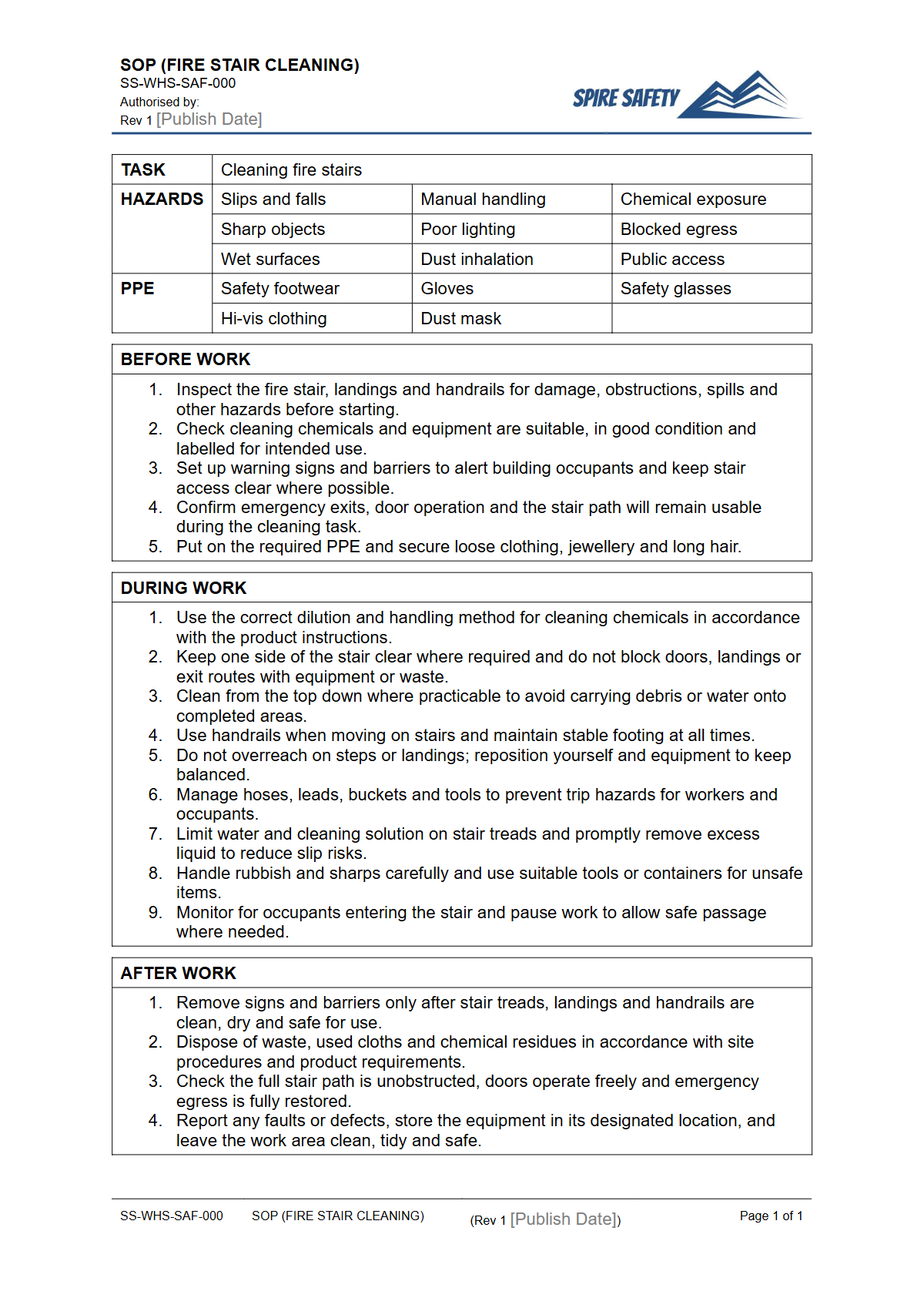
This Free Safe Operating Procedure (Fire Stair Cleaning) Template provides a structured starting point for your business to document the required steps, hazards, and controls for this vital task. Using an SOP helps standardise your approach, ensuring every worker follows the same safe process, every time.
A well-drafted SOP identifies potential hazards such as slips from wet surfaces, trips over equipment, manual handling injuries from carrying buckets or vacuums, and exposure to cleaning chemicals. By formalising control measures, you can systematically reduce risk.
This document serves as a practical tool within your broader WHS management system, demonstrating a commitment to proactive risk management and worker safety.
Video walkthrough
How to use the Free Safe Operating Procedure (Fire Stair Cleaning) Template
This template is available in both DOCX and PDF formats for your convenience. The DOCX file is fully editable, allowing you to tailor it to your specific operational needs.
Effective implementation requires more than just adding your company logo; you must conduct a site-specific risk assessment and incorporate the findings into the document.
Important: It is crucial to remember that this is a template, not a finished document. You must customise it with your site-specific details, including the types of cleaning chemicals used (and their corresponding Safety Data Sheets), specific equipment, the layout of your building's fire stairs, and emergency contact information.
We have included prompts and comments to guide you through this customisation process to create a robust, site-specific procedure.
What is included in the template?
Our template is aligned with Australian WHS principles and guides you to consider:
- Required Personal Protective Equipment (PPE) such as gloves and non-slip footwear.
- Pre-operational checks, including equipment inspection and securing the work area.
- A step-by-step cleaning process, from top to bottom.
- Hazard identification for manual tasks, chemical use, and slip/trip risks.
- Control measures to mitigate identified risks.
- Waste disposal and post-cleaning procedures.
- Emergency and incident response protocols.
When to use this Safe Operating Procedure
This SOP should be used as the primary reference document for all fire stair cleaning activities. It is not a document to be filed away; it should be made readily accessible to all relevant workers, including cleaners, maintenance staff, and their supervisors.
It is essential for inducting and training new employees and serves as an excellent tool for regular refresher training sessions to reinforce safe work habits. The procedure should also be reviewed and updated whenever there is a change in equipment, chemicals, processes, or following any related incident.
While cleaning is a routine task, other facility maintenance might involve machinery; for these, a specific procedure like our free air compressor SOP is essential. Having documented procedures for all significant tasks ensures consistency and safety across your operations.
Who should use this SOP
This Safe Operating Procedure is intended for use by multiple roles within an organisation. Person(s) Conducting a Business or Undertaking (PCBUs), facilities managers, and WHS managers can use it to establish and formalise safe work practices.
Cleaning supervisors will find it invaluable for training their teams and monitoring day-to-day work. Most importantly, the cleaning and maintenance workers who perform the task are the end-users.
They must be trained in the SOP's contents to understand the risks and the controls that keep them safe.
Ensuring all procedures are current and effectively implemented can be a complex task. Spire Safety provides comprehensive WHS compliance auditing services to help identify gaps and opportunities for improvement in your safety systems.
Properly documenting specialised tasks is a key part of this, similar to how a commercial building's kitchen needs a specific deep fryer standard operation procedure to manage unique hazards.
For organisations needing assistance tailoring this document or developing a suite of SOPs for various maintenance tasks, from minor repairs requiring specific tools to broader safety protocols, our WHS consulting team can provide expert guidance. You can also browse our complete free WHS resources library for more templates and guides to support your safety management efforts.
Common mistakes
Common mistakes to avoid
- Blocking or obstructing the fire exit path with equipment, barriers, or signage.
- Using incorrect or incompatible cleaning chemicals, leading to surface damage or toxic fumes.
- Failing to use appropriate 'wet floor' signage at all entrances to the stairwell.
- Leaving cleaning equipment, supplies, or waste bags in the stairwell after the job is complete.
Legal references
Legal considerations
The following legal requirements may be relevant to this type of work.
- Work Health and Safety Act (Harmonised) — Provides the primary duties for protecting workers and other people from work health and safety risks.
- Work Health and Safety Regulations (Harmonised) — Sets out requirements supporting the management of workplace hazards and risks.
The following codes may be relevant to this type of work.
- Managing WHS Risks Code of Practice — Provides practical guidance on identifying hazards, assessing risks and applying effective controls.
- Work Health and Safety Consultation, Cooperation and Coordination Code of Practice — Provides practical guidance on consulting workers and coordinating with other duty holders.
- Managing the Work Environment and Facilities Code of Practice — Provides practical guidance on safe work environments, workplace facilities and related controls.
Did you know
Slips, Trips, and Falls
According to Safe Work Australia, slips, trips, and falls are the second leading cause of serious workers' compensation claims, highlighting the importance of managing wet and slippery surfaces during cleaning.
Emergency Egress
The National Construction Code mandates that paths of travel to an exit, including fire stairs, must be kept clear of obstructions at all times. This includes temporary obstructions like cleaning carts or equipment.
FAQ
Frequently asked questions
01What are the biggest hazards when cleaning fire stairs?
02How often should fire stairs be cleaned?
03Do I need a Safety Data Sheet (SDS) for cleaning chemicals?
04Can I use a 'wet floor' sign instead of a full SOP?
Share this resource
Free Safe Operating Procedure (Fire Stair Cleaning) Template
Browse Categories
How To Use It
- 1Download and open in Word or PDF.
- 2Replace the placeholders with your business details.
- 3Get it reviewed by a WHS specialist before rollout.
Need it customised?
Our WHS consultants can adapt this template to your site, run a gap analysis, or audit what you already have in place.
Book a Free Consultation WHS consulting servicesor call 1300 156 382
Related templates
- Free Safe Operating Procedure (Firewood Processor) Template
- Free Safe Operating Procedure (Fish Filleting) Template
- Free Safe Operating Procedure (Fish Scaling) Template
- Free Safe Operating Procedure (Fitness Equipment Setup) Template
- Free Safe Operating Procedure (Fitness Mat Cleaning) Template
- Free Safe Operating Procedure (Fitness Room Cleaning) Template