
Free Safe Operating Procedure (Firewood Processor) Template
Effectively manage the risks of operating a firewood processor with our detailed template. Download this free Safe Operating Procedure to get started.
Free Safe Operating Procedure (Firewood Processor) Template
DOCX • 126 KB + PDF
Updated Oct 2026
No signup required
Purpose of the Free Safe Operating Procedure (Firewood Processor) Template
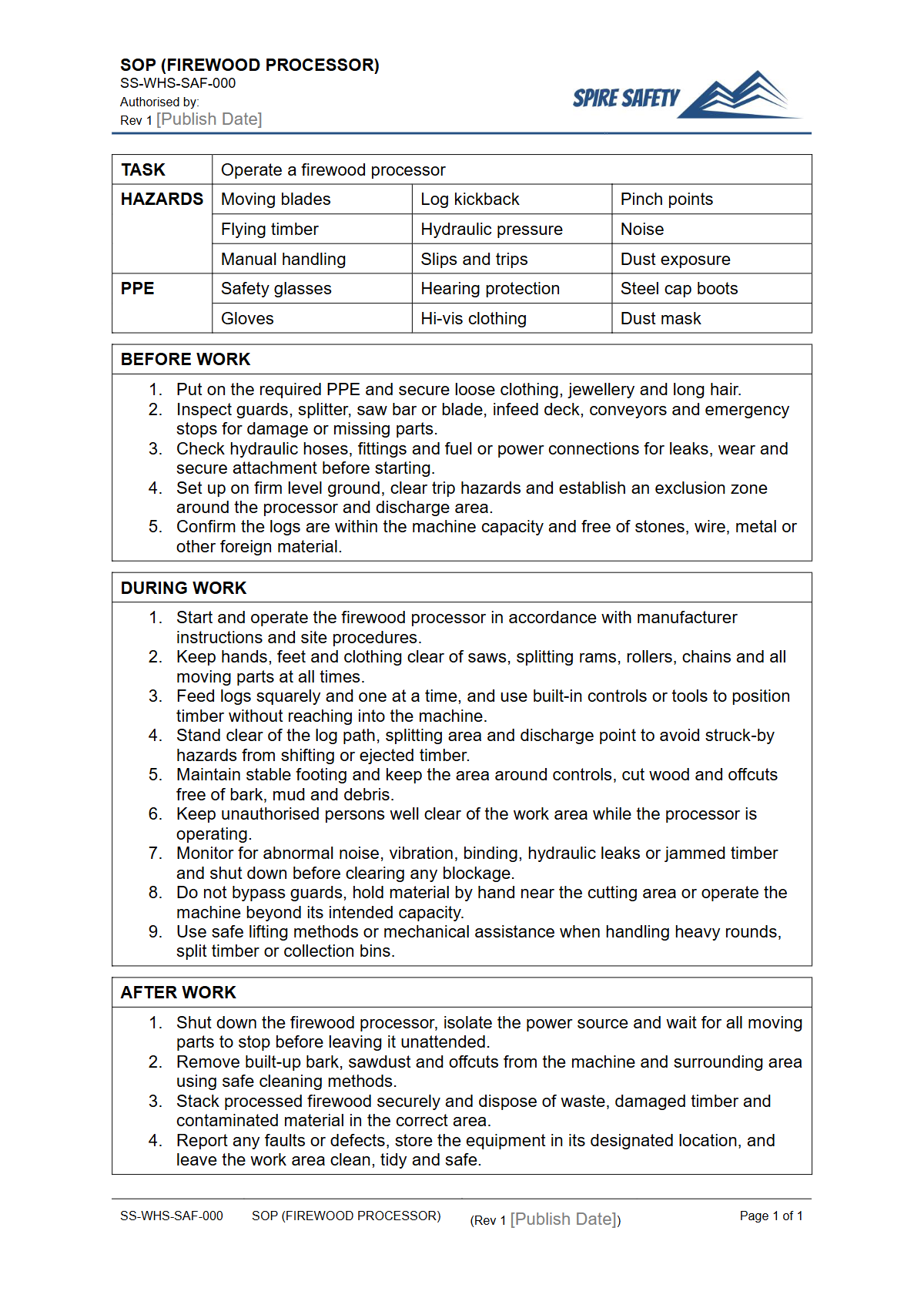
Operating a firewood processor involves significant risks, including entanglement in moving parts, being struck by logs, and cuts from the saw mechanism. This free Safe Operating Procedure (Firewood Processor) Template provides a structured framework for documenting the required steps to operate this machinery safely.
The primary purpose of this SOP is to provide a clear, consistent, and documented process that minimises risks to operators and others in the vicinity. By formalising procedures, you can standardise training, simplify supervision, and demonstrate a commitment to providing a safe system of work.
A well-defined SOP is a cornerstone of an effective safety program. It serves as a critical training tool for new operators and a reference for experienced workers, ensuring everyone follows the same safe practices.
This document helps translate your risk assessment findings into practical, actionable steps that operators can follow every day. Integrating this procedure is a vital step in developing more comprehensive WHS management systems within your organisation.
Video walkthrough
How to use the Free Safe Operating Procedure (Firewood Processor) Template
This resource is available for immediate download in both DOCX and PDF formats. The DOCX version is fully editable, allowing you to tailor the content directly to your workplace's specific equipment and environment.
The PDF is ideal for quick printing and distribution once you have finalised your procedure. To use the template, download the file and systematically work through each section, adding details specific to your firewood processor model, site conditions, and company policies.
Important: Customise to Your Workplace
This document is a template, not a finished product. We have provided a comprehensive starting point based on Australian WHS principles, but you must customise it to reflect your specific machinery, site conditions, and organisational procedures.
A generic SOP is insufficient; it must be tailored to the unique hazards present in your operational context. Regular reviews and updates are essential to ensure its ongoing relevance and effectiveness.
Once your SOP is implemented, its effectiveness can be verified through practical observation and feedback. Processes like WHS compliance auditing can help confirm that documented procedures are being followed correctly on the ground, closing the loop between policy and practice.
When to Use This Safe Operating Procedure
A Safe Operating Procedure for a firewood processor should be a living document used throughout the lifecycle of the equipment's use in your business. Its primary applications include:
- Operator Training and Induction: Use the SOP as a foundational document for training new workers, ensuring they understand all steps from pre-start checks to shutdown.
- Pre-Operational Checks: The SOP outlines the critical safety features and functions that must be checked before every use, such as guards, emergency stops, and hydraulic systems.
- Refresher Training: It serves as a valuable tool for conducting periodic refresher training to prevent complacency and reinforce safe work habits.
- Incident Investigation: Following a near miss or incident, the SOP can be reviewed to identify whether the procedure was followed and if any steps need to be revised.
The operational logic for a firewood processor often involves related equipment. For instance, many processors use an infeed or outfeed system, which requires its own set of controls detailed in our free Conveyer System SOP.
Who Should Use This Document
This Safe Operating Procedure is intended for use by several key roles within an organisation to ensure a multi-layered approach to safety.
- Persons Conducting a Business or Undertaking (PCBUs): To meet their primary duty of care by providing and maintaining safe systems of work.
- Managers and Supervisors: To train, supervise, and monitor operators, ensuring they adhere to the documented procedures.
- Operators: As a step-by-step guide for performing their tasks safely and consistently.
- WHS Professionals: As a template to adapt and integrate into the broader safety management system.
Firewood processing is often part of a larger operation involving various types of plant. You might also find our Telehandler SOP template useful for documenting the safe loading of logs onto the processor. For other cutting tasks on site, our free Circular Saw SOP provides specific guidance on portable cutting tools. You can find these and more in our extensive free WHS resources library.
Common mistakes
Common mistakes to avoid
- Failing to properly guard belts, chains, and saw blades.
- Bypassing safety interlocks or two-hand controls to increase speed.
- Operating the machine on uneven, unstable, or sloped ground.
- Neglecting pre-start checks of hydraulic hoses, guards, and safety features.
Legal references
Legal considerations
The following legal requirements may be relevant to this type of work.
- Work Health and Safety Act (Harmonised) — Provides the primary duties for protecting workers and other people from work health and safety risks.
- Work Health and Safety Regulations (Harmonised) — Sets out requirements supporting the management of workplace hazards and risks.
The following codes may be relevant to this type of work.
- Managing WHS Risks Code of Practice — Provides practical guidance on identifying hazards, assessing risks and applying effective controls.
- Work Health and Safety Consultation, Cooperation and Coordination Code of Practice — Provides practical guidance on consulting workers and coordinating with other duty holders.
- Managing the Work Environment and Facilities Code of Practice — Provides practical guidance on safe work environments, workplace facilities and related controls.
Did you know
Log Splitter Force
Commercial firewood processors can exert over 30 tonnes of splitting force. This immense power underscores the critical need for guarding and exclusion zones to prevent crushing injuries.
Kinetic Energy
A log kicked back or ejected from a processor can travel at high speed. A documented safe system of work, including correct operator positioning and PPE, is essential to mitigate this risk.
FAQ
Frequently asked questions
01What are the main hazards of a firewood processor?
02Is a Safe Operating Procedure a legal requirement for firewood processors in Australia?
03How often should an SOP for a firewood processor be reviewed?
04Can I use this template for different models of firewood processors?
Share this resource
Free Safe Operating Procedure (Firewood Processor) Template
Browse Categories
How To Use It
- 1Download and open in Word or PDF.
- 2Replace the placeholders with your business details.
- 3Get it reviewed by a WHS specialist before rollout.
Need it customised?
Our WHS consultants can adapt this template to your site, run a gap analysis, or audit what you already have in place.
Book a Free Consultation WHS consulting servicesor call 1300 156 382
Related templates
- Free Safe Operating Procedure (Fish Filleting) Template
- Free Safe Operating Procedure (Fish Scaling) Template
- Free Safe Operating Procedure (Fitness Equipment Setup) Template
- Free Safe Operating Procedure (Fitness Mat Cleaning) Template
- Free Safe Operating Procedure (Fitness Room Cleaning) Template
- Free Safe Operating Procedure (Flange Alignment Tool) Template