
Free Safe Operating Procedure (Flange Alignment Tool) Template
Download our free Safe Operating Procedure (Flange Alignment Tool) Template to document safe work practices. Get your customisable DOCX and PDF now.
Free Safe Operating Procedure (Flange Alignment Tool) Template
DOCX • 126 KB + PDF
Updated Oct 2026
No signup required
Purpose of the Free Safe Operating Procedure (Flange Alignment Tool) Template
Using a flange alignment tool is essential for connecting pipework accurately and safely in many industrial settings, including mining, oil and gas, and manufacturing. However, the task involves significant risks if not managed correctly.
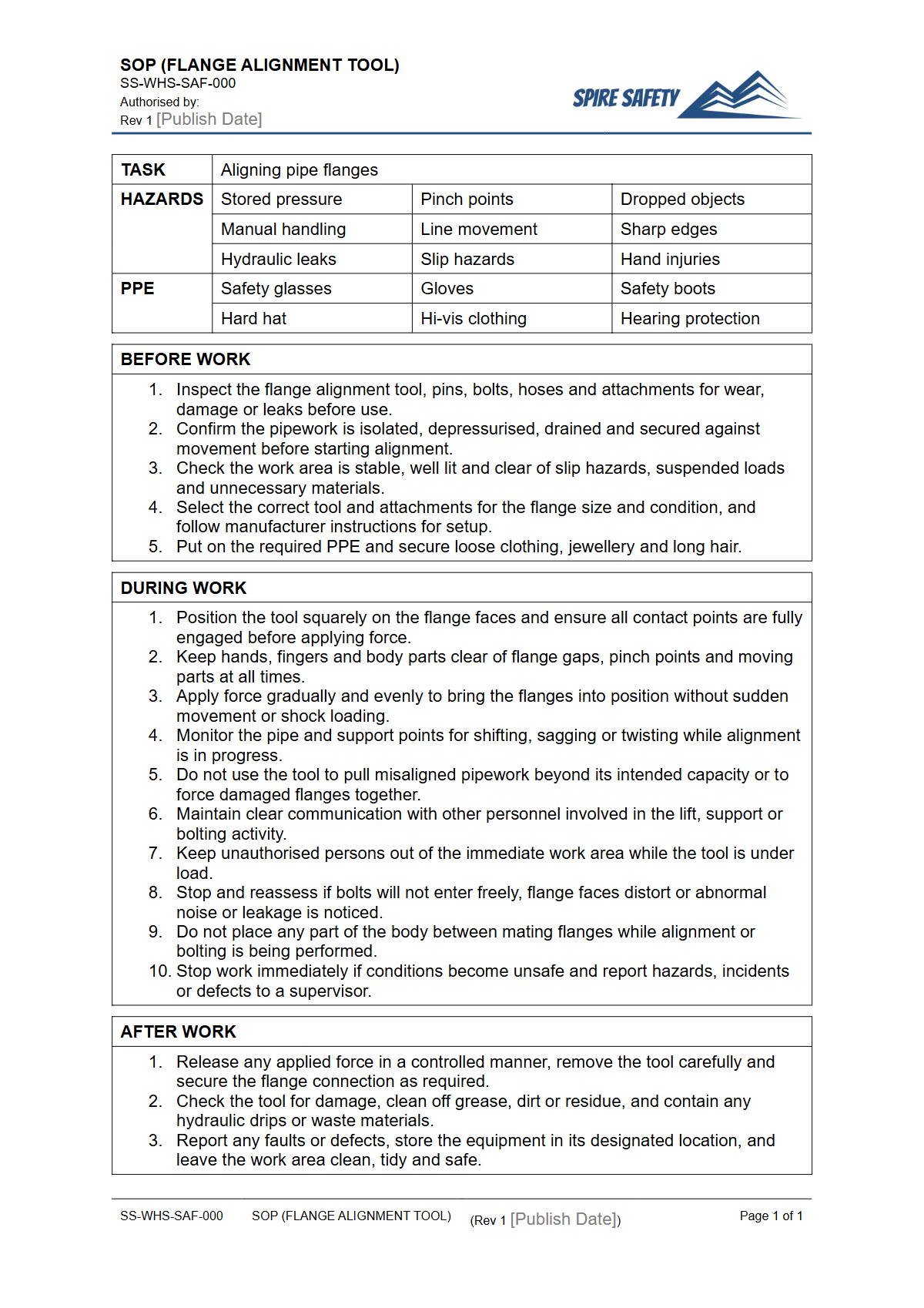
This free Safe Operating Procedure (Flange Alignment Tool) Template provides a structured framework for documenting the required steps to perform the task safely. It helps organisations meet their duty of care by identifying hazards and outlining control measures, forming a key part of your site's safety documentation.
A well-developed SOP helps control risks such as crush injuries from moving parts, high-pressure fluid injection from hydraulic tools, and musculoskeletal strain from manual handling. By formalising the procedure, you ensure a consistent and safe approach every time the task is performed.
This document should integrate seamlessly within your broader WHS management systems, reinforcing a proactive safety culture. It provides a clear reference for workers and a training tool for new personnel.
Video walkthrough
How to use the Free Safe Operating Procedure (Flange Alignment Tool) Template
This template is a comprehensive starting point, designed to be adapted to your specific operational needs. It is available in both DOCX and PDF formats for your convenience.
To use it effectively, download the document and methodically work through each section, replacing the placeholder text with information relevant to your worksite, the specific flange alignment tools in use, and your established safety protocols. Key sections include personal protective equipment (PPE) requirements, pre-operational checks, the step-by-step procedure for aligning flanges, and post-operational clean-up.
Important: It is crucial to understand that this is a template, not a finished document. You must customise it with your specific workplace details, including the make and model of equipment, site-specific hazards, and emergency procedures.
We recommend a competent person, such as a maintenance supervisor or WHS advisor, leads this customisation process in consultation with the workers who will be using the SOP. The goal is to create a practical document that reflects how work is actually and safely done on your site, much like when documenting procedures for other equipment, such as when using a FREE Telehandler SOP Template to position heavy components.
When to use it
A Safe Operating Procedure for a flange alignment tool should be used every time the task is undertaken. It is not just for complex or non-routine jobs.
Consistent application is key to building safe work habits. This SOP is particularly vital during:
- Routine and preventative maintenance on pipe systems.
- Installation of new pipelines and associated equipment.
- Shutdowns and turnarounds where extensive pipework is disassembled and reassembled.
- Training and competency verification for new or inexperienced technicians.
- Following any modification to the plant or procedure that could affect how flange alignment is performed.
The SOP should be readily available at the point of work, either as a printed, laminated copy or accessible on a digital device. It serves as a pre-task checklist and a guide during the operation, ensuring no critical safety steps are missed.
Who should use it
This SOP is intended for any person required to use flange alignment tools as part of their job. This typically includes:
- Mechanical Fitters
- Pipefitters
- Boilermakers
- Maintenance Technicians
- Supervisors overseeing this type of work
All personnel must be deemed competent to perform the task. Competency involves more than just reading the SOP; it requires appropriate training, practical experience, and a thorough understanding of the equipment and its associated hazards.
This document supports, but does not replace, hands-on training and supervision. Creating robust safety frameworks is a core responsibility for any business.
For guidance on developing these frameworks, our WHS consulting services can provide expert support.
Integrating the SOP into Your Safety System
An SOP is most effective when it is a living document within a dynamic safety system. Once you have customised this template, ensure it is properly implemented.
This involves communicating the procedure to all relevant workers, providing training, and ensuring supervisors enforce its use. The SOP should be included in your site's risk register and referenced in any relevant permits to work or Job Safety Analyses (JSAs).
Consistency across all your documented procedures, such as those for a FREE Circular Saw SOP (Safe Operating Procedure) Template, helps reinforce a holistic safety message.
Furthermore, the procedure's effectiveness should be reviewed periodically. This should happen annually, or sooner if there is an incident, a near miss, or a change in equipment or process.
Regular WHS compliance auditing ensures the procedures remain effective and are being followed correctly. You can find this and many other templates in our free WHS resources library to build out your safety documentation.
Common mistakes
Common mistakes to avoid
- Using a tool that is not rated for the size or pressure class of the flange.
- Failing to fully de-pressurise and isolate the pipeline before starting work.
- Neglecting to wear appropriate PPE, especially impact-resistant gloves and safety glasses.
- Not following the correct bolt-tightening sequence and pattern after alignment, leading to uneven gasket compression.
Legal references
Legal considerations
The following legal requirements may be relevant to this type of work.
- Work Health and Safety Act (Harmonised) — Provides the primary duties for protecting workers and other people from work health and safety risks.
- Work Health and Safety Regulations (Harmonised) — Sets out requirements supporting the management of workplace hazards and risks.
The following codes may be relevant to this type of work.
- Managing WHS Risks Code of Practice — Provides practical guidance on identifying hazards, assessing risks and applying effective controls.
- Work Health and Safety Consultation, Cooperation and Coordination Code of Practice — Provides practical guidance on consulting workers and coordinating with other duty holders.
- Managing the Work Environment and Facilities Code of Practice — Provides practical guidance on safe work environments, workplace facilities and related controls.
Did you know
The Cost of Misalignment
Even a minor flange misalignment of 1.5mm can impose dangerous stress on pipework and lead to premature gasket failure, resulting in costly and hazardous leaks.
Hydraulic Force
Hydraulic flange alignment tools can exert immense force, often exceeding 10 tonnes. A pinhole leak in a hydraulic hose at this pressure can inject fluid through skin and cause severe, life-changing injuries.
FAQ
Frequently asked questions
01What are the main hazards of using a flange alignment tool?
02Is an SOP a legal requirement for flange alignment tools in Australia?
03How often should an SOP for a flange alignment tool be reviewed?
04Can I use a generic SOP for all flange alignment tasks?
Share this resource
Free Safe Operating Procedure (Flange Alignment Tool) Template
Browse Categories
How To Use It
- 1Download and open in Word or PDF.
- 2Replace the placeholders with your business details.
- 3Get it reviewed by a WHS specialist before rollout.
Need it customised?
Our WHS consultants can adapt this template to your site, run a gap analysis, or audit what you already have in place.
Book a Free Consultation WHS consulting servicesor call 1300 156 382
Related templates
- Free Safe Operating Procedure (Flange Spreader) Template
- Free Safe Operating Procedure (Flanging Machine) Template
- Free Safe Operating Procedure (Flashback Arrestor Test) Template
- Free Safe Operating Procedure (Flat Top Grill) Template
- Free Safe Operating Procedure (Fleet Key Handover) Template
- Free Safe Operating Procedure (Floating Dock Access) Template