
Free Safe Operating Procedure (Flange Spreader) Template
Download our free Safe Operating Procedure (Flange Spreader) Template to formalise safety protocols for flange spreading tasks. Get your customisable DOCX now.
Free Safe Operating Procedure (Flange Spreader) Template
DOCX • 126 KB + PDF
Updated Oct 2026
No signup required
Purpose of the Free Safe Operating Procedure (Flange Spreader) Template
This free Safe Operating Procedure (Flange Spreader) Template provides a structured starting point for documenting the safety requirements for using mechanical or hydraulic flange spreaders. Using these tools involves significant risks, including high-pressure hydraulic fluid injection, stored energy release from pipework, pinch points, and ergonomic strains.
A documented SOP is a critical control measure that outlines the required steps for pre-operational checks, safe operation, and post-task clean-up, helping to ensure tasks are performed consistently and safely every time.
Formalising your processes with SOPs is a key component in demonstrating proactive risk management. By clearly defining safe work methods, you help fulfil your primary duty of care under Australian WHS legislation.
Integrating this procedure into your broader safety framework helps build robust, comprehensive WHS management systems that protect your workers and your organisation.
Video walkthrough
How to use the Free Safe Operating Procedure (Flange Spreader) Template
To effectively use this Safe Operating Procedure for flange spreaders, download the DOCX file and adapt it to your specific operational context. This involves consulting with workers and supervisors who use the equipment daily.
You must identify the specific models of flange spreaders used, the types of flanges they are used on, and the unique environmental conditions of your worksite. Once customised, the SOP should be used as a basis for training and competency assessment.
Important: This is a template, not a finished document. We are not a WHS consultancy.
You must customise this SOP to address the specific equipment, chemicals, and hazards in your workplace. This includes adding site-specific emergency procedures and contact details.
Similar to our Free Air Compressor SOP, its effectiveness depends entirely on your site-specific customisation and implementation.
When to Use a Flange Spreader SOP
A Safe Operating Procedure for flange spreaders should be developed and implemented before any worker is permitted to operate the equipment. It is not a document to be filed away; it is an active tool for daily safety management.
It should be used for initial worker training, for refresher training sessions, and as a reference document for pre-start meetings or toolbox talks. The SOP is also an essential document during incident investigations to determine if procedures were followed and whether they require revision.
Key Implementation Points:
- Worker Training and Induction: Use the SOP as the foundation for training new operators.
- Competency Assessment: Verify a worker's ability to follow the procedure safely before authorising them to work unsupervised.
- Risk Assessments: Refer to the SOP when conducting or reviewing a risk assessment for flange maintenance tasks.
- Incident Investigation: Use the SOP as a benchmark to understand deviations that may have contributed to an incident or near-miss.
Who Should Use This Procedure
This SOP is intended for a range of personnel within an organisation. Persons Conducting a Business or Undertaking (PCBUs), managers, and supervisors have a responsibility to ensure safe work systems are in place, making them the primary authors and custodians of the document.
Health and Safety Representatives (HSRs) should be consulted during its development to ensure it reflects the practical realities of the task.
The end-users are the workers and maintenance personnel who physically operate the flange spreaders. They must be trained on the SOP's contents and have easy access to it in their work area.
The effectiveness of this and other procedures can be verified through periodic WHS compliance auditing to ensure they are being followed correctly and remain effective at controlling risk.
Included Sections in the Template
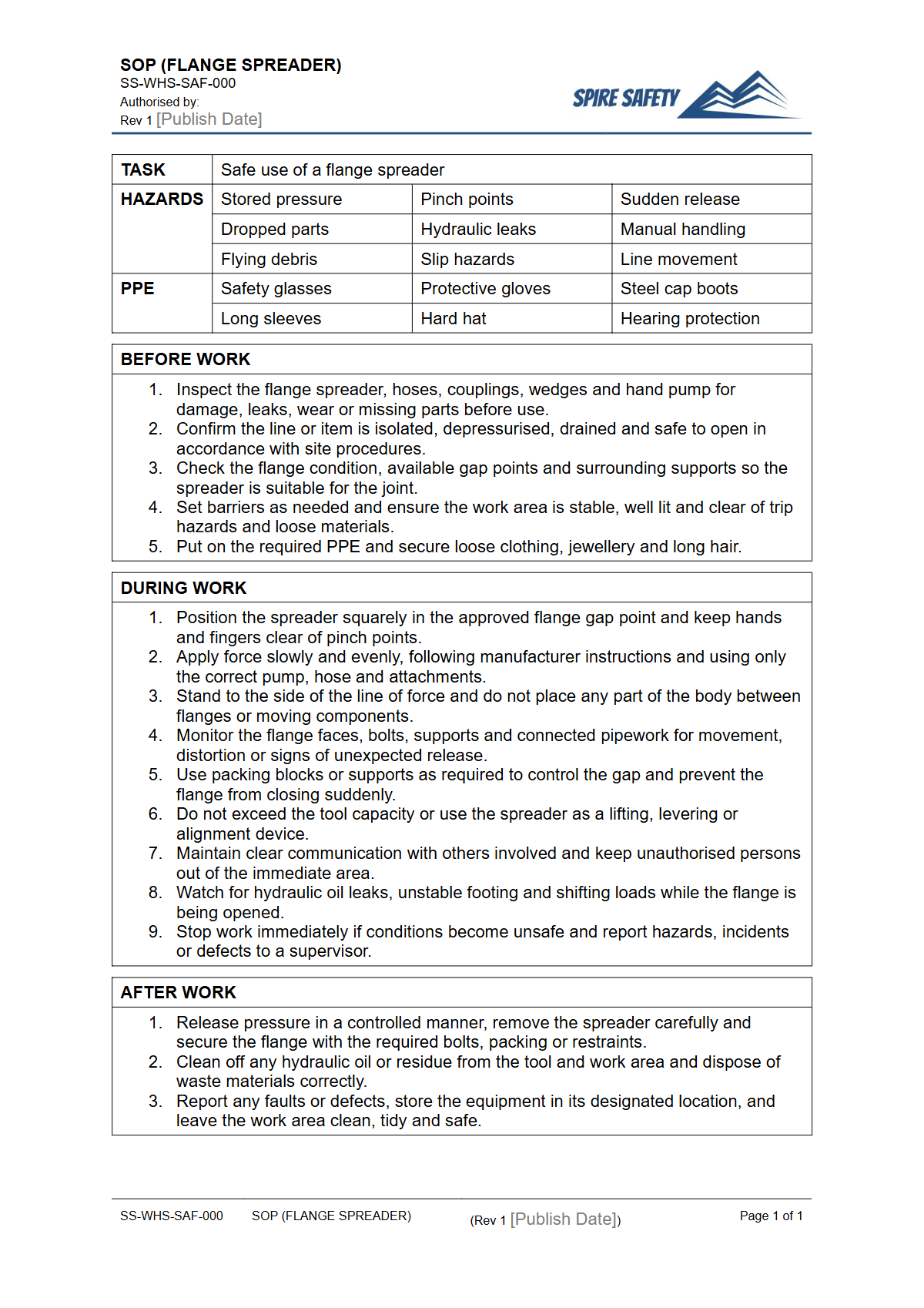
Our flange spreader SOP template provides a logical structure to guide your customisation. It prompts you to detail essential safety information, including the required Personal Protective Equipment (PPE) such as safety glasses and gloves, comprehensive pre-operational checks for the tool and hydraulic lines, and a step-by-step guide for the operating sequence.
It also includes sections for post-operation shutdown and cleaning, much like the systematic approach found in our Conveyer System SOP, ensuring all phases of the task are covered.
Common mistakes
Common mistakes to avoid
- Failing to verify the system is fully de-pressurised and isolated before inserting the tool.
- Using the wrong size or type of spreader for the specific flange, leading to tool failure or flange damage.
- Neglecting to inspect the spreader's hydraulic hoses and fittings for leaks or wear before use.
- Placing hands or fingers in the pinch zone between the flanges as the gap is created.
Legal references
Legal considerations
The following legal requirements may be relevant to this type of work.
- Work Health and Safety Act (Harmonised) — Provides the primary duties for protecting workers and other people from work health and safety risks.
- Work Health and Safety Regulations (Harmonised) — Sets out requirements supporting the management of workplace hazards and risks.
The following codes may be relevant to this type of work.
- Managing WHS Risks Code of Practice — Provides practical guidance on identifying hazards, assessing risks and applying effective controls.
- Work Health and Safety Consultation, Cooperation and Coordination Code of Practice — Provides practical guidance on consulting workers and coordinating with other duty holders.
- Managing the Work Environment and Facilities Code of Practice — Provides practical guidance on safe work environments, workplace facilities and related controls.
Did you know
Force Multiplication
Hydraulic flange spreaders use Pascal's principle to multiply a small amount of manual force into several tonnes of spreading force, capable of separating even the most stubborn industrial pipe flanges.
Stored Energy Risk
One of the greatest hazards in flange maintenance is not the tool itself, but the unexpected release of stored pressure (pneumatic, hydraulic, or thermal) from the pipeline. Always verify isolation and depressurisation before starting work.
FAQ
Frequently asked questions
01What is a Safe Operating Procedure for a flange spreader?
02Is a flange spreader SOP legally required in Australia?
03Who is responsible for writing a flange spreader SOP?
04How often should a flange spreader SOP be reviewed?
Share this resource
Free Safe Operating Procedure (Flange Spreader) Template
Browse Categories
How To Use It
- 1Download and open in Word or PDF.
- 2Replace the placeholders with your business details.
- 3Get it reviewed by a WHS specialist before rollout.
Need it customised?
Our WHS consultants can adapt this template to your site, run a gap analysis, or audit what you already have in place.
Book a Free Consultation WHS consulting servicesor call 1300 156 382
Related templates
- Free Safe Operating Procedure (Flanging Machine) Template
- Free Safe Operating Procedure (Flashback Arrestor Test) Template
- Free Safe Operating Procedure (Flat Top Grill) Template
- Free Safe Operating Procedure (Fleet Key Handover) Template
- Free Safe Operating Procedure (Floating Dock Access) Template
- Free Safe Operating Procedure (Floor Buffing) Template