
Free Safe Operating Procedure (Floating Dock Access) Template
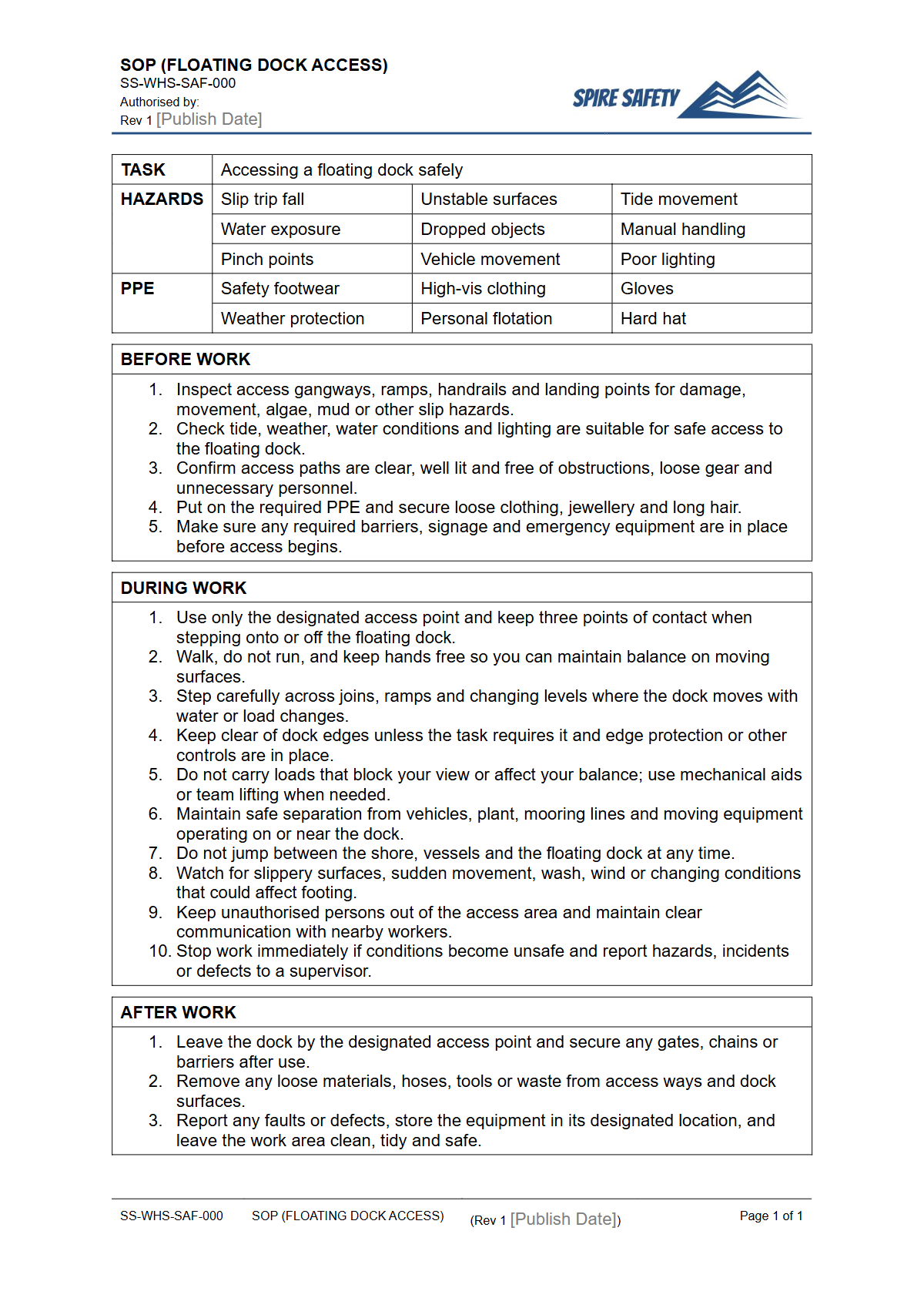
Effectively manage hazards associated with accessing floating docks with our detailed template. Download this free Safe Operating Procedure to get started.
Free Safe Operating Procedure (Floating Dock Access) Template
DOCX • 126 KB + PDF
Updated Oct 2026
No signup required
Purpose of the Free Safe Operating Procedure (Floating Dock Access) Template
Accessing floating docks presents unique and significant risks, including falls into water, instability due to tidal and weather changes, and hazards associated with gangways and pontoons. This Free Safe Operating Procedure (Floating Dock Access) Template provides a structured framework for documenting the controls necessary to manage these risks.
It is designed to help your organisation establish and communicate a clear, step-by-step process for workers to follow, ensuring tasks are performed safely and consistently. By formalising these procedures, you create a vital reference for training, induction, and supervision, forming a key component of your overall safety management system.
A well-documented SOP demonstrates a commitment to proactively managing workplace hazards. It assists Persons Conducting a Business or Undertaking (PCBUs) in meeting their primary duty of care under Australian WHS legislation.
Integrating this procedure into your operational framework is a critical step in building robust WHS management systems that protect workers in marine environments.
Video walkthrough
How to use the Free Safe Operating Procedure (Floating Dock Access) Template
This template is provided in both DOCX and PDF formats for your convenience. The DOCX version is fully editable, allowing for comprehensive customisation.
To use it effectively, you must adapt its contents to reflect the specific conditions of your worksite. This includes identifying the particular types of floating docks, access gangways, environmental factors like tides and currents, and the specific tasks being performed.
Important: This document is a template only. You must consult with workers and other relevant stakeholders to conduct a site-specific risk assessment.
The information gathered should be used to populate and modify this SOP. We strongly recommend a competent person reviews and approves the final document before implementation to ensure it adequately controls all identified risks for your location.
If you are unsure about site-specific hazards, engaging WHS consulting services can provide expert guidance.
When to use a Safe Operating Procedure for Floating Dock Access
This Safe Operating Procedure should be used before any work activity that requires personnel to access or work on a floating dock. This applies to a wide range of scenarios, including vessel mooring and unmooring, loading and unloading goods, routine inspections, maintenance and repair tasks, and emergency response activities.
It is particularly crucial when environmental conditions are challenging, such as during high winds, strong currents, or poor visibility.
The SOP should be a core part of pre-start meetings and toolbox talks, ensuring all personnel are reminded of the required safety measures before commencing work. It should also be reviewed and updated regularly, especially after an incident or near miss, or when changes are made to the dock, equipment, or work processes. Procedures for using equipment during maintenance, such as for cutting timber, should be covered by separate documents, such as a specific circular saw SOP.
Who should use it
This SOP is intended for use by anyone involved in work on or near floating docks. This includes, but is not limited to:
- Workers and Contractors: Personnel who physically access the dock to perform their duties must be trained in and follow the procedure.
- Supervisors and Managers: Those responsible for overseeing work must use the SOP to ensure tasks are planned safely, workers are adequately trained, and controls are implemented effectively.
- WHS/HSE Professionals: Safety advisors can use this template as a foundation for developing site-specific documentation and for conducting training and audits.
- PCBU/Business Owners: Management can use the finalised procedure as evidence of their commitment to providing a safe system of work.
Documenting procedures for all high-risk equipment is crucial. For instance, tasks involving pneumatic tools would require workers to also understand a dedicated air compressor SOP. To discover more templates for various plant and equipment, you can explore our free WHS resources library for additional support.
Regular reviews of all safety documentation are essential for maintaining a safe workplace. Periodic WHS compliance auditing can help verify that procedures like this one are being followed correctly and remain effective in controlling risks.
Common mistakes
Common mistakes to avoid
- Failing to check tide levels and their effect on gangway slope before use.
- Neglecting to wear a personal flotation device (PFD) when the risk assessment mandates it.
- Using the SOP as a generic document without customising it for site-specific hazards.
- Overloading the dock or gangway with equipment or personnel beyond its rated capacity.
Legal references
Legal considerations
The following legal requirements may be relevant to this type of work.
- Work Health and Safety Act (Harmonised) — Provides the primary duties for protecting workers and other people from work health and safety risks.
- Work Health and Safety Regulations (Harmonised) — Sets out requirements supporting the management of workplace hazards and risks.
The following codes may be relevant to this type of work.
- Managing WHS Risks Code of Practice — Provides practical guidance on identifying hazards, assessing risks and applying effective controls.
- Work Health and Safety Consultation, Cooperation and Coordination Code of Practice — Provides practical guidance on consulting workers and coordinating with other duty holders.
- Managing the Work Environment and Facilities Code of Practice — Provides practical guidance on safe work environments, workplace facilities and related controls.
Did you know
A Leading Cause
According to Safe Work Australia, drowning is a significant cause of workplace fatalities, with many incidents resulting from falls from height into water. This highlights the critical need for robust controls like PFDs and secure gangways.
The Gangway Angle
The angle of an access gangway to a floating dock can change dramatically with the tide. A slope that is safe at high tide can become dangerously steep at low tide, significantly increasing the risk of slips and falls.
FAQ
Frequently asked questions
01What are the main hazards when accessing a floating dock?
02Why is a specific SOP needed for floating docks compared to fixed jetties?
03How often should a Safe Operating Procedure for floating dock access be reviewed?
04What PPE is essential for accessing a floating dock?
Share this resource
Free Safe Operating Procedure (Floating Dock Access) Template
Browse Categories
How To Use It
- 1Download and open in Word or PDF.
- 2Replace the placeholders with your business details.
- 3Get it reviewed by a WHS specialist before rollout.
Need it customised?
Our WHS consultants can adapt this template to your site, run a gap analysis, or audit what you already have in place.
Book a Free Consultation WHS consulting servicesor call 1300 156 382
Related templates
- Free Safe Operating Procedure (Floor Buffing) Template
- Free Safe Operating Procedure (Floor Burnishing) Template
- Free Safe Operating Procedure (Floor Coating) Template
- Free Safe Operating Procedure (Floor Grinder) Template
- Free Safe Operating Procedure (Floor Machine Setup) Template
- Free Safe Operating Procedure (Floor Polisher) Template