
Free Safe Operating Procedure (Floor Coating) Template
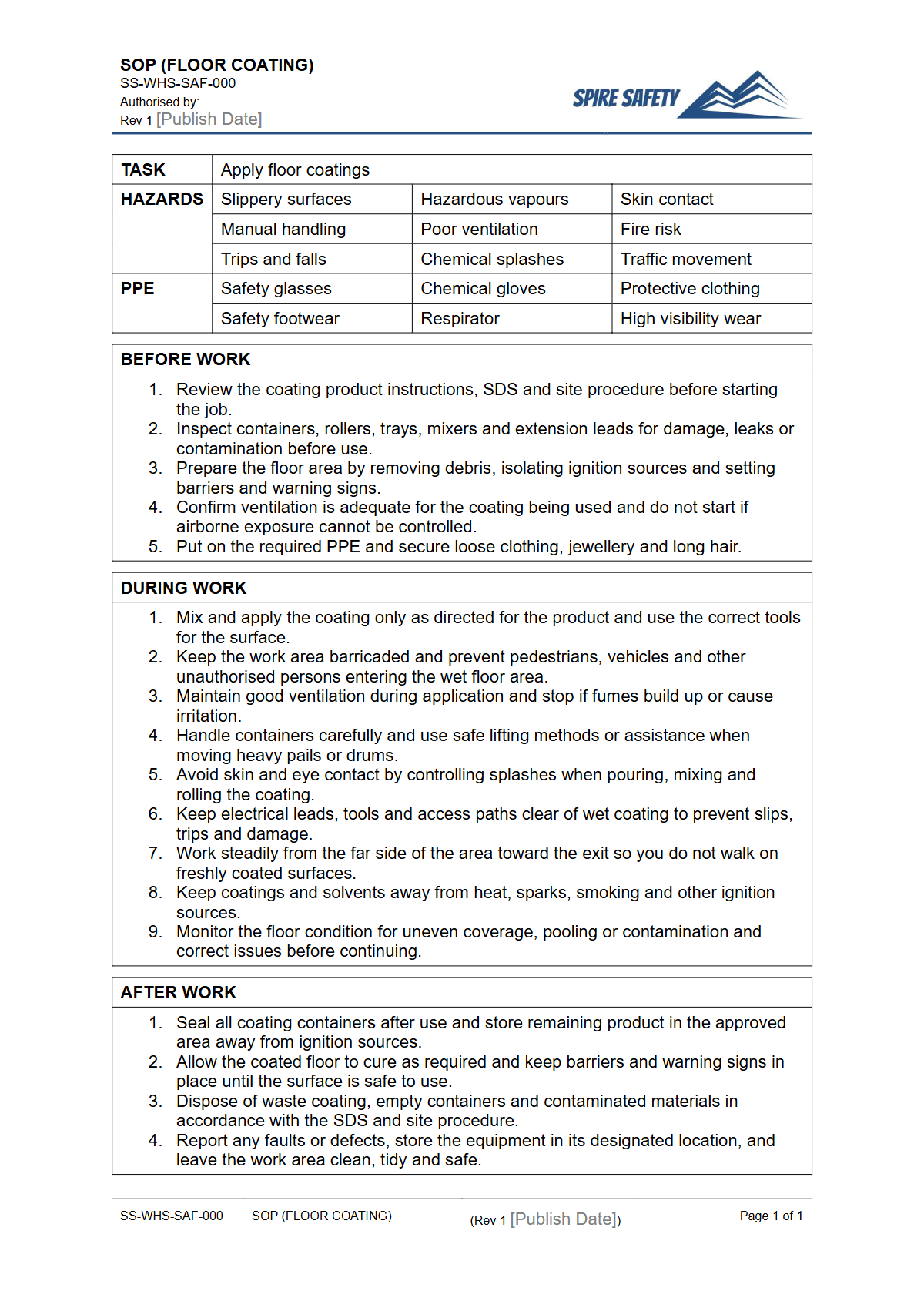
Download our Free Safe Operating Procedure for Floor Coating to manage hazards and outline safe work steps.
Free Safe Operating Procedure (Floor Coating) Template
DOCX • 126 KB + PDF
Updated Oct 2026
No signup required
Purpose of the Free Safe Operating Procedure (Floor Coating) Template
Applying floor coatings involves significant risks, from chemical exposure to slip and fall hazards. A structured Safe Operating Procedure (SOP) is essential for ensuring this task is performed safely and consistently.
This Free Safe Operating Procedure (Floor Coating) Template provides a comprehensive framework for documenting the hazards, risks, and control measures specific to your workplace. It guides you in creating a step-by-step process that helps protect your workers from harm and ensures a high-quality finish without compromising safety.
By systematically addressing each phase of the job—from preparation to clean-up—this document becomes a vital tool for training, supervision, and operational consistency.
Implementing documented procedures like this is a cornerstone of effective safety management. It demonstrates a commitment to health and safety and forms a critical part of a business’s overall risk management strategy.
Integrating these documents into comprehensive WHS management systems ensures that safety protocols are not just written down, but actively used and maintained throughout the organisation.
Video walkthrough
How to use the Free Safe Operating Procedure (Floor Coating) Template
This resource is available for immediate download in both DOCX and PDF formats. The DOCX version is fully editable, allowing you to tailor the content to your specific operational needs.
To use the template effectively, download the file and systematically work through each section, replacing the placeholder text with information relevant to your worksite, equipment, chemical products, and personnel. Engage with workers who perform the task to ensure the procedure reflects the practical realities of the job.
Important: This is a template, not a finished document. You must customise it to reflect the specific hazards, equipment, chemicals, environment, and personnel in your workplace.
A generic procedure is insufficient for ensuring safety. Spire Safety is not liable for any incidents that may arise from the use of this document without proper, site-specific customisation.
Key information to include:
- Hazard Identification: List all potential hazards, such as chemical exposure from isocyanates or solvents, slips on wet surfaces, fire risks from flammable materials, and manual handling injuries.
- Risk Control Measures: Specify the controls for each hazard, including mandatory Personal Protective Equipment (PPE), ventilation requirements, and safe handling techniques.
- Step-by-Step Instructions: Detail the entire process from pre-start checks (e.g., surface preparation, checking ventilation) through to application and post-job clean-up.
- Emergency Procedures: Outline the response for foreseeable emergencies like chemical spills, first aid incidents, or fire.
For large areas, surface preparation is a critical first step. You may need a separate procedure for mechanical cleaning, such as our Safe Operating Procedure for Floor Scrubber Operation, to complement this document.
When to use this Safe Operating Procedure
This SOP should be used whenever floor coating tasks are performed. It is particularly important in several key scenarios.
Use it to train new employees or contractors on the established safe method of work before they begin. It should also be a reference document for experienced workers to ensure standards are maintained.
This procedure is critical during project planning for commercial or industrial floor refurbishments, new builds, and routine maintenance applications. It should be reviewed and updated whenever a new coating system, piece of equipment, or chemical is introduced.
If old coatings or tiles need to be removed, additional procedures may be necessary. For manual removal tasks, a resource like our Scraper SOP template can help detail the specific hazards and controls for that preliminary phase.
Who should use it
This Safe Operating Procedure is intended for a range of personnel within an organisation. Workers directly involved in mixing and applying floor coatings must be trained on and follow the procedure.
Supervisors and team leaders are responsible for ensuring the SOP is implemented correctly on-site and that workers have the required training and PPE. WHS managers and advisors will use this document as part of the site’s safety management system, for risk assessments, and during incident investigations.
Business owners (PCBUs) should ensure such procedures are developed, implemented, and reviewed as part of their primary duty of care.
The effectiveness of an SOP is often reviewed during safety evaluations. Having well-documented and implemented procedures is a key indicator of a healthy safety culture during internal WHS compliance auditing.
Common Hazards in Floor Coating
Floor coating activities present a unique combination of chemical, physical, and fire hazards. A thorough SOP must identify and control these risks effectively.
Key hazards to address include:
- Chemical Exposure: Inhalation of Volatile Organic Compounds (VOCs), isocyanates, and other solvent vapours can cause respiratory damage, sensitisation, and long-term health issues. Skin contact can lead to dermatitis or chemical burns.
- Fire and Explosion: Many coating products and solvents are highly flammable. Vapour build-up in poorly ventilated areas can create an explosive atmosphere, easily ignited by sparks from tools, static electricity, or other ignition sources.
- Slips, Trips, and Falls: Wet, freshly coated surfaces are an obvious slip hazard. Equipment, power leads, and material containers can create trip hazards in the work area.
- Manual Handling: Lifting and carrying heavy drums of resin or hardener, as well as mixing and pouring, can lead to musculoskeletal injuries if not performed correctly.
- Inadequate Ventilation: Failure to establish sufficient mechanical and natural ventilation can lead to a dangerous accumulation of toxic and flammable vapours.
The equipment used during preparation and application also introduces hazards. If spray application is performed using compressed air, an Air Compressor SOP should also be referenced to manage associated risks.
Common mistakes
Common mistakes to avoid
- Neglecting to read the Safety Data Sheet (SDS) for each chemical product before use.
- Using inadequate ventilation, leading to a harmful and potentially flammable buildup of fumes.
- Failing to properly prepare the floor surface, causing coating failure and creating rework hazards.
- Not providing or using the correct type of Personal Protective Equipment (PPE), especially chemical-resistant gloves and respirators.
Legal references
Legal considerations
The following legal requirements may be relevant to this type of work.
- Work Health and Safety Act (Harmonised) — Provides the primary duties for protecting workers and other people from work health and safety risks.
- Work Health and Safety Regulations (Harmonised) — Sets out requirements supporting the management of workplace hazards and risks.
The following codes may be relevant to this type of work.
- Managing WHS Risks Code of Practice — Provides practical guidance on identifying hazards, assessing risks and applying effective controls.
- Work Health and Safety Consultation, Cooperation and Coordination Code of Practice — Provides practical guidance on consulting workers and coordinating with other duty holders.
- Managing the Work Environment and Facilities Code of Practice — Provides practical guidance on safe work environments, workplace facilities and related controls.
Did you know
Invisible Dangers
Many floor coating systems release Volatile Organic Compounds (VOCs) that can cause both short-term and long-term health effects. Proper ventilation and respiratory protection are non-negotiable safety measures.
Curing Time is Safety Time
A floor coating isn't safe until it is fully cured as per the manufacturer's specifications. Premature foot traffic can not only ruin the finish but may also create slip hazards and expose people to uncured chemical components.
FAQ
Frequently asked questions
01What key sections should be included in an SOP for floor coating?
02How do you manage VOCs and chemical fumes when applying floor coatings?
03Is a Safe Work Method Statement (SWMS) required for floor coating?
04Who is responsible for creating a Safe Operating Procedure?
Share this resource
Free Safe Operating Procedure (Floor Coating) Template
Browse Categories
How To Use It
- 1Download and open in Word or PDF.
- 2Replace the placeholders with your business details.
- 3Get it reviewed by a WHS specialist before rollout.
Need it customised?
Our WHS consultants can adapt this template to your site, run a gap analysis, or audit what you already have in place.
Book a Free Consultation WHS consulting servicesor call 1300 156 382
Related templates
- Free Safe Operating Procedure (Floor Grinder) Template
- Free Safe Operating Procedure (Floor Machine Setup) Template
- Free Safe Operating Procedure (Floor Polisher) Template
- Free Safe Operating Procedure (Floor Polishing Prep) Template
- Free Safe Operating Procedure (Floor Sander) Template
- Free Safe Operating Procedure (Floor Scarifier) Template