
Free Safe Operating Procedure (Floor Sander) Template
Streamline your workplace safety with our comprehensive Safe Operating Procedure for floor sanders. Download this free, customisable template today.
Free Safe Operating Procedure (Floor Sander) Template
DOCX • 126 KB + PDF
Updated Oct 2026
No signup required
Purpose of the Free Safe Operating Procedure (Floor Sander) Template
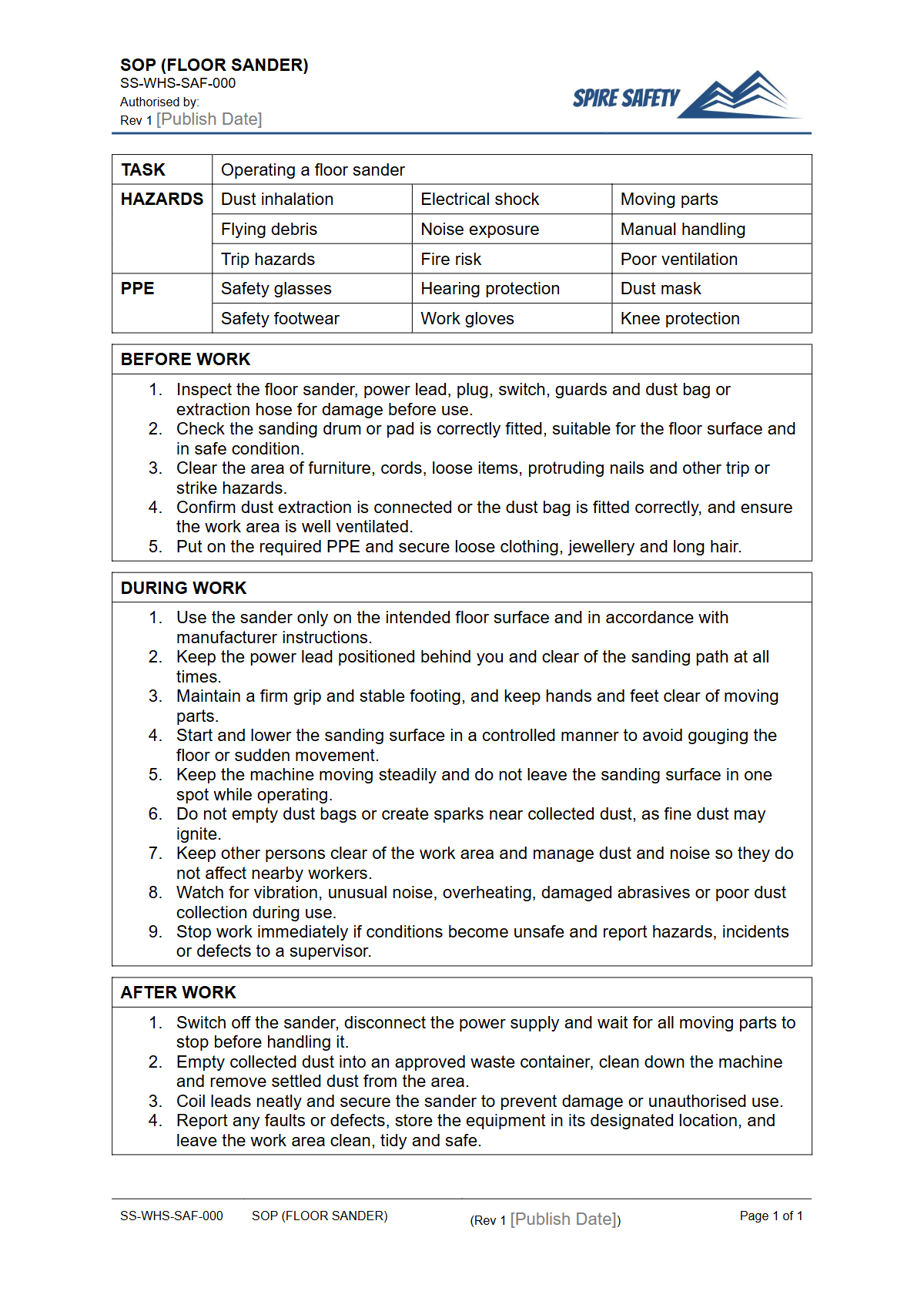
Operating a floor sander, whether a drum sander or an edger, introduces significant workplace hazards, including electrical risks, airborne dust, noise, and ergonomic strains. This Free Safe Operating Procedure (Floor Sander) Template provides a structured framework for documenting the safest way to perform this task.
By clearly outlining pre-operational checks, step-by-step instructions, and potential hazards, this SOP helps organisations meet their duty of care. It serves as a vital tool for worker training, competency assessment, and incident prevention, ensuring tasks are completed consistently and safely every time.
Implementing documented procedures is a cornerstone of a functional safety framework. This SOP should form part of a broader risk management approach, integrated into a comprehensive WHS management system that covers all operational risks.
What is a Safe Operating Procedure?
A Safe Operating Procedure (SOP) is a written document that provides detailed, step-by-step instructions on how to safely perform a specific task or operate a piece of machinery. It identifies the hazards associated with the task and outlines the control measures required to eliminate or minimise the risk of injury or illness.
An SOP is an essential administrative control used to standardise a work process and ensure everyone performs it in the same safe manner.
Video walkthrough
How to use the Free Safe Operating Procedure (Floor Sander) Template
This template is provided in both DOCX and PDF formats for your convenience. The DOCX file is fully editable, allowing you to tailor the content to the specific requirements of your workplace and the particular model of floor sander in use.
It is crucial that you customise this document before implementation.
To effectively use this template:
- Download the DOCX version.
- Insert your company name, logo, and other relevant details in the header and designated fields.
- Conduct a specific risk assessment for floor sanding activities in your workplace.
- Modify the content to reflect the make and model of your sander, the types of surfaces being worked on, and the specific control measures your site has in place (e.g., brand of dust extractor, type of PPE).
- Consult with your workers and any health and safety representatives during the customisation process. Their direct experience is invaluable for creating a practical and effective procedure.
- Review and approve the final document through your organisation's official process.
- Use the finalised SOP to train all relevant workers, ensuring they understand and can follow the procedure before they are authorised to operate the equipment.
Remember, this is a template, not a finished document. We have provided a solid foundation based on Australian WHS principles, but you must adapt it to your unique operational context to ensure its effectiveness. For tasks involving other types of floor maintenance equipment, you may find that similar principles apply, such as those detailed in our Free Safe Operating Procedure (Floor Scrubber Operation) Template.
When to use a Safe Operating Procedure for a Floor Sander
An SOP for a floor sander should be developed and implemented before any worker is permitted to operate the equipment. It should be readily accessible in the work area for easy reference. This document is particularly important in several situations:
- Training and Induction: Use the SOP as a primary training document for new or inexperienced workers.
- Refresher Training: Periodically review the SOP with experienced workers to reinforce safe practices and communicate any updates.
- Before Starting Work: Operators should review the SOP as a pre-start checklist to ensure they have not missed any safety steps.
- Incident Investigation: Following an incident or near-miss, the SOP should be reviewed to determine if the procedure was adequate and if it was followed correctly.
- Audits and Inspections: The SOP serves as evidence of a formalised system for managing risks associated with plant operation during internal or external safety audits.
For tools that generate significant dust, the SOP should integrate controls for airborne hazards. This is also true for other high-risk equipment, like what is outlined in the FREE Circular Saw SOP.
Who should use this document
This Safe Operating Procedure is intended for use by multiple groups within an organisation:
- Persons Conducting a Business or Undertaking (PCBUs): Business owners and managers can use this template to fulfil their primary duty of care to provide safe systems of work.
- Supervisors and Team Leaders: Front-line leaders use the SOP to supervise work, deliver on-the-job training, and ensure their team members are working to the required safety standard. The process may involve other plant like air compressors for cleanup, which would require their own SOP, like the one found in our Free Air Compressor SOP.
- Workers/Operators: The individuals performing the floor sanding use the SOP as a guide for how to do their job safely, protecting themselves and others from harm.
- Health and Safety Representatives (HSRs): HSRs can use the document as a reference point when consulting with management on health and safety matters related to plant and equipment.
- WHS Professionals: Safety advisors and managers use this template as a starting point for developing comprehensive, site-specific procedures. For more complex risk environments, seeking external WHS consulting can provide valuable expertise.
You can find a wide range of similar documents to support your safety management system in our free WHS resources library.
Common mistakes
Common mistakes to avoid
- Failing to inspect the power cord and plug for damage before every use.
- Using the wrong grit sandpaper, leading to damaged floors or ineffective sanding.
- Neglecting to use adequate dust extraction and personal respiratory protection.
- Leaving the sander running stationary on the floor, causing divots or burn marks.
Legal references
Legal considerations
The following legal requirements may be relevant to this type of work.
- Work Health and Safety Act (Harmonised) — Provides the primary duties for protecting workers and other people from work health and safety risks.
- Work Health and Safety Regulations (Harmonised) — Sets out requirements supporting the management of workplace hazards and risks.
The following codes may be relevant to this type of work.
- Managing WHS Risks Code of Practice — Provides practical guidance on identifying hazards, assessing risks and applying effective controls.
- Work Health and Safety Consultation, Cooperation and Coordination Code of Practice — Provides practical guidance on consulting workers and coordinating with other duty holders.
- Managing the Work Environment and Facilities Code of Practice — Provides practical guidance on safe work environments, workplace facilities and related controls.
Did you know
Dust Hazards
Fine dust from floor sanding, especially from older floors or particleboard, can contain hazardous substances like silica, formaldehyde, or even lead from old paint. Always use appropriate respiratory protection and effective dust extraction systems.
Vibration Risk
Prolonged use of high-vibration equipment like floor sanders can lead to Hand-Arm Vibration Syndrome (HAVS), a painful and disabling condition affecting nerves and blood vessels. It is crucial to manage exposure times and use low-vibration equipment where possible.
FAQ
Frequently asked questions
01What should a Safe Operating Procedure for a floor sander include?
02Is an SOP a legal requirement in Australia?
03How often should an SOP be reviewed?
04Can this template be used for all types of floor sanders?
Share this resource
Free Safe Operating Procedure (Floor Sander) Template
Browse Categories
How To Use It
- 1Download and open in Word or PDF.
- 2Replace the placeholders with your business details.
- 3Get it reviewed by a WHS specialist before rollout.
Need it customised?
Our WHS consultants can adapt this template to your site, run a gap analysis, or audit what you already have in place.
Book a Free Consultation WHS consulting servicesor call 1300 156 382
Related templates
- Free Safe Operating Procedure (Floor Scarifier) Template
- Free Safe Operating Procedure (Floor Scrubber Operation) Template
- Free Safe Operating Procedure (Floor Spot Cleaning) Template
- Free Safe Operating Procedure (Floor Stripping) Template
- Free Safe Operating Procedure (Floor Waxing) Template
- Free Safe Operating Procedure (Flow Meter Test) Template