
Free Safe Operating Procedure (Floor Scarifier) Template
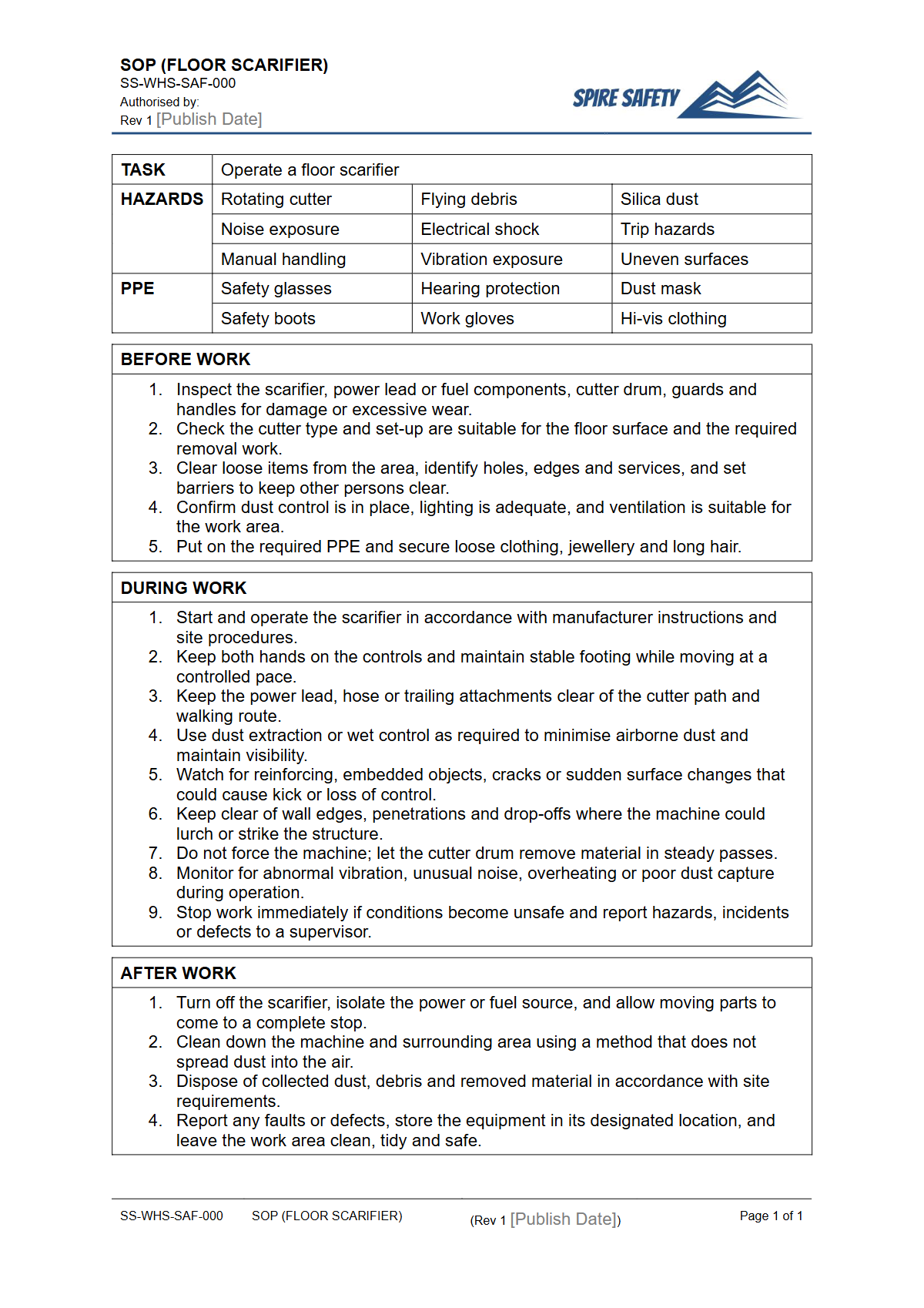
Download our free Safe Operating Procedure for floor scarifiers. This template helps you outline the hazards and controls for safe equipment operation.
Free Safe Operating Procedure (Floor Scarifier) Template
DOCX • 126 KB + PDF
Updated Oct 2026
No signup required
Purpose of the Free Safe Operating Procedure (Floor Scarifier) Template
Operating heavy machinery like a floor scarifier requires clear, documented safety instructions. This Free Safe Operating Procedure (Floor Scarifier) Template provides a structured starting point for your organisation to develop its own site-specific procedures.
By outlining the sequence of tasks, potential hazards, and necessary control measures, a well-drafted SOP is a critical tool in preventing incidents and promoting a safer work environment for everyone involved in surface preparation tasks.
What is a Safe Operating Procedure?
A Safe Operating Procedure (SOP), sometimes called a Safe Work Procedure (SWP), is a formal document that details the safest and most efficient way to perform a specific task. For a floor scarifier, this includes everything from pre-start checks and operation to cleaning and maintenance.
The goal is to minimise risks to health and safety by establishing a clear, repeatable process. Properly implemented, it becomes a core component of your overall WHS management systems.
Video walkthrough
How to use the Free Safe Operating Procedure (Floor Scarifier) Template
To effectively use this Free Safe Operating Procedure (Floor Scarifier) Template, download the DOCX file and adapt it to your specific operational context. This includes detailing the make and model of your floor scarifier, the unique environmental conditions of your worksite, and your company’s specific safety protocols.
Remember, this document is a template, not a finished procedure. We have provided a framework, but it is your responsibility to customise it with accurate, site-specific information to ensure it is relevant and effective for your workplace. You must consult with your workers and any other relevant stakeholders during this customisation process.
When to use it
A Safe Operating Procedure for a floor scarifier should be developed and implemented before the equipment is first used at a worksite. It must be readily accessible to operators whenever they are required to use the machine.
The SOP should be a central part of operator training and induction. Furthermore, it should be reviewed and updated whenever there is a change in the equipment, the work process, or the work environment.
It's also crucial to review the SOP after any incident or near-miss to identify and incorporate necessary improvements. For tasks involving similar floor preparation equipment, you might also find our Free Safe Operating Procedure (Floor Scrubber Operation) Template useful as a reference.
Who should use it
This SOP is intended for use by several groups within an organisation. Primarily, operators of the floor scarifier must be trained on and follow the procedure diligently.
Supervisors and managers are responsible for ensuring the SOP is implemented, understood, and enforced. They must also facilitate the training and provide the necessary resources, such as Personal Protective Equipment (PPE).
Safety officers or WHS representatives will find this template useful for establishing consistent safety standards across different projects or departments. The development of SOPs, like our FREE Circular Saw SOP (Safe Operating Procedure) Template, is a collaborative effort.
Key Hazards and Control Measures
Operating a floor scarifier introduces several significant hazards that must be controlled. These include mechanical hazards from moving parts, noise exposure, hand-arm vibration, and manual handling risks.
One of the most serious risks is exposure to hazardous dust, particularly respirable crystalline silica, which can be generated when scarifying concrete surfaces. Your SOP must detail specific control measures for each identified hazard.
Examples include using integrated dust collection systems, specifying mandatory PPE like P2/N95 respirators and hearing protection, implementing job rotation to limit vibration exposure, and ensuring proper manual handling techniques for moving the machine. Regular WHS compliance auditing can help verify that these controls are being effectively applied.
Consultation in Developing Your SOP
Under Australian WHS law, consultation is mandatory when identifying hazards and deciding on control measures. When customising this SOP template, you must consult with the workers who will be operating the floor scarifier.
Their direct experience is invaluable for identifying practical risks and effective controls that might be missed in a top-down assessment. Consultation should also involve health and safety representatives (HSRs) and any relevant managers or supervisors.
This collaborative approach not only leads to a more robust and practical SOP but also increases worker buy-in and ownership of safety procedures. For a broader view of available templates, you can browse our full free WHS resources library.
Common mistakes
Common mistakes to avoid
- Using a generic SOP from the internet without customising it for the specific machine and worksite.
- Failing to train operators on the contents of the finalised SOP and verify their understanding.
- Not enforcing the use of mandatory Personal Protective Equipment (PPE) listed in the procedure.
- Neglecting to review and update the SOP after an incident or when new hazards are identified.
Legal references
Legal considerations
The following legal requirements may be relevant to this type of work.
- Work Health and Safety Act (Harmonised) — Provides the primary duties for protecting workers and other people from work health and safety risks.
- Work Health and Safety Regulations (Harmonised) — Sets out requirements supporting the management of workplace hazards and risks.
The following codes may be relevant to this type of work.
- Managing WHS Risks Code of Practice — Provides practical guidance on identifying hazards, assessing risks and applying effective controls.
- Work Health and Safety Consultation, Cooperation and Coordination Code of Practice — Provides practical guidance on consulting workers and coordinating with other duty holders.
- Managing the Work Environment and Facilities Code of Practice — Provides practical guidance on safe work environments, workplace facilities and related controls.
Did you know
Dust Hazards
Scarifying concrete can release respirable crystalline silica, a hazardous dust that can cause silicosis, a serious and incurable lung disease. Effective dust control is a critical safety requirement.
Vibration Risk
Prolonged use of floor scarifiers can expose operators to Hand-Arm Vibration (HAV), which can lead to permanent and painful conditions like "vibration white finger."
FAQ
Frequently asked questions
01What is a Safe Operating Procedure for a floor scarifier?
02Who is responsible for creating a floor scarifier SOP?
03How often should a floor scarifier SOP be reviewed?
04Is training required in addition to a floor scarifier SOP?
Share this resource
Free Safe Operating Procedure (Floor Scarifier) Template
Browse Categories
How To Use It
- 1Download and open in Word or PDF.
- 2Replace the placeholders with your business details.
- 3Get it reviewed by a WHS specialist before rollout.
Need it customised?
Our WHS consultants can adapt this template to your site, run a gap analysis, or audit what you already have in place.
Book a Free Consultation WHS consulting servicesor call 1300 156 382
Related templates
- Free Safe Operating Procedure (Floor Scrubber Operation) Template
- Free Safe Operating Procedure (Floor Spot Cleaning) Template
- Free Safe Operating Procedure (Floor Stripping) Template
- Free Safe Operating Procedure (Floor Waxing) Template
- Free Safe Operating Procedure (Flow Meter Test) Template
- Free Safe Operating Procedure (Flow Transmitter) Template