
Free Safe Operating Procedure (Flow Transmitter) Template
Download our free Safe Operating Procedure for flow transmitters to guide your team. This template helps you document safe work steps and controls.
Free Safe Operating Procedure (Flow Transmitter) Template
DOCX • 126 KB + PDF
Updated Oct 2026
No signup required
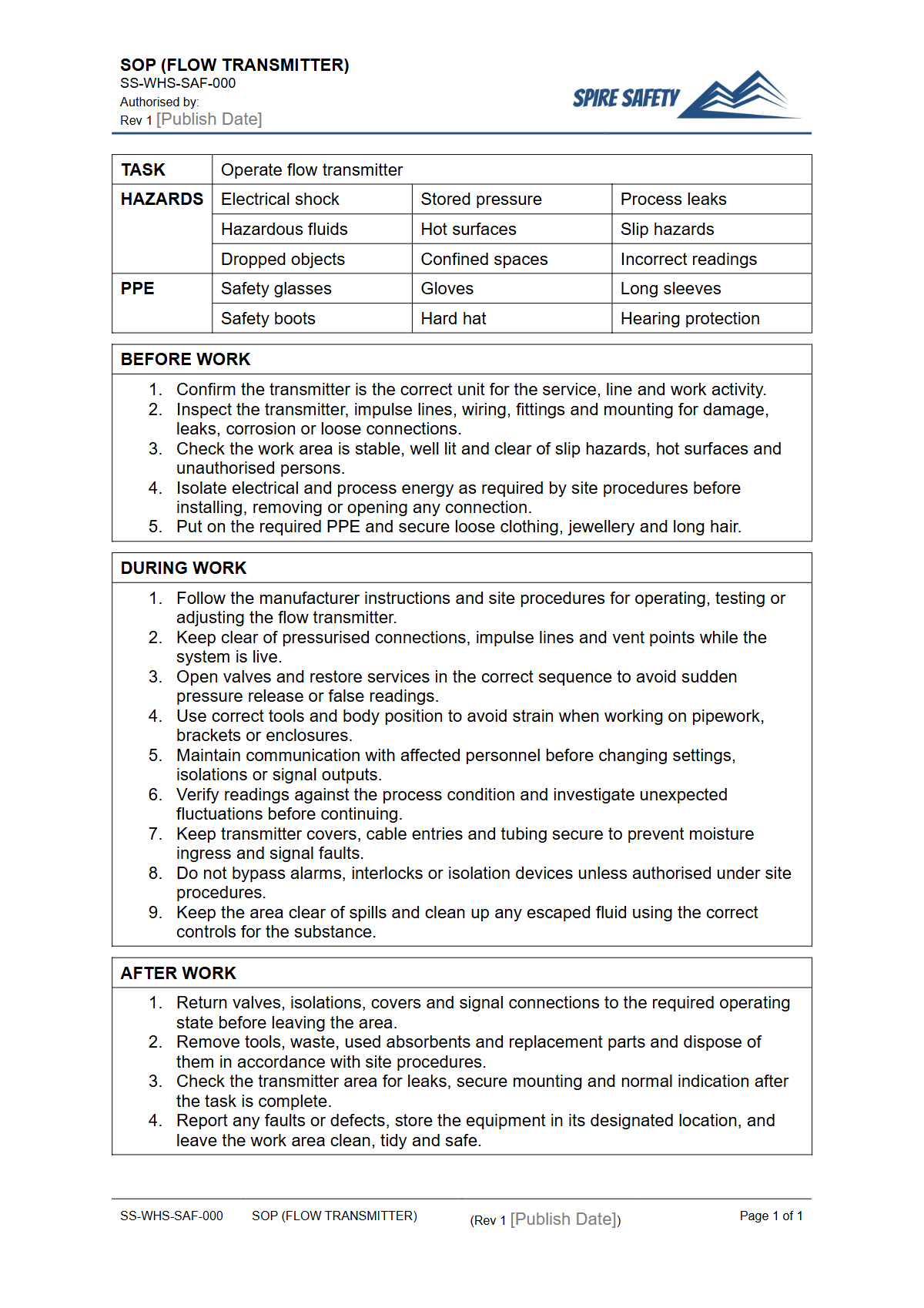
Purpose of the Free Safe Operating Procedure (Flow Transmitter) Template
Working with process instrumentation like flow transmitters involves specific risks that must be managed to ensure worker safety. Our Free Safe Operating Procedure (Flow Transmitter) Template provides a structured framework for identifying hazards and outlining safe work methods for tasks such as installation, calibration, operation, and maintenance.
Using this SOP helps your organisation meet its duty of care by providing clear, step-by-step instructions that minimise risks like exposure to hazardous substances, electrical shock, or injuries from high-pressure systems.
A well-developed SOP is a critical tool for worker training, competency assessment, and incident investigation. It forms an essential part of your overall safety framework, demonstrating a commitment to proactive risk management.
Integrating documents like this into your operational controls is a cornerstone of effective WHS management systems, ensuring that safety is embedded in your daily processes.
Video walkthrough
How to use the Free Safe Operating Procedure (Flow Transmitter) Template
This template is available as a fully editable DOCX file and a ready-to-print PDF. To use it effectively, download the DOCX version and thoroughly adapt it to your specific operational context.
It is crucial to understand that this is a template, not a finished document. You must customise it with your specific workplace details, including the make and model of the flow transmitter, the substances it measures, site-specific hazards, and relevant Personal Protective Equipment (PPE).
We have included comments and prompts within the document to guide your customisation process.
Once customised, the SOP should be used to train all relevant personnel and be made readily accessible in the work area. For other equipment-specific procedures, you might find our Free Air Compressor SOP (Safe Operating Procedure) Template a useful reference for how to detail operational checks and shutdown steps.
Regular review and updates are necessary to ensure the SOP remains current and effective.
When to use a Flow Transmitter SOP
A Safe Operating Procedure for a flow transmitter should be developed and implemented before any work on the equipment begins. It is a vital resource that should be consulted prior to and during any of the following activities:
- Initial installation and commissioning of a new flow transmitter.
- Routine operational checks and monitoring.
- Calibration, servicing, or maintenance tasks.
- Troubleshooting and fault-finding activities.
- Decommissioning and removal of the equipment.
Furthermore, the SOP serves as a key document during safety reviews and inspections. It provides clear evidence of your documented safety processes, which is a fundamental aspect checked during a professional WHS compliance auditing process.
Who should use this SOP
This Safe Operating Procedure is intended for use by a range of personnel within an organisation. The primary users are the individuals who directly interact with the equipment, including:
- Instrument and Control Technicians
- Electricians
- Mechanical Fitters
- Process Operators
- Maintenance Planners and Schedulers
Supervisors and managers should also be familiar with the SOP to ensure they can oversee work safely and confirm that procedures are being followed correctly. Like our FREE Conveyer System SOP is for plant operators, this document is specifically for those qualified to work on process instrumentation.
It helps standardise work methods across different shifts and teams, ensuring a consistent level of safety.
What's included in the template
Our template provides a comprehensive starting point aligned with Australian WHS principles. It is structured to guide you through documenting all necessary safety information, including sections for:
- Hazard Identification: A table to list potential hazards (e.g., electrical, chemical, pressure, thermal) and corresponding control measures.
- Personal Protective Equipment (PPE): A list of required PPE for specific tasks.
- Pre-operational Checks: Step-by-step checks to perform before starting work, such as verifying isolation and lock-out/tag-out (LOTO).
- Operating Procedure: A detailed sequence of steps for safely performing the task (e.g., calibration, removal).
- Post-operational Checks: Steps to ensure the equipment is returned to a safe operational state.
- Emergency Procedures: Instructions for responding to foreseeable emergencies like spills, leaks, or personal exposure.
This structure ensures all critical safety aspects are considered, similar to how our Safe Operating Procedure (Deep Fryer - Standard Operation) template covers every stage from setup to cleaning. Remember to browse our complete free WHS resources library for more templates to support your safety management system.
Common mistakes
Common mistakes to avoid
- Failing to de-pressurise and isolate the pipeline correctly before starting work.
- Using the template without customising it for the specific fluid, pressure, temperature, and equipment model.
- Neglecting to list the specific Personal Protective Equipment (PPE) required for the substance and task.
- Forgetting to include emergency procedures for leaks, spills, or chemical exposure.
Legal references
Legal considerations
The following legal requirements may be relevant to this type of work.
- Work Health and Safety Act (Harmonised) — Provides the primary duties for protecting workers and other people from work health and safety risks.
- Work Health and Safety Regulations (Harmonised) — Sets out requirements supporting the management of workplace hazards and risks.
The following codes may be relevant to this type of work.
- Managing WHS Risks Code of Practice — Provides practical guidance on identifying hazards, assessing risks and applying effective controls.
- Work Health and Safety Consultation, Cooperation and Coordination Code of Practice — Provides practical guidance on consulting workers and coordinating with other duty holders.
- Managing the Work Environment and Facilities Code of Practice — Provides practical guidance on safe work environments, workplace facilities and related controls.
Did you know
Smart Transmitters
Modern 'smart' flow transmitters can be diagnosed and calibrated remotely. This technology reduces the need for direct physical interaction, minimising worker exposure to hazardous areas and process conditions.
Process Safety
In many industrial facilities, flow transmitters are critical safety devices within a Process Safety Management (PSM) system. They provide essential data to control systems that prevent major incidents like chemical spills or explosions.
FAQ
Frequently asked questions
01What is a Safe Operating Procedure for a flow transmitter?
02Why do I need an SOP for something as simple as a flow transmitter?
03Is this template suitable for all types of flow transmitters?
04How often should a Safe Operating Procedure be reviewed?
Share this resource
Free Safe Operating Procedure (Flow Transmitter) Template
Browse Categories
How To Use It
- 1Download and open in Word or PDF.
- 2Replace the placeholders with your business details.
- 3Get it reviewed by a WHS specialist before rollout.
Need it customised?
Our WHS consultants can adapt this template to your site, run a gap analysis, or audit what you already have in place.
Book a Free Consultation WHS consulting servicesor call 1300 156 382
Related templates
- Free Safe Operating Procedure (Flower Bed Maintenance) Template
- Free Safe Operating Procedure (Flower Bed Weeding) Template
- Free Safe Operating Procedure (Flower Deadheading) Template
- Free Safe Operating Procedure (Flower Potting) Template
- Free Safe Operating Procedure (Fly Press) Template
- Free Safe Operating Procedure (Fogging Machine) Template