
Free Safe Operating Procedure (Fly Press) Template
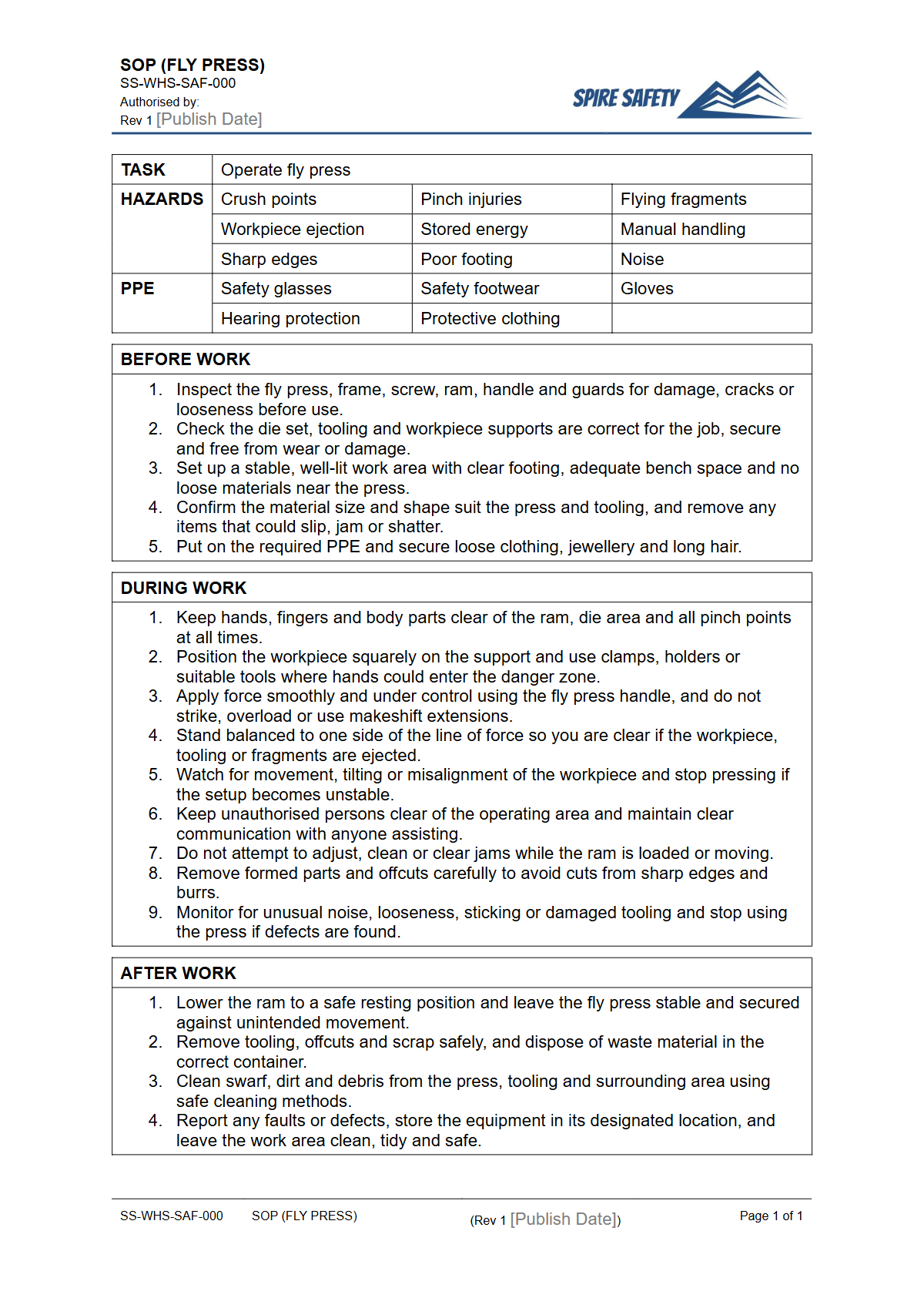
Download our free Safe Operating Procedure (Fly Press) Template. This customisable DOCX and PDF helps you document safe work methods for fly press operations.
Free Safe Operating Procedure (Fly Press) Template
DOCX • 126 KB + PDF
Updated Oct 2026
No signup required
Purpose of the Free Safe Operating Procedure (Fly Press) Template
Operating a fly press presents significant risks, including crushing, pinching, and musculoskeletal injuries. A documented Safe Operating Procedure (SOP) is a critical tool for managing these hazards effectively.
This free Safe Operating Procedure (Fly Press) Template provides a structured framework for outlining the required steps to perform tasks safely. It helps organisations meet their duty of care by clearly defining pre-operational checks, step-by-step operating instructions, and emergency protocols, ensuring all workers are informed of the recognised safety standards for the equipment.
An SOP standardises your work methods, which is fundamental to consistent safety performance and operational efficiency. By implementing a clear procedure, you reduce the likelihood of incidents, provide a reliable basis for worker training, and create a reference point for supervisors and safety officers.
This document formalises the expectation that safety is integrated into every task performed on the fly press. A well-developed procedure is a key component of robust WHS management systems, demonstrating a proactive approach to risk management.
Video walkthrough
How to use the Free Safe Operating Procedure (Fly Press) Template
This resource is provided in both DOCX and PDF formats for your convenience. The DOCX file is fully editable, allowing you to adapt the content to the specific machinery and processes used in your workplace.
A generic template cannot account for the unique variables of your site, such as machine model, specific tooling, materials used, and environmental conditions.
Important: This document is a template only and must be customised to be effective. We have provided a structured starting point aligned with Australian WHS principles, but you are responsible for adding site-specific information.
This includes identifying all relevant hazards, detailing your risk controls, and consulting with your workers to ensure the procedure is practical and understood. Without proper customisation, the document will not adequately control risk in your workplace.
Key Elements to Customise
- Plant & Equipment Details: Specify the make, model, and serial number of the fly press.
- Risk Assessment: Integrate findings from your plant-specific risk assessment, including identified hazards and the hierarchy of controls implemented.
- Personal Protective Equipment (PPE): List the mandatory PPE required for operators, such as safety glasses, protective footwear, and appropriate gloves.
- Operating Steps: Detail the sequential steps for setting up, operating, and shutting down the press safely. Include instructions for tool changes and adjustments.
- Emergency Procedures: Outline the exact steps to take in an emergency, including shutdown procedures, first aid contacts, and incident reporting processes.
When to use it
A Fly Press SOP should be a living document integrated into your daily operations. It is essential during new worker inductions and for specific task training to ensure a baseline of competency.
The SOP serves as a checklist for pre-start inspections, helping operators verify that safety guards and emergency stops are functional before commencing work. It should also be reviewed and referenced during incident investigations to identify any procedural gaps or non-conformance.
Procedures for other workshop machinery, such as a Free Brake Press SOP, follow similar principles of integration into daily work life.
Who should use it
This Safe Operating Procedure is intended for several key roles within an organisation. Primarily, operators of the fly press must be trained on and follow the procedure for every task.
Supervisors and managers should use the SOP to oversee work, conduct safety observations, and supports your compliance efforts with established protocols. WHS personnel and trainers will use the document as a foundational part of their training programs and as a reference during safety audits.
Involving experienced operators in the drafting and review process is crucial, as their practical knowledge ensures the procedure is accurate and workable.
The SOP helps standardise practices across a workshop, which is vital when multiple pieces of equipment are in use. Consistent procedural documentation, whether for a fly press or a plasma cutter SOP, contributes to a stronger overall safety culture.
Regular reviews, often as part of routine WHS compliance audits, ensure these documents remain current and effective as workshop practices evolve.
This template is just one of many resources designed to support your safety management efforts. For more templates and guides covering a wide range of plant and equipment, browse our complete free WHS resources library. Documents such as our Air Compressor SOP can help you build a comprehensive suite of procedures for your workplace.
Common mistakes
Common mistakes to avoid
- Failing to customise the template with site-specific machine details, hazards, and controls.
- Neglecting to involve experienced operators and supervisors in the drafting and review process.
- Treating the SOP as a 'set and forget' document instead of reviewing and updating it regularly.
- Not providing adequate hands-on training and competency assessment alongside the written procedure.
Legal references
Legal considerations
The following legal requirements may be relevant to this type of work.
- Work Health and Safety Act (Harmonised) — Provides the primary duties for protecting workers and other people from work health and safety risks.
- Work Health and Safety Regulations (Harmonised) — Sets out requirements supporting the management of workplace hazards and risks.
The following codes may be relevant to this type of work.
- Managing WHS Risks Code of Practice — Provides practical guidance on identifying hazards, assessing risks and applying effective controls.
- Work Health and Safety Consultation, Cooperation and Coordination Code of Practice — Provides practical guidance on consulting workers and coordinating with other duty holders.
- Managing the Work Environment and Facilities Code of Practice — Provides practical guidance on safe work environments, workplace facilities and related controls.
Did you know
Historical Significance
Fly presses, a type of screw press, have been used for centuries. Their original applications included coining money and book printing before they were adapted for industrial sheet metal forming and forging.
Manual Power
Unlike modern hydraulic or pneumatic presses, traditional fly presses rely entirely on the kinetic energy generated by the operator spinning a large, weighted flywheel to exert force.
FAQ
Frequently asked questions
01What are the main hazards of operating a fly press?
02Is a Safe Operating Procedure a legal requirement for a fly press in Australia?
03How often should a Fly Press SOP be reviewed?
04Who is responsible for writing a Safe Operating Procedure for a fly press?
Share this resource
Free Safe Operating Procedure (Fly Press) Template
Browse Categories
How To Use It
- 1Download and open in Word or PDF.
- 2Replace the placeholders with your business details.
- 3Get it reviewed by a WHS specialist before rollout.
Need it customised?
Our WHS consultants can adapt this template to your site, run a gap analysis, or audit what you already have in place.
Book a Free Consultation WHS consulting servicesor call 1300 156 382
Related templates
- Free Safe Operating Procedure (Fogging Machine) Template
- Free Safe Operating Procedure (Food Cart Handling) Template
- Free Safe Operating Procedure (Food Dehydrator) Template
- Free Safe Operating Procedure (Food Display Cleaning) Template
- Free Safe Operating Procedure (Food Label Printer) Template
- Free Safe Operating Procedure (Food Prep Sink Cleaning) Template