
Free Safe Operating Procedure (Food Dehydrator) Template
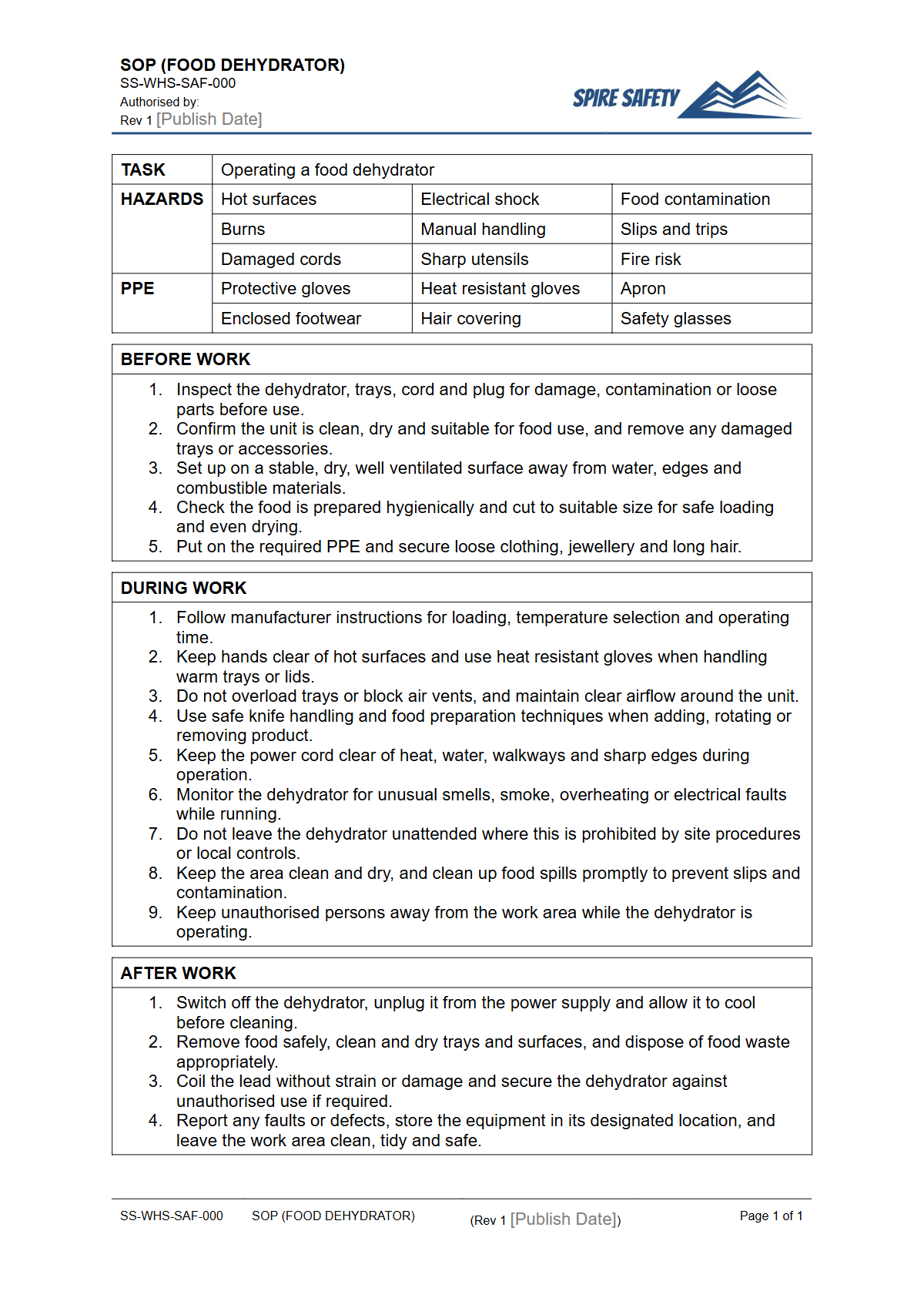
Download our free Safe Operating Procedure (Food Dehydrator) Template. This customisable Word & PDF resource helps establish safe work practices.
Free Safe Operating Procedure (Food Dehydrator) Template
DOCX • 126 KB + PDF
Updated Oct 2026
No signup required
Purpose of the Free Safe Operating Procedure (Food Dehydrator) Template
This free Safe Operating Procedure (Food Dehydrator) Template provides a structured starting point for documenting the safe use of commercial and domestic food dehydrators in a workplace setting. Using a food dehydrator, while seemingly simple, introduces hazards that must be managed to ensure worker safety and food hygiene.
The primary purpose of this SOP is to provide a clear, step-by-step guide for operators, minimising risks such as electrical shocks, burns, and food contamination.
By implementing a formal SOP, you can standardise operating methods, assist in training, and demonstrate a commitment to fulfilling your Work Health and Safety (WHS) duties. This template is designed to be adapted to your specific equipment and operational context, helping you to control identified risks effectively.
Video walkthrough
How to use the Free Safe Operating Procedure (Food Dehydrator) Template
To get the most value from this resource, it must be customised for your workplace. A generic document cannot account for your specific dehydrator model, work environment, or the types of food being processed.
After downloading the DOCX or PDF file, consult with the workers who will be using the equipment to tailor the steps and safety precautions.
Follow these steps:
- Review and Edit: Add your company name and details. Go through each section and modify the content to reflect the exact make and model of your food dehydrator.
- Site-Specific Risks: Incorporate hazards unique to your location, such as ventilation, proximity to water, and workflow.
- Consultation: Discuss the draft SOP with your team. Their direct experience is invaluable for creating a practical and effective document.
- Approval and Training: Once finalised, have the SOP formally approved. Use it as a key tool for training new operators and for refresher training sessions.
- Integration: A single SOP is just one part of a holistic safety framework. This procedure should be integrated into your broader WHS management systems to ensure it is supported by appropriate training, supervision, and review processes.
A Note on Customisation
This template is a starting point. As we are not present in your workplace, we cannot know your specific equipment, environment, or processes. It is your responsibility as the Person Conducting a Business or Undertaking (PCBU) to ensure the final document is comprehensive, accurate, and suitable for your needs.
When to use a Food Dehydrator SOP
A Safe Operating Procedure for a food dehydrator should be a readily accessible document used in day-to-day operations. It is particularly critical in several situations: during the induction and training of new employees, before operating an unfamiliar model of dehydrator, as a reference for periodic cleaning and maintenance tasks, and as a review document following any incident or near-miss involving the equipment.
Who should use it
This SOP is intended for all personnel involved with the food dehydrator. This includes:
- Workers/Operators: As a direct guide for performing their tasks safely.
- Supervisors and Managers: To assist in providing effective training, monitoring safe work practices, and conducting workplace inspections.
- WHS Representatives and Committees: As a tool for risk assessment and reviewing control measures.
- PCBUs: To help meet their primary duty of care to provide and maintain a safe system of work.
Key Safety Considerations
When customising this SOP, pay close attention to the most common hazards associated with food dehydrators. These include electrical risks from faulty cords or plugs, thermal hazards from contact with hot surfaces, and biological hazards from improper food handling or inadequate cleaning.
Ensure your procedures detail pre-operational checks, correct PPE (like heat-resistant gloves), and strict cleaning schedules.
Electrical safety is paramount. Any incident involving electricity carries the risk of serious injury or fatality.
Having immediate access to emergency equipment and trained first-aiders is crucial. Our Free Safe Operating Procedure (Defibrillator Operation) Template can help formalise your emergency response for cardiac events.
Beyond the dehydrator itself, consider the surrounding work environment. Are operators required to reach high shelves for supplies?
If so, ensuring safe access with appropriate equipment is vital. A FREE Step Ladder SOP Template can help manage risks associated with working at heights, even minor ones.
A comprehensive SOP also includes guidelines for maintenance. In larger food processing facilities, maintenance tasks might involve other equipment. For example, using compressed air for cleaning requires its own set of safety protocols, which can be documented using a resource like our Free Air Compressor SOP Template. For more resources on a variety of equipment and tasks, you can browse our complete free WHS resources library.
Common mistakes
Common mistakes to avoid
- Failing to customise the template with model-specific operating and cleaning instructions.
- Neglecting to include detailed hygiene and food handling protocols, leading to contamination risks.
- Overlooking electrical safety checks, such as inspecting cords and plugs for damage before each use.
- Not providing hands-on training and verifying worker competency after the SOP is implemented.
Legal references
Legal considerations
The following legal requirements may be relevant to this type of work.
- Work Health and Safety Act (Harmonised) — Provides the primary duties for protecting workers and other people from work health and safety risks.
- Work Health and Safety Regulations (Harmonised) — Sets out requirements supporting the management of workplace hazards and risks.
The following codes may be relevant to this type of work.
- Managing WHS Risks Code of Practice — Provides practical guidance on identifying hazards, assessing risks and applying effective controls.
- Work Health and Safety Consultation, Cooperation and Coordination Code of Practice — Provides practical guidance on consulting workers and coordinating with other duty holders.
- Managing the Work Environment and Facilities Code of Practice — Provides practical guidance on safe work environments, workplace facilities and related controls.
Did you know
Ancient Practice
Food dehydration is one of the oldest methods of food preservation, with evidence of sun-drying fruits, vegetables, and meats dating back to ancient civilisations.
Hygiene is Key
The low temperatures used in dehydration can create an ideal environment for bacterial growth if equipment isn't scrupulously cleaned, making hygiene as important as electrical or thermal safety.
FAQ
Frequently asked questions
01What are the main hazards of using a food dehydrator in a workplace?
02Does this food dehydrator SOP template cover commercial models?
03How often should I review the SOP for our food dehydrator?
04Who is responsible for training workers on this SOP?
Share this resource
Free Safe Operating Procedure (Food Dehydrator) Template
Browse Categories
How To Use It
- 1Download and open in Word or PDF.
- 2Replace the placeholders with your business details.
- 3Get it reviewed by a WHS specialist before rollout.
Need it customised?
Our WHS consultants can adapt this template to your site, run a gap analysis, or audit what you already have in place.
Book a Free Consultation WHS consulting servicesor call 1300 156 382
Related templates
- Free Safe Operating Procedure (Food Display Cleaning) Template
- Free Safe Operating Procedure (Food Label Printer) Template
- Free Safe Operating Procedure (Food Prep Sink Cleaning) Template
- Free Safe Operating Procedure (Food Probe Sanitising) Template
- Free Safe Operating Procedure (Food Processor) Template
- Free Safe Operating Procedure (Food Recall Isolation) Template