
Free Safe Operating Procedure (Food Prep Sink Cleaning) Template
Download our free Safe Operating Procedure for food prep sink cleaning.
Free Safe Operating Procedure (Food Prep Sink Cleaning) Template
DOCX • 126 KB + PDF
Updated Oct 2026
No signup required
Purpose of the Free Safe Operating Procedure (Food Prep Sink Cleaning) Template
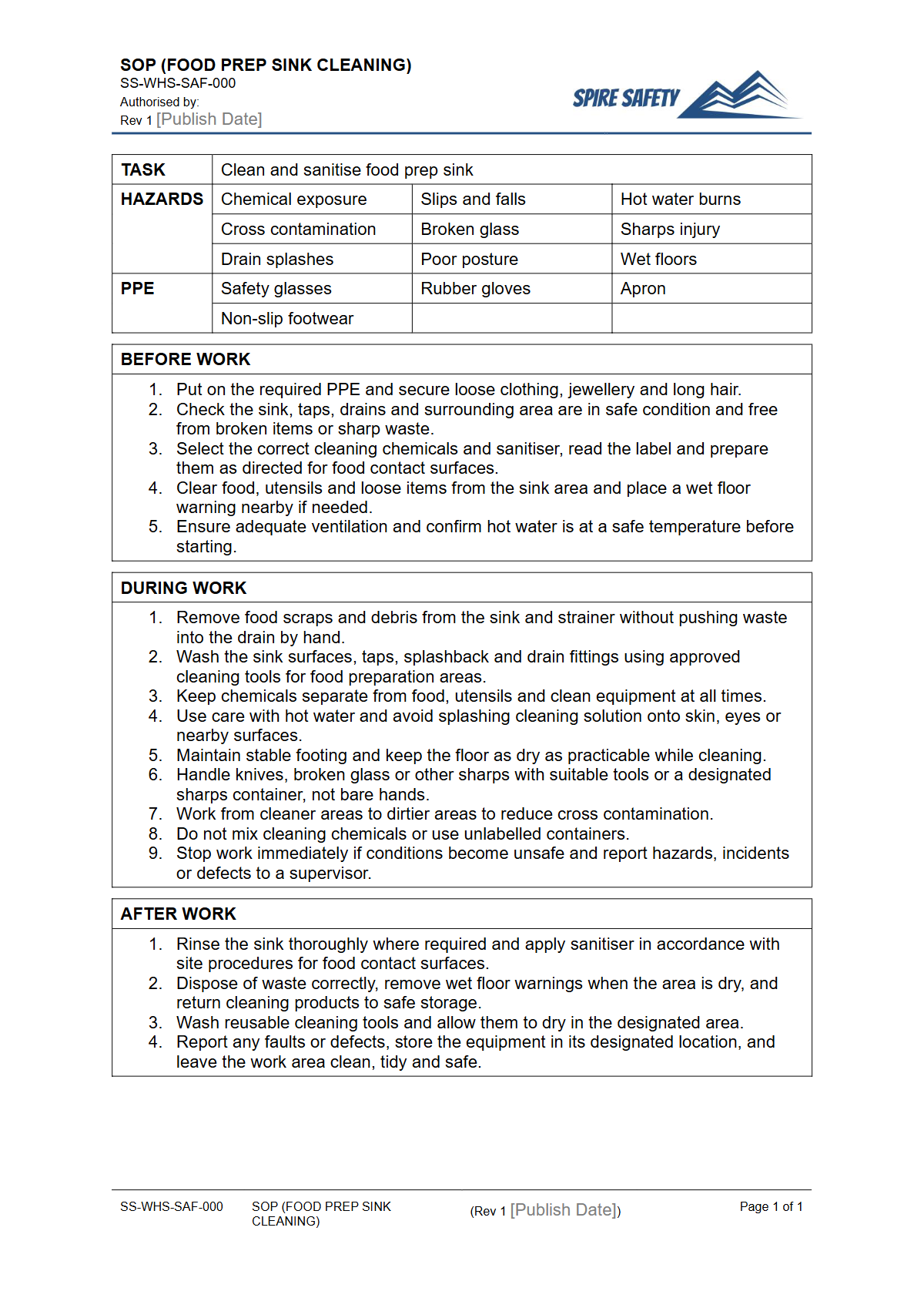
Properly cleaning and sanitising food preparation sinks is a critical task in any commercial kitchen, cafe, or food handling environment. This free Safe Operating Procedure (Food Prep Sink Cleaning) Template provides a structured framework for documenting a safe and effective process.
Using a standardised SOP helps minimise the risk of foodborne illness from cross-contamination, ensures the correct and safe use of cleaning chemicals, and protects workers from associated hazards. This document is an essential tool for demonstrating that a safe system of work is in place for routine hygiene tasks.
A well-defined SOP guides employees through the required steps, from pre-cleaning to final sanitisation, ensuring consistency and adherence to food safety standards. It outlines the specific hazards involved, such as exposure to chemicals or slips on wet floors, and specifies the control measures required to manage them.
Implementing formal procedures is a cornerstone of effective WHS management systems, providing clarity for staff and evidence of due diligence for the business.
Video walkthrough
How to use the Free Safe Operating Procedure (Food Prep Sink Cleaning) Template
This resource is provided as a fully editable DOCX file, with a PDF version also available for easy printing and distribution. To make it effective, you must adapt it to the specific context of your workplace.
This involves a review and customisation process to incorporate details unique to your site, equipment, and processes.
Key customisation steps include:
- Site-Specific Information: Add your company name, ABN, and the specific location or kitchen where the procedure applies.
- Chemicals and Equipment: List the exact names of the detergents and sanitisers used, including their Safety Data Sheets (SDS) references. Specify the type of personal protective equipment (PPE) required, such as gloves and safety glasses.
- Procedure Details: Adjust the step-by-step instructions to match your sink setup (e.g., two-basin or three-basin sinks) and the specific cleaning products and tools available.
- Consultation: Involve your workers in the drafting and review process. They perform the task daily and can provide valuable insights into potential hazards and practical improvements.
Important: This is a template, not a finished document. We have provided a solid foundation based on Australian WHS principles, but you are responsible for ensuring the final SOP is accurate and relevant to your specific operational needs.
If you require assistance with customisation or developing more complex procedures, consider our expert WHS consulting services.
When to use this Safe Operating Procedure
The Food Prep Sink Cleaning SOP should be used as the primary reference document whenever the task is performed. It serves multiple functions throughout the safety lifecycle.
It should be used during the induction and training of new kitchen staff or cleaners to ensure they understand the correct procedure from day one. It also acts as a valuable tool for refresher training to prevent procedural drift and maintain high standards.
Supervisors and managers should use the SOP as a benchmark for observing work practices and confirming that tasks are being completed safely and correctly. Furthermore, the document is a key piece of evidence during internal or external safety reviews.
A regular WHS compliance auditing program will often involve checking that documented procedures like this exist and are being followed by workers.
Who should use this Safe Operating Procedure
This SOP is designed for use by a range of personnel within any organisation that prepares or handles food. This includes restaurants, cafes, hotels, catering companies, childcare centres, and aged care facilities.
Primary users include:
- Kitchen Hands and Food Handlers: The individuals directly responsible for carrying out the cleaning and sanitising tasks.
- Chefs and Cooks: Staff who oversee or use the food preparation areas and need to ensure hygiene standards are met.
- Cleaning Staff: Designated cleaners who may be responsible for end-of-day deep cleaning procedures.
- Supervisors and Managers: Those responsible for training staff, overseeing kitchen operations, and ensuring compliance with food safety and WHS regulations. In an emergency, such as a chemical splash, other procedures may be needed, such as our Free Safe Operating Procedure (Defibrillator Operation) template for medical emergencies.
Ultimately, anyone involved in the chain of command for food safety and workplace hygiene should be familiar with this procedure. While this document covers sinks, other common tasks require similar guidance.
For tasks involving working at height, even at low levels, a FREE Step Ladder SOP Template can provide essential safety instructions. You can explore our full free WHS resources library for other templates relevant to your business.
Common mistakes
Common mistakes to avoid
- Using incorrect dilution ratios for detergents and sanitisers, making them ineffective or too strong.
- Failing to allow for sufficient sanitiser contact time on the sink surface.
- Using the same cloth to wash the sink that was used for wiping other surfaces, leading to cross-contamination.
- Neglecting to clean and sanitise faucets, handles, and drain plugs, which also harbour bacteria.
Legal references
Legal considerations
The following legal requirements may be relevant to this type of work.
- Work Health and Safety Act (Harmonised) — Provides the primary duties for protecting workers and other people from work health and safety risks.
- Work Health and Safety Regulations (Harmonised) — Sets out requirements supporting the management of workplace hazards and risks.
The following codes may be relevant to this type of work.
- Managing WHS Risks Code of Practice — Provides practical guidance on identifying hazards, assessing risks and applying effective controls.
- Work Health and Safety Consultation, Cooperation and Coordination Code of Practice — Provides practical guidance on consulting workers and coordinating with other duty holders.
- Managing the Work Environment and Facilities Code of Practice — Provides practical guidance on safe work environments, workplace facilities and related controls.
Did you know
Contact Time is Critical
For a chemical sanitiser to be effective, it must remain in contact with the surface for a minimum period specified by the manufacturer, typically ranging from 30 seconds to several minutes.
The 'Two-Sink' vs 'Three-Sink' Method
The three-sink method (wash, rinse, sanitise) is the gold standard for manual dishwashing and sanitising in commercial kitchens, ensuring each step is distinct and contamination is minimised.
FAQ
Frequently asked questions
01What is the difference between cleaning and sanitising a food prep sink?
02How often should a food preparation sink be cleaned and sanitised?
03What PPE is typically required for cleaning a food prep sink?
04Why can't I use a handwashing sink for food preparation or cleaning equipment?
Share this resource
Free Safe Operating Procedure (Food Prep Sink Cleaning) Template
Browse Categories
How To Use It
- 1Download and open in Word or PDF.
- 2Replace the placeholders with your business details.
- 3Get it reviewed by a WHS specialist before rollout.
Need it customised?
Our WHS consultants can adapt this template to your site, run a gap analysis, or audit what you already have in place.
Book a Free Consultation WHS consulting servicesor call 1300 156 382
Related templates
- Free Safe Operating Procedure (Food Probe Sanitising) Template
- Free Safe Operating Procedure (Food Processor) Template
- Free Safe Operating Procedure (Food Recall Isolation) Template
- Free Safe Operating Procedure (Food Scale Cleaning) Template
- Free Safe Operating Procedure (Food Smoker) Template
- Free Safe Operating Procedure (Food Tray Collection) Template