
Free Safe Operating Procedure (Food Smoker) Template
Download our free Safe Operating Procedure (Food Smoker) Template. This customisable DOCX & PDF helps you outline safe work methods for food smokers.
Free Safe Operating Procedure (Food Smoker) Template
DOCX • 126 KB + PDF
Updated Oct 2026
No signup required
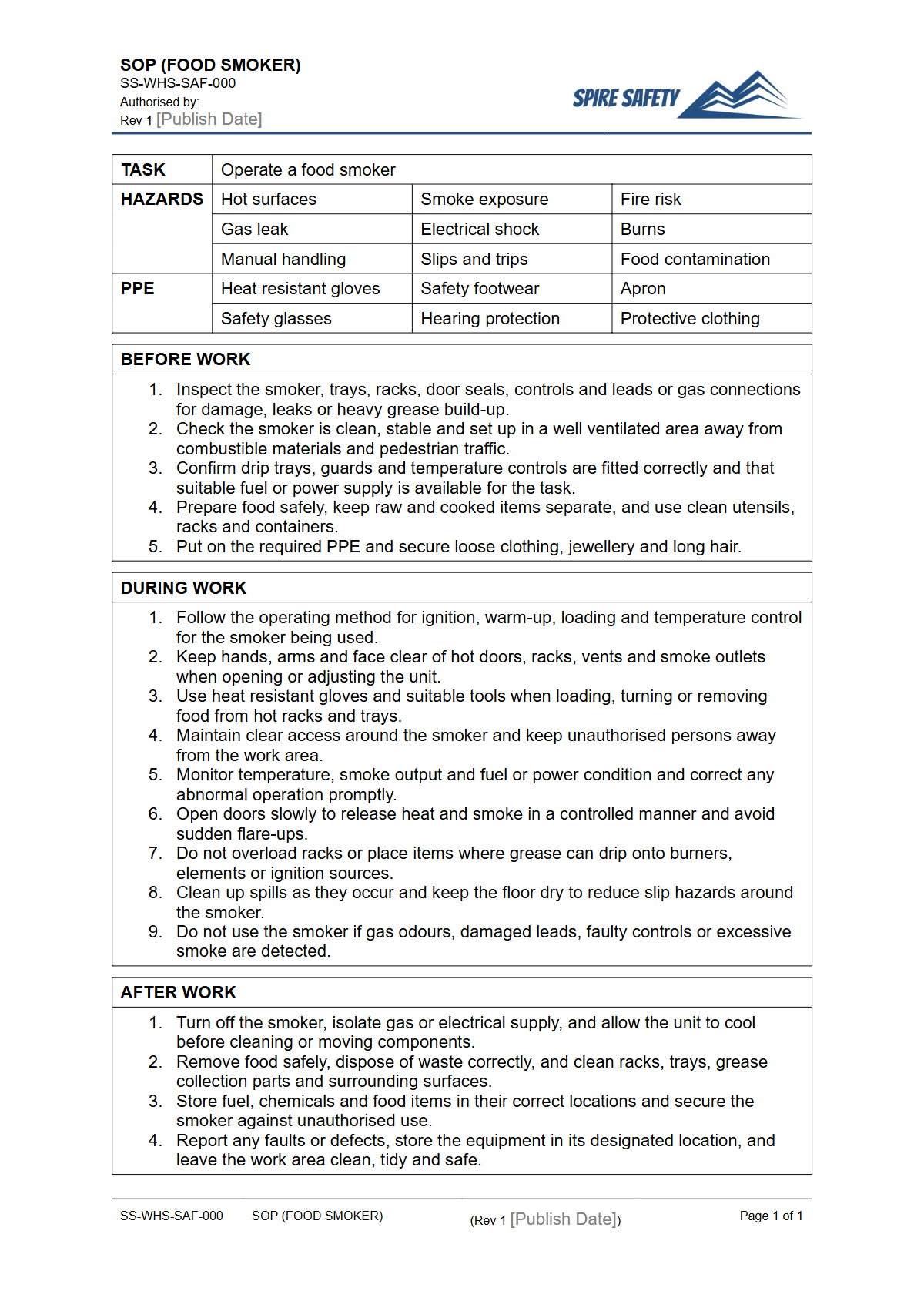
Purpose of the Free Safe Operating Procedure (Food Smoker) Template
This free Safe Operating Procedure (Food Smoker) Template provides a structured framework for documenting the safe use of commercial food smokers in your workplace. Operating a food smoker, whether gas, electric, or solid fuel-powered, introduces significant workplace hazards.
These include severe burns from hot surfaces, fire from flammable grease buildup or fuel mismanagement, and potential exposure to carbon monoxide in poorly ventilated areas. A documented SOP is a critical tool for managing these risks, ensuring workers understand the required steps for safe operation, cleaning, and maintenance.
It forms an essential part of a proactive approach to safety, helping to fulfil your duty of care under Australian WHS laws.
Using a standardised procedure helps ensure consistency in how tasks are performed, reducing the likelihood of incidents caused by human error. This SOP template acts as a foundation for your safety documentation, contributing to the development of a comprehensive WHS management system that protects your people and your business.
Video walkthrough
How to use the Free Safe Operating Procedure (Food Smoker) Template
To effectively implement this Safe Operating Procedure (Food Smoker) Template, you must adapt it to your specific operational context. A generic document is not sufficient; customisation is key to creating a useful and effective control measure.
The process should be collaborative, involving the people who actually operate the equipment daily.
IMPORTANT
This document is a template only. We cannot guarantee it will be suitable for your specific circumstances.
You must customise it by consulting with your workers and assessing the unique risks associated with your equipment, processes, and work environment. A thorough risk assessment should be completed before finalising this SOP.
Steps for Implementation:
- Download and Review: Start by downloading the DOCX or PDF and familiarising yourself with its sections.
- Consult and Customise: Work with supervisors and equipment operators to fill in the details. Add model-specific information, site-specific rules (e.g., ventilation requirements), details on fuel handling and storage, and the exact Personal Protective Equipment (PPE) required.
- Train and Induct: Use the finalised SOP as a training tool for all new and existing workers who will operate the food smoker. Keep records of this training.
- Supervise and Monitor: Managers and supervisors must ensure the procedures outlined in the SOP are consistently followed.
- Review and Update: The SOP should be reviewed regularly (e.g., annually) and updated whenever there is a change to the equipment, work environment, or after any incident.
If you are unsure whether your safety procedures meet all relevant standards, engaging a professional for a WHS compliance audit can provide clarity and help identify any gaps in your system.
When to use this Safe Operating Procedure
A Safe Operating Procedure for a food smoker should be a living document, referenced at multiple points in your operations. It is not a file-and-forget exercise.
Use this SOP for worker induction and competency training, ensuring everyone understands the hazards and controls before they begin work. It should also be readily available near the equipment as a quick reference guide for pre-start checks, operational steps, and shutdown procedures.
Furthermore, the SOP is an invaluable tool during incident investigations. It provides a baseline of expected safe behaviour against which actions can be compared.
Procedures for associated tasks, such as cleaning grease traps or maintaining exhaust systems that may involve working at height, should also be considered. For tasks involving ladders, you may also need our FREE Step Ladder SOP Template.
Who is Responsible for the SOP
Under WHS legislation, the Person Conducting a Business or Undertaking (PCBU) holds the primary duty of care and is ultimately responsible for ensuring a safe work environment. This includes providing and maintaining safe plant and structures, and providing the necessary information, training, instruction, and supervision.
While the PCBU is ultimately responsible, this responsibility is actioned by different roles within the organisation.
- Managers and Supervisors: Responsible for implementing the SOP, ensuring workers are trained on its contents, and enforcing its use on the floor. They also typically lead the review and update process.
- Workers: Responsible for following the procedures outlined in the SOP, wearing the required PPE, and reporting any hazards or incidents to their supervisor immediately.
An organisation will often have numerous SOPs covering different types of equipment and tasks. For example, while this SOP covers food smokers, a workshop might use our FREE Circular Saw SOP Template. The principles of development and implementation remain the same.
Emergency Procedures for Food Smokers
Your SOP must include a clear plan for emergency situations. This section should detail procedures for responding to a fire, including the location and correct use of fire extinguishers (e.g., Wet Chemical for cooking oil fires).
It should also outline first aid responses for common injuries such as burns or smoke inhalation. All workers should know the location of first aid kits and who the trained first aiders are on site.
Having accessible and operational emergency equipment is critical, which includes maintaining items like automated external defibrillators; our Safe Operating Procedure for Defibrillator Operation can assist with this.
This template is one of many documents designed to help you build a safer workplace. You can explore our complete free WHS resources library for more templates, checklists, and guides to support your safety management efforts.
Common mistakes
Common mistakes to avoid
- Using a generic template without customising it for the specific smoker model and workplace.
- Neglecting to specify required Personal Protective Equipment (PPE), such as heat-resistant gloves and aprons.
- Failing to include clear procedures for managing fuel sources, ventilation, and potential fire.
- Overlooking cleaning and maintenance schedules, leading to dangerous grease buildup and increased fire risk.
Legal references
Legal considerations
The following legal requirements may be relevant to this type of work.
- Work Health and Safety Act (Harmonised) — Provides the primary duties for protecting workers and other people from work health and safety risks.
- Work Health and Safety Regulations (Harmonised) — Sets out requirements supporting the management of workplace hazards and risks.
The following codes may be relevant to this type of work.
- Managing WHS Risks Code of Practice — Provides practical guidance on identifying hazards, assessing risks and applying effective controls.
- Work Health and Safety Consultation, Cooperation and Coordination Code of Practice — Provides practical guidance on consulting workers and coordinating with other duty holders.
- Managing the Work Environment and Facilities Code of Practice — Provides practical guidance on safe work environments, workplace facilities and related controls.
Did you know
Fire Risk in Kitchens
Commercial kitchen fires are a significant risk, with cooking equipment being the leading cause. Regular cleaning and maintenance of appliances like food smokers are critical prevention measures.
The Invisible Danger
Wood and charcoal-fired smokers produce carbon monoxide (CO), a colourless and odourless toxic gas. Proper ventilation as specified by the manufacturer and building codes is essential to prevent CO buildup in enclosed spaces.
FAQ
Frequently asked questions
01What are the main hazards of using a commercial food smoker?
02Does a Safe Operating Procedure replace a risk assessment?
03How often should a food smoker SOP be reviewed?
04Who is responsible for training workers on the food smoker SOP?
Share this resource
Free Safe Operating Procedure (Food Smoker) Template
Browse Categories
How To Use It
- 1Download and open in Word or PDF.
- 2Replace the placeholders with your business details.
- 3Get it reviewed by a WHS specialist before rollout.
Need it customised?
Our WHS consultants can adapt this template to your site, run a gap analysis, or audit what you already have in place.
Book a Free Consultation WHS consulting servicesor call 1300 156 382
Related templates
- Free Safe Operating Procedure (Food Tray Collection) Template
- Free Safe Operating Procedure (Food Tray Delivery) Template
- Free Safe Operating Procedure (Food Tray Stacking) Template
- Free Safe Operating Procedure (Food Waste Bin Cleaning) Template
- Free Safe Operating Procedure (Footpath Cleaning) Template
- Free Safe Operating Procedure (Footstool Cleaning) Template