
Free Safe Operating Procedure (Food Tray Stacking) Template
Download our free Safe Operating Procedure (Food Tray Stacking) Template.
Free Safe Operating Procedure (Food Tray Stacking) Template
DOCX • 126 KB + PDF
Updated Oct 2026
No signup required
Purpose of the Free Safe Operating Procedure (Food Tray Stacking) Template
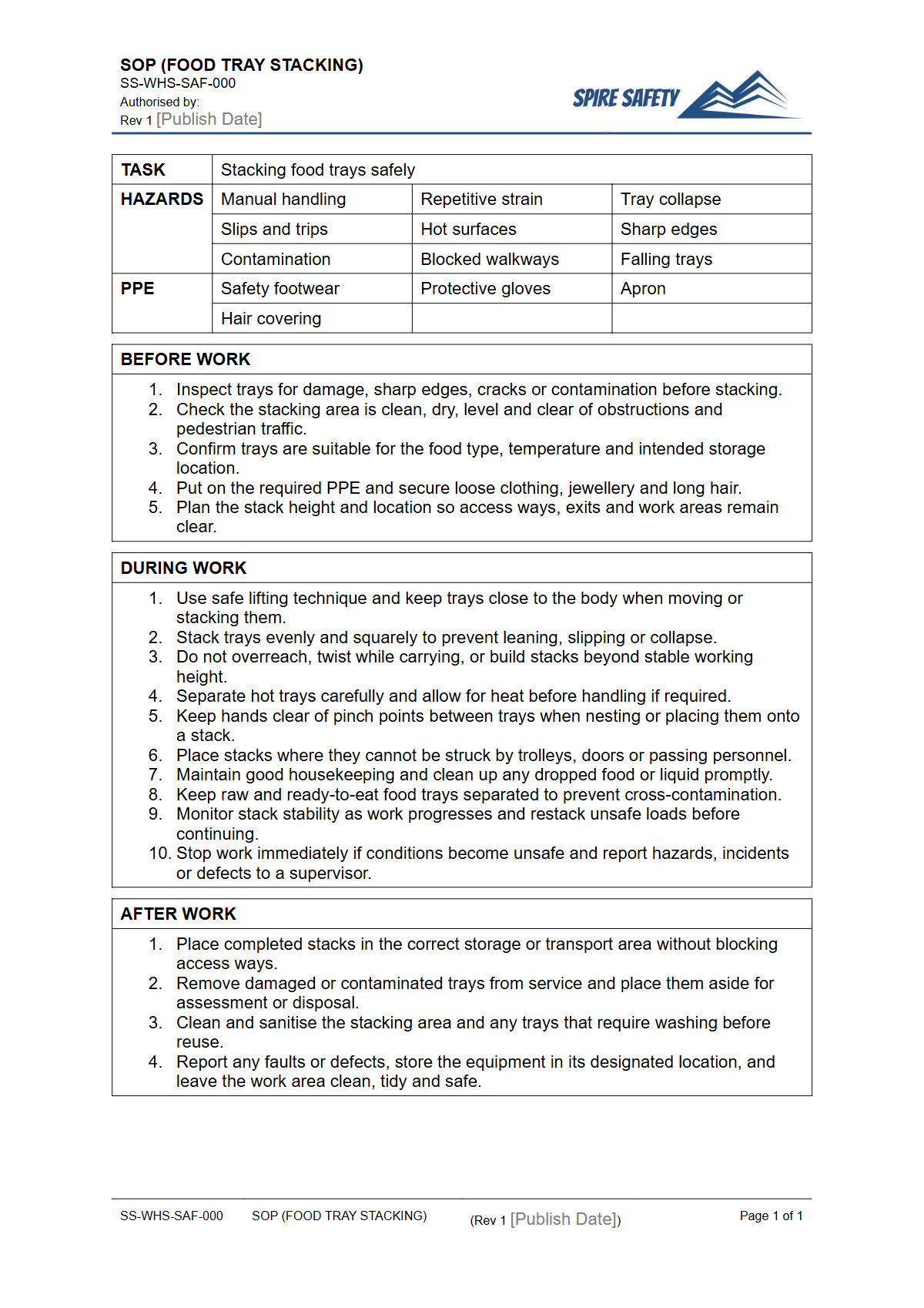
This Free Safe Operating Procedure (Food Tray Stacking) Template provides a structured framework for documenting the required steps to safely stack and handle food trays in a commercial kitchen, canteen, or hospitality environment. Its main purpose is to help organisations minimise the risk of injury from hazardous manual tasks, such as musculoskeletal disorders (sprains and strains) from lifting, carrying, and placing trays.
It also addresses secondary risks like slips, trips, and falls from potential spills or poorly organised work areas.
By formalising the process, you create a clear, consistent guide for all workers, reducing procedural variation and the likelihood of incidents. A well-defined SOP is a fundamental component of a proactive safety culture and is essential for demonstrating due diligence.
It acts as a key training tool and a reference point for daily operations, ensuring that control measures identified during the risk assessment process are consistently applied. Using a structured template ensures all critical safety elements, from pre-operational checks to shutdown procedures, are considered.
A robust SOP for food tray stacking should be integrated into your broader safety framework. Developing clear procedures for all common workplace tasks is a key part of effective WHS management systems, creating a safer and more organised operational environment.
Video walkthrough
How to use the Free Safe Operating Procedure (Food Tray Stacking) Template
Begin by downloading the template in your preferred format (DOCX for easy editing or PDF for straightforward printing). The document is logically structured to guide you through the process, covering personal protective equipment (PPE), pre-operational checks, step-by-step instructions for the task, and post-operational clean-up.
Customisation is Essential
IMPORTANT: This document is a template and must be customised to meet the specific needs of your workplace. You must review and amend the content to reflect your unique equipment (e.g., types of trays, trolleys, or racks), work environment, and existing policies.
We strongly recommend consulting with the workers who perform the task to ensure the SOP is practical and accurately reflects the on-the-ground reality. Spire Safety is not liable for any incidents arising from the use of this generic template.
Once tailored to your site, the SOP should be formally approved by management and made readily accessible to all relevant personnel. It becomes a critical document for worker inductions, task-specific training, and refresher courses. For particularly complex or high-risk manual tasks, you may seek expert advice to ensure all hazards are controlled, which is a core part of broader WHS consulting.
When to use it
A Safe Operating Procedure for food tray stacking should be used in several key situations. It serves as the primary training document for new employees or those new to the task, ensuring they learn the correct, safe method from the outset.
It should also be used for regular refresher training to reinforce safe work habits and communicate any changes to the procedure.
Supervisors should use the SOP as a tool for monitoring work practices and correcting unsafe behaviours. Following an incident, near miss, or the identification of a new hazard, the SOP must be reviewed and updated to incorporate new learnings and control measures.
Regular reviews, even without an incident, ensure the procedure remains current with any changes in equipment or processes. This process of periodic verification is similar to conducting a WHS compliance auditing program for your procedures.
Who should use it
This SOP is intended for a range of personnel within any organisation involved in food preparation and service. The primary users are the workers who directly perform the task, including kitchen hands, catering staff, cooks, and food and beverage attendants.
It provides them with clear, unambiguous instructions to perform their duties safely.
Supervisors, team leaders, and managers must also use the document to train their staff, enforce safe procedures, and conduct workplace inspections. Furthermore, Health and Safety Representatives (HSRs) and WHS managers will find it an essential tool for risk management, incident investigation, and demonstrating compliance with safety obligations.
The principles in this SOP can be adapted for many manual tasks, just as you might need a specific step ladder SOP for tasks involving work at height in a stockroom.
This template is just one example of the procedural documents available. You can explore our complete free WHS resources library to find templates for a wide variety of equipment and tasks.
Common mistakes
Common mistakes to avoid
- Using a generic SOP without customising it for the specific trays, trolleys, and work area.
- Failing to train workers on the procedure or confirm their understanding.
- Not reviewing and updating the SOP after an incident, near miss, or change in process.
- Ignoring practical ergonomic factors like stack height, weight limits, and travel paths.
Legal references
Legal considerations
The following legal requirements may be relevant to this type of work.
- Work Health and Safety Act (Harmonised) — Provides the primary duties for protecting workers and other people from work health and safety risks.
- Work Health and Safety Regulations (Harmonised) — Sets out requirements supporting the management of workplace hazards and risks.
The following codes may be relevant to this type of work.
- Managing WHS Risks Code of Practice — Provides practical guidance on identifying hazards, assessing risks and applying effective controls.
- Work Health and Safety Consultation, Cooperation and Coordination Code of Practice — Provides practical guidance on consulting workers and coordinating with other duty holders.
- Managing the Work Environment and Facilities Code of Practice — Provides practical guidance on safe work environments, workplace facilities and related controls.
Did you know
Manual Task Injuries
According to Safe Work Australia, the accommodation and food services industry has one of the highest rates of serious workers' compensation claims, with manual handling injuries being a significant contributor.
FAQ
Frequently asked questions
01What is a Safe Operating Procedure for food tray stacking?
02What are the main risks associated with stacking food trays?
03Do I need to train my staff on this specific SOP?
04Is this SOP template aligned with Australian WHS laws?
Share this resource
Free Safe Operating Procedure (Food Tray Stacking) Template
Browse Categories
How To Use It
- 1Download and open in Word or PDF.
- 2Replace the placeholders with your business details.
- 3Get it reviewed by a WHS specialist before rollout.
Need it customised?
Our WHS consultants can adapt this template to your site, run a gap analysis, or audit what you already have in place.
Book a Free Consultation WHS consulting servicesor call 1300 156 382
Related templates
- Free Safe Operating Procedure (Food Waste Bin Cleaning) Template
- Free Safe Operating Procedure (Footpath Cleaning) Template
- Free Safe Operating Procedure (Footstool Cleaning) Template
- Free Safe Operating Procedure (Forestry Harvester) Template
- Free Safe Operating Procedure (Forklift - Battery LPG Changeover) Template
- Free Safe Operating Procedure (Forwarder) Template