
Free Safe Operating Procedure (Forestry Harvester) Template
Download a free Safe Operating Procedure (Forestry Harvester) template to document safe work methods for operating forestry machinery.
Free Safe Operating Procedure (Forestry Harvester) Template
DOCX • 126 KB + PDF
Updated Oct 2026
No signup required
Purpose of the Free Safe Operating Procedure (Forestry Harvester) Template
Operating a forestry harvester involves significant risks, from falling objects and mechanical failures to difficult terrain and operator fatigue. Establishing a clear, documented process is crucial for operator safety and managing WHS duties.
This Free Safe Operating Procedure (Forestry Harvester) Template provides a structured starting point for your business, helping you outline the step-by-step processes required to operate this heavy machinery safely and ensure all workers understand the associated hazards and control measures.
The primary purpose of this Safe Operating Procedure is to provide a detailed, sequential guide for the safe operation of forestry harvesters. It acts as a vital tool for risk management, helping to standardise practices across your team and minimise the chance of incidents.
A well-developed SOP helps in identifying hazards such as falling trees, hydraulic system failures, fire risks, and ergonomic strains. It also documents the specific control measures required to mitigate these risks, forming a critical component of your overall WHS management system.
This procedure ensures every operator follows a consistent, safe method, which is essential for training, competency verification, and incident investigation. Similar to documenting processes for earthmoving equipment, like in a FREE Dozer SOP Template, a harvester SOP focuses on the unique risks of its operating environment.
Video walkthrough
How to use the Free Safe Operating Procedure (Forestry Harvester) Template
This template is provided in both DOCX and PDF formats for your convenience. The DOCX file is fully editable, allowing you to tailor the content to your specific workplace, machinery models, site conditions, and organisational policies.
Important: This is a template, not a finished document. To be effective, you must customise it to reflect the specific hazards and control measures relevant to your site.
We recommend a person with competency and experience in forestry operations consults with workers and other stakeholders during this process. A generic SOP that doesn't match your actual work practices is not useful and may not meet your legal obligations.
The customisation process is similar to adapting other plant-specific documents, such as a FREE Trencher SOP Template, where site-specific variables are paramount to creating a useful safety document.
Key sections to include in your Harvester SOP
When customising the template, ensure you detail the following key areas:
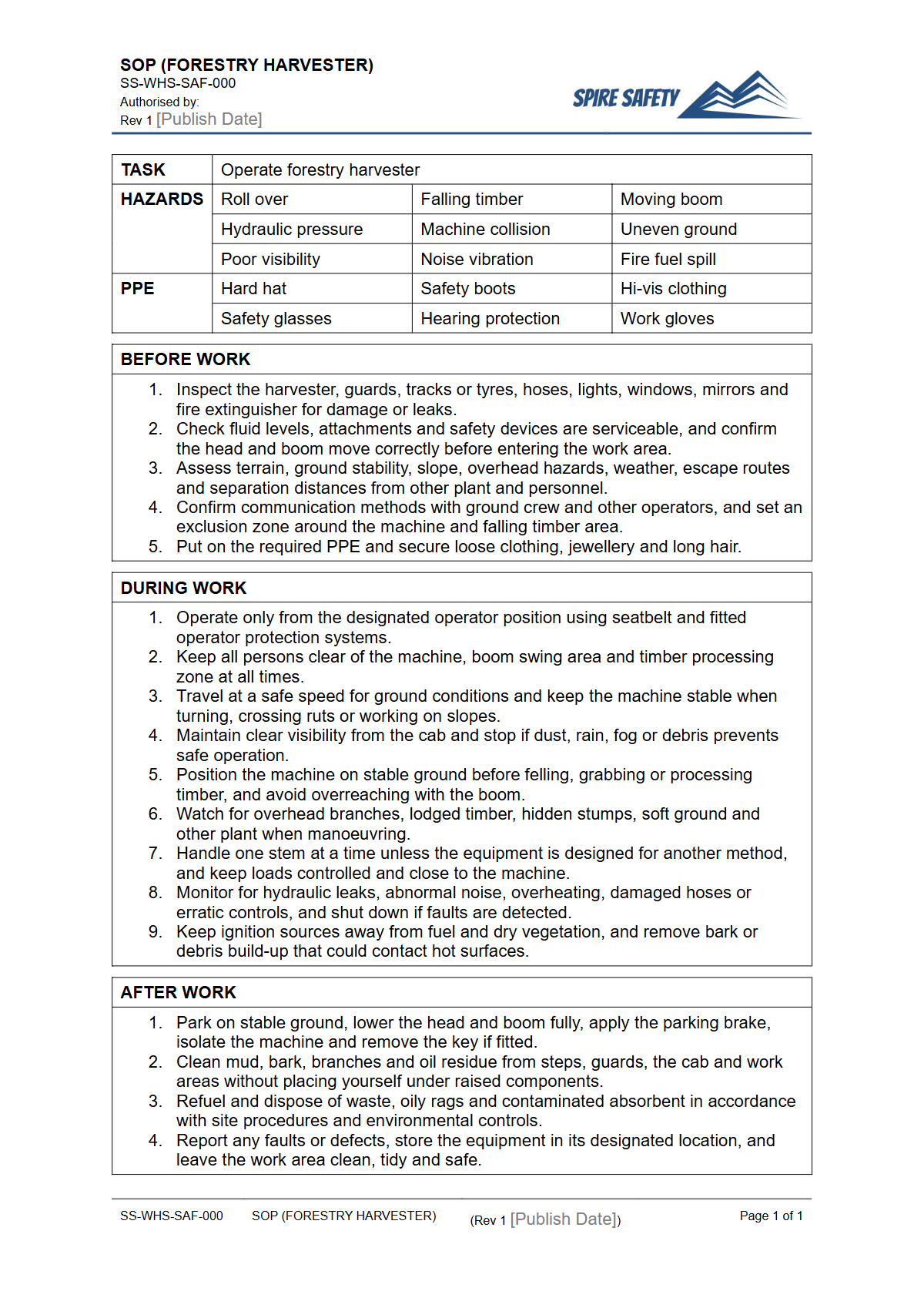
- Required PPE: Specify items like hard hats, high-visibility clothing, hearing protection, steel-capped boots, and cut-resistant gloves.
- Pre-start Checks: A detailed checklist covering fluid levels, hydraulic hoses, fire suppression systems, controls, and communication equipment.
- Step-by-Step Operating Sequence: From entering the cabin safely to felling, processing, and stacking timber. Include procedures for operating on slopes and in adverse weather.
- Emergency Procedures: Steps for machine fire, hydraulic failure, medical emergencies, and cabin evacuation. This complements general emergency response plans, like those for using an automated external defibrillator, which can be documented using a specific SOP for Defibrillator Operation.
- Shutdown and Maintenance Procedures: Correct sequence for powering down, securing the machine, and lock-out/tag-out procedures for maintenance.
When to use it
A Safe Operating Procedure for a forestry harvester should be used as a core reference document in several key situations:
- Operator Training and Induction: As a foundational document for training new or inexperienced operators on the correct, safe methods.
- Pre-operational Checks: To guide operators through the required daily inspections and function tests before starting work.
- Refresher Training: For ongoing competency checks and periodic refreshers for experienced operators.
- Risk Assessment Reviews: Use the SOP as a reference when conducting or reviewing risk assessments for forestry operations.
- Incident Investigations: To determine if established procedures were followed and identify any gaps that may have contributed to an incident.
Who should use it
This SOP template is designed for use by various roles within an organisation conducting forestry operations:
- Persons Conducting a Business or Undertaking (PCBUs): To meet their primary duty of care by providing safe systems of work.
- Managers and Supervisors: To train, supervise, and monitor operators, ensuring they adhere to the established safe procedures.
- Forestry Harvester Operators: As a direct guide for their day-to-day tasks, from start-up to shutdown and maintenance.
- WHS Professionals: As a tool for developing and integrating safety documentation into the broader safety management framework.
For organisations needing support in developing their documentation, seeking expert WHS consulting can ensure procedures are robust and practical.
The principles of documenting safe use apply to a wide range of heavy equipment. This includes machinery with complex hydraulic systems and stability risks, such as those covered in our FREE Boom Pump SOP Template.
By thoroughly customising and implementing this SOP, your organisation can significantly improve the safety and consistency of its forestry harvesting operations. For more document templates and safety guides, explore our complete free WHS resources library.
Common mistakes
Common mistakes to avoid
- Using a generic, non-customised SOP that doesn't reflect actual site conditions.
- Failing to consult with operators when drafting or reviewing the procedure.
- Not providing adequate training on the SOP, assuming workers will just read it.
- Neglecting to review and update the SOP after an incident or near-miss.
Legal references
Legal considerations
The following legal requirements may be relevant to this type of work.
- Work Health and Safety Act (Harmonised) — Provides the primary duties for protecting workers and other people from work health and safety risks.
- Work Health and Safety Regulations (Harmonised) — Sets out requirements supporting the management of workplace hazards and risks.
The following codes may be relevant to this type of work.
- Managing WHS Risks Code of Practice — Provides practical guidance on identifying hazards, assessing risks and applying effective controls.
- Work Health and Safety Consultation, Cooperation and Coordination Code of Practice — Provides practical guidance on consulting workers and coordinating with other duty holders.
- Managing the Work Environment and Facilities Code of Practice — Provides practical guidance on safe work environments, workplace facilities and related controls.
Did you know
Operator Blind Spots
Modern forestry harvesters have extensive glass and camera systems, but significant blind spots still exist, especially to the rear and sides of the machine. This is a leading cause of incidents involving ground workers.
Fire Suppression Systems
Due to the high risk of fire from hydraulic oil, electrical faults, and flammable debris, many forestry machines are fitted with automatic fire suppression systems. Regular inspection of these systems is a critical pre-start check.
FAQ
Frequently asked questions
01What is the difference between a SWMS and an SOP for a forestry harvester?
02How often should a Forestry Harvester SOP be reviewed?
03Who is responsible for developing the Forestry Harvester SOP?
04Does this template cover all legal WHS requirements for forestry harvesters?
Share this resource
Free Safe Operating Procedure (Forestry Harvester) Template
Browse Categories
How To Use It
- 1Download and open in Word or PDF.
- 2Replace the placeholders with your business details.
- 3Get it reviewed by a WHS specialist before rollout.
Need it customised?
Our WHS consultants can adapt this template to your site, run a gap analysis, or audit what you already have in place.
Book a Free Consultation WHS consulting servicesor call 1300 156 382
Related templates
- Free Safe Operating Procedure (Forklift - Battery LPG Changeover) Template
- Free Safe Operating Procedure (Forwarder) Template
- Free Safe Operating Procedure (Freezer Stocking) Template
- Free Safe Operating Procedure (Freight Bay Allocation) Template
- Free Safe Operating Procedure (Freight Damage Reporting) Template
- Free Safe Operating Procedure (Freight Label Check) Template