
Free Safe Operating Procedure (Freight Label Check) Template
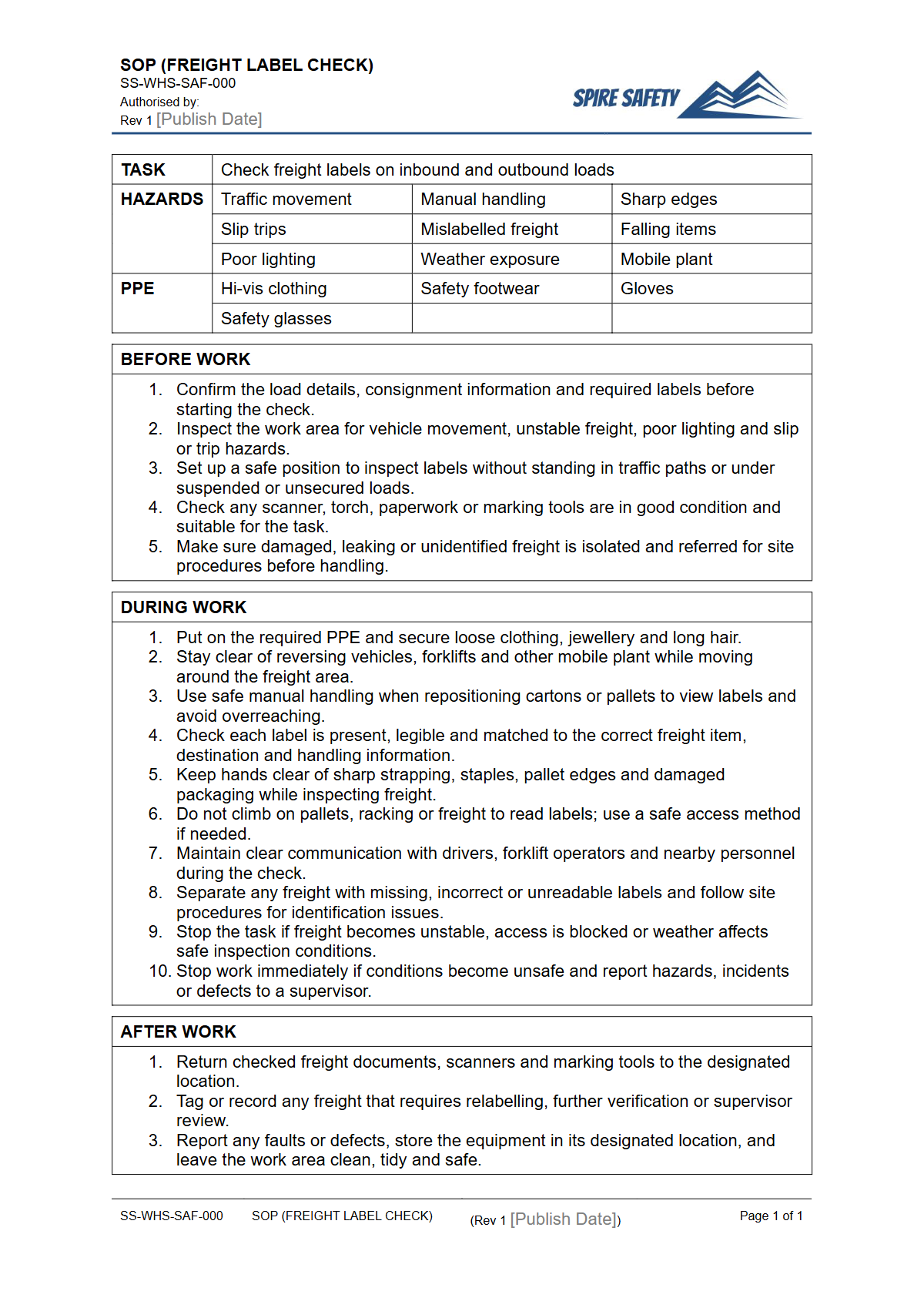
Download our free Safe Operating Procedure (Freight Label Check) template. This DOCX & PDF helps standardise checks for accurate freight labelling.
Free Safe Operating Procedure (Freight Label Check) Template
DOCX • 126 KB + PDF
Updated Oct 2026
No signup required
Purpose of the Free Safe Operating Procedure (Freight Label Check) Template
Incorrect freight labelling is a common source of delays, lost goods, and customer dissatisfaction. Establishing a clear, repeatable process is essential for any organisation involved in logistics and dispatch.
Our Free Safe Operating Procedure (Freight Label Check) Template provides a structured framework to help your team perform accurate and consistent checks before goods leave your facility. Using a standardised procedure minimises human error, ensures accountability, and streamlines your dispatch workflow.
This Safe Operating Procedure serves as a vital component of a quality control process. By formalising the steps for verifying addresses, consignment details, and special handling instructions, you create a more resilient and efficient logistics operation.
Integrating SOPs like this one is a fundamental part of developing robust WHS management systems, as they translate policy into practical, on-the-ground action that protects both your people and your business interests.
Video walkthrough
How to use the Free Safe Operating Procedure (Freight Label Check) Template
This template is designed as a starting point. Once downloaded, you can edit the DOCX file to align with your specific operational context.
This involves adding your company name, relevant dates, and the names of those responsible for authorising and reviewing the document. The most critical step is customising the procedural steps to match your unique workflow, software systems, and types of freight.
Important: This is a template, not a finished document. We cannot know the specific hazards, equipment, or processes in your workplace.
You must adapt the content to suit your operational environment, consulting with your workers throughout the process. A generic procedure is not an effective control measure.
For instance, your procedure might need to integrate with tasks involving specific machinery, which would require its own documentation, like our free Telehandler SOP template for moving pallets.
When to use it
The freight label check SOP should be implemented as a mandatory step in your pre-dispatch process. It should be used every time an item or consignment is prepared for shipping to an external party.
The procedure acts as a final quality gate, catching potential errors before they become costly problems. It is also a critical training tool for new warehouse and logistics staff, providing them with a clear, step-by-step guide to follow.
Furthermore, the document should be a point of reference during regular safety and quality reviews, forming part of your continuous improvement cycle. This review process may be part of a broader program of WHS compliance auditing to ensure procedures remain current and effective.
Who should use it
This Safe Operating Procedure is intended for all personnel involved in the packing, labelling, and dispatch of goods. This typically includes:
- Warehouse Operatives
- Dispatch Officers
- Logistics Coordinators
- Inventory Clerks
- Team Leaders and Supervisors
Managers and supervisors should also be thoroughly familiar with the SOP to effectively oversee its implementation, conduct training, and ensure consistent adherence. A strong safety culture relies on documented procedures for all key tasks, from operational processes to emergency preparedness, such as having a clear Safe Operating Procedure for Defibrillator Operation readily available.
Benefits of a Standardised Procedure
A well-implemented freight label check SOP delivers numerous benefits beyond basic compliance. It contributes directly to operational excellence by reducing the frequency of shipping errors, which in turn lowers costs associated with returns and re-shipments.
It also improves inventory accuracy and boosts customer satisfaction by ensuring reliable delivery. For staff, it provides clarity, reduces ambiguity, and simplifies the training process.
In a warehouse environment, where tasks can be varied, having clear procedures for all common activities, even those as simple as using a ladder, is crucial. You might also find our FREE Step Ladder SOP Template useful in this context.
Ultimately, formalising this check helps build a more professional and reliable logistics function. Explore our complete free WHS resources library for more templates to support your organisation's safety and quality management efforts.
Common mistakes
Common mistakes to avoid
- Failing to customise the template for specific freight carriers and internal software.
- Not adequately training staff on the procedure or enforcing its consistent use.
- Forgetting to schedule regular reviews, leading to an outdated and ineffective SOP.
- Storing the procedure where it is inaccessible to the workers who need it most.
Legal references
Legal considerations
The following legal requirements may be relevant to this type of work.
- Work Health and Safety Act (Harmonised) — Provides the primary duties for protecting workers and other people from work health and safety risks.
- Work Health and Safety Regulations (Harmonised) — Sets out requirements supporting the management of workplace hazards and risks.
The following codes may be relevant to this type of work.
- Managing WHS Risks Code of Practice — Provides practical guidance on identifying hazards, assessing risks and applying effective controls.
- Work Health and Safety Consultation, Cooperation and Coordination Code of Practice — Provides practical guidance on consulting workers and coordinating with other duty holders.
- Managing the Work Environment and Facilities Code of Practice — Provides practical guidance on safe work environments, workplace facilities and related controls.
Did you know
The Cost of Error
Industry estimates suggest that a single shipping error, often caused by incorrect labelling, can cost a business anywhere from $50 to over $100 after factoring in labour, customer service time, and return freight.
Barcode Beginnings
The first commercial use of a barcode was in 1974, when a pack of Wrigley's Juicy Fruit gum was scanned at a supermarket in Ohio, USA. This technology now underpins global logistics and inventory management.
FAQ
Frequently asked questions
01What information should be included in a freight label check procedure?
02Why is a Safe Operating Procedure important for a non-hazardous task like label checking?
03How often should we review our freight label check SOP?
04Can this template be used for dangerous goods labelling?
Share this resource
Free Safe Operating Procedure (Freight Label Check) Template
Browse Categories
How To Use It
- 1Download and open in Word or PDF.
- 2Replace the placeholders with your business details.
- 3Get it reviewed by a WHS specialist before rollout.
Need it customised?
Our WHS consultants can adapt this template to your site, run a gap analysis, or audit what you already have in place.
Book a Free Consultation WHS consulting servicesor call 1300 156 382
Related templates
- Free Safe Operating Procedure (Freight Repackaging) Template
- Free Safe Operating Procedure (Freight Screening) Template
- Free Safe Operating Procedure (Freight Segregation) Template
- Free Safe Operating Procedure (Freight Transfer) Template
- Free Safe Operating Procedure (Fruit Bin Handling) Template
- Free Safe Operating Procedure (Fruit Grader) Template