
Free Safe Operating Procedure (Fruit Bin Handling) Template
Download our free Safe Operating Procedure (Fruit Bin Handling) template for Australian workplaces.
Free Safe Operating Procedure (Fruit Bin Handling) Template
DOCX • 126 KB + PDF
Updated Oct 2026
No signup required
Purpose of the Free Safe Operating Procedure (Fruit Bin Handling) Template
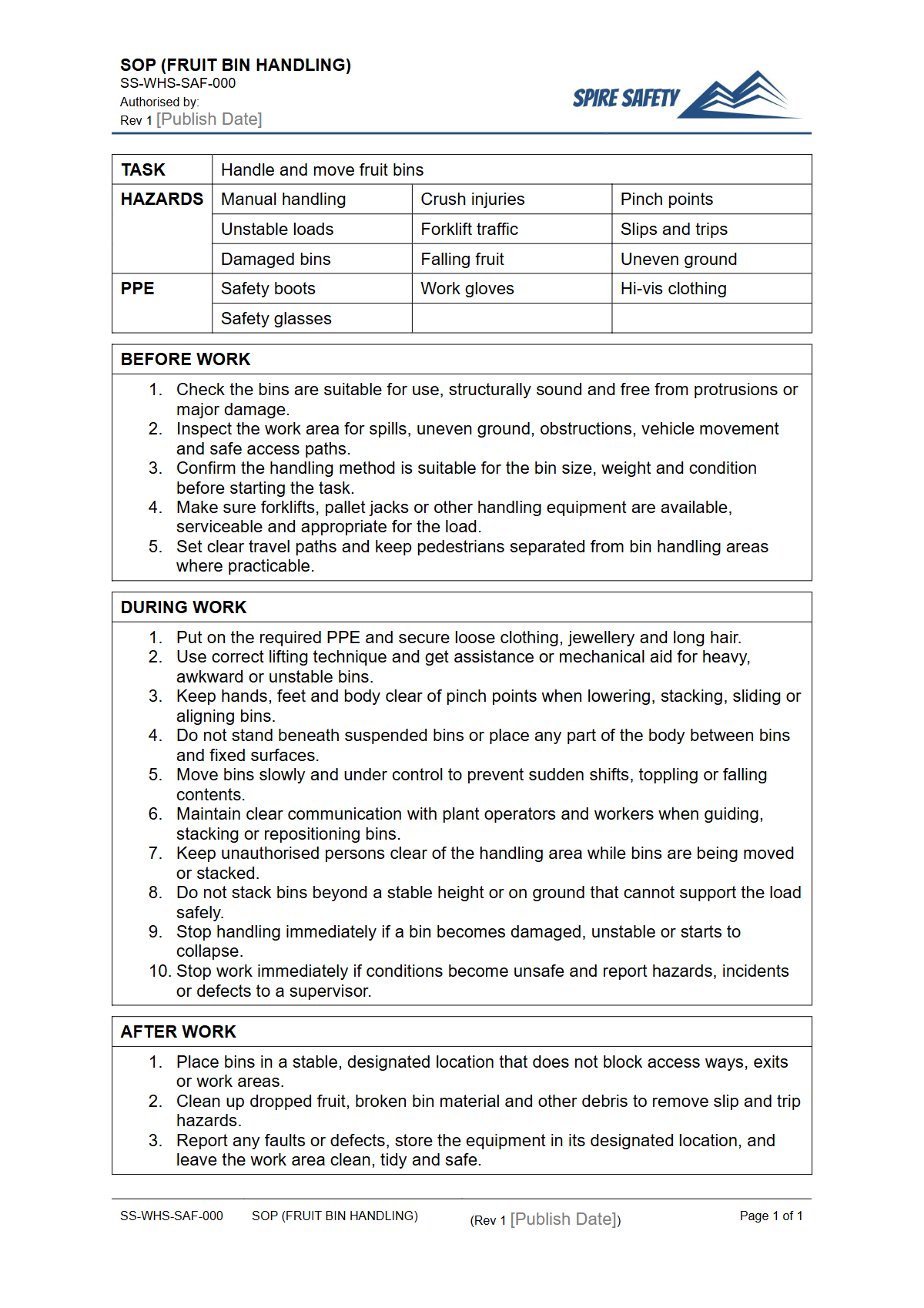
Handling large, heavy fruit bins is a high-risk activity common in Australian agriculture, horticulture, and food processing industries. This Free Safe Operating Procedure (Fruit Bin Handling) Template provides a structured framework for documenting the safe methods required to move, stack, transport, and empty fruit bins.
Its purpose is to help Persons Conducting a Business or Undertaking (PCBUs) establish and communicate clear, step-by-step instructions to workers, minimising the risk of incidents such as crush injuries, musculoskeletal disorders, and collisions involving mobile plant.
By implementing a formal Safe Operating Procedure (SOP), you can standardise work practices, support worker training, and demonstrate a systematic approach to managing workplace health and safety. The procedure details required personal protective equipment (PPE), pre-operational checks for machinery like forklifts, and the sequence of actions for completing the task safely.
This is especially critical when using machinery, and for tasks requiring specific training, you may need additional documentation like our FREE Telehandler SOP (Safe Operating Procedure) Template to cover all equipment used on site.
Video walkthrough
How to use the Free Safe Operating Procedure (Fruit Bin Handling) Template
This document is provided as a downloadable DOCX and PDF file, designed for easy customisation. After downloading, you must adapt the content to reflect the specific hazards and control measures relevant to your operation.
This involves conducting a thorough risk assessment of your fruit bin handling processes.
IMPORTANT: This is a template that you must customise for your specific workplace. We've provided a framework based on common industry practices, but you need to add details specific to your site, equipment (e.g., forklift models, bin types, attachments), environmental conditions, and personnel competency requirements.
A generic document is insufficient for ensuring safety. An effective SOP is a vital component of broader comprehensive WHS management systems that protect your workers and your business.
Key considerations for customisation include:
- Equipment Specifics: Detail the make and model of forklifts, tractors, or other plant used. Include capacity limits and specific attachments.
- Bin Types: Specify the types of bins used (e.g., wooden, plastic, half-tonne, one-tonne) and their unique handling requirements.
- Work Environment: Describe the layout of the work area, including designated stacking zones, pedestrian exclusion zones, ground conditions, and any overhead obstructions.
- Emergency Procedures: Outline the steps to take in case of a bin spill, equipment failure, or injury.
When to Use This Safe Operating Procedure
An SOP for fruit bin handling should be a core document used consistently throughout your operations. It is not a document to be filed away and forgotten. Use it during:
- Worker Training and Induction: Ensure all new and existing workers involved in the task are trained on the procedure before starting work.
- Pre-Start Meetings: Briefly review key safety points before commencing shifts, especially during peak seasons like harvest.
- Risk Assessments: Use the SOP as a baseline document when conducting or reviewing a task-based risk assessment.
- Incident Investigations: Refer to the SOP to determine if procedures were followed correctly or if they need to be revised.
- Audits and Reviews: Procedures should form part of your safety management system and be subject to periodic review and regular WHS compliance auditing to ensure they remain current and effective.
Who Should Use This Procedure
This Safe Operating Procedure is intended for all personnel involved in the lifecycle of fruit bin handling within an organisation. Key users include:
- Forklift and Plant Operators: The primary users who must follow the step-by-step instructions to perform the task safely.
- Packhouse Staff and Farm Hands: Workers who may be in the vicinity of bin handling operations or assist with tasks like bin tipping or cleaning.
- Supervisors and Team Leaders: Responsible for ensuring the procedure is followed, providing adequate supervision, and addressing any non-conformance.
- WHS Managers and Officers: Responsible for developing, implementing, and reviewing the procedure as part of the overall safety system. While this SOP covers bin handling, other agricultural tasks require their own specific procedures, such as our Grain Drill SOP Template.
Ultimately, everyone on site has a responsibility to understand the risks associated with moving plant and heavy loads. Having clear, documented procedures is fundamental to creating a safe work environment.
This SOP is just one of many essential documents you may need; browse our free WHS resources library to find other templates relevant to your operations.
Common mistakes
Common mistakes to avoid
- Failing to customise the template for specific forklift models and bin types.
- Neglecting to train workers on the finalised SOP and verify their understanding.
- Not establishing and enforcing clear exclusion zones for pedestrians around moving machinery.
- Ignoring regular review and updates, especially after a near miss or change in operations.
Legal references
Legal considerations
The following legal requirements may be relevant to this type of work.
- Work Health and Safety Act (Harmonised) — Provides the primary duties for protecting workers and other people from work health and safety risks.
- Work Health and Safety Regulations (Harmonised) — Sets out requirements supporting the management of workplace hazards and risks.
The following codes may be relevant to this type of work.
- Managing WHS Risks Code of Practice — Provides practical guidance on identifying hazards, assessing risks and applying effective controls.
- Work Health and Safety Consultation, Cooperation and Coordination Code of Practice — Provides practical guidance on consulting workers and coordinating with other duty holders.
- Managing the Work Environment and Facilities Code of Practice — Provides practical guidance on safe work environments, workplace facilities and related controls.
Did you know
Manual Task Injuries
Musculoskeletal disorders resulting from hazardous manual tasks are one of the most common types of workplace injuries in Australian agriculture, often stemming from repetitive or forceful movements involved in harvesting and processing.
Forklift Stability
A forklift's stability is dramatically affected by the load's weight, height, and position. A one-tonne fruit bin lifted high creates a much higher centre of gravity, significantly increasing the risk of the forklift tipping over, especially on uneven ground.
FAQ
Frequently asked questions
01What is a Safe Operating Procedure for fruit bin handling?
02Is this fruit bin handling SOP template enough for my business to be compliant?
03What are the main hazards of handling fruit bins?
04How often should a fruit bin handling SOP be reviewed?
Share this resource
Free Safe Operating Procedure (Fruit Bin Handling) Template
Browse Categories
How To Use It
- 1Download and open in Word or PDF.
- 2Replace the placeholders with your business details.
- 3Get it reviewed by a WHS specialist before rollout.
Need it customised?
Our WHS consultants can adapt this template to your site, run a gap analysis, or audit what you already have in place.
Book a Free Consultation WHS consulting servicesor call 1300 156 382
Related templates
- Free Safe Operating Procedure (Fruit Grader) Template
- Free Safe Operating Procedure (Fruit Picking) Template
- Free Safe Operating Procedure (Fruit Sorting) Template
- Free Safe Operating Procedure (Fuel Dock Operation) Template
- Free Safe Operating Procedure (Fuel Hydrant Cart) Template
- Free Safe Operating Procedure (Fuel Line Disconnect) Template