
Free Safe Operating Procedure (Fuel Line Disconnect) Template
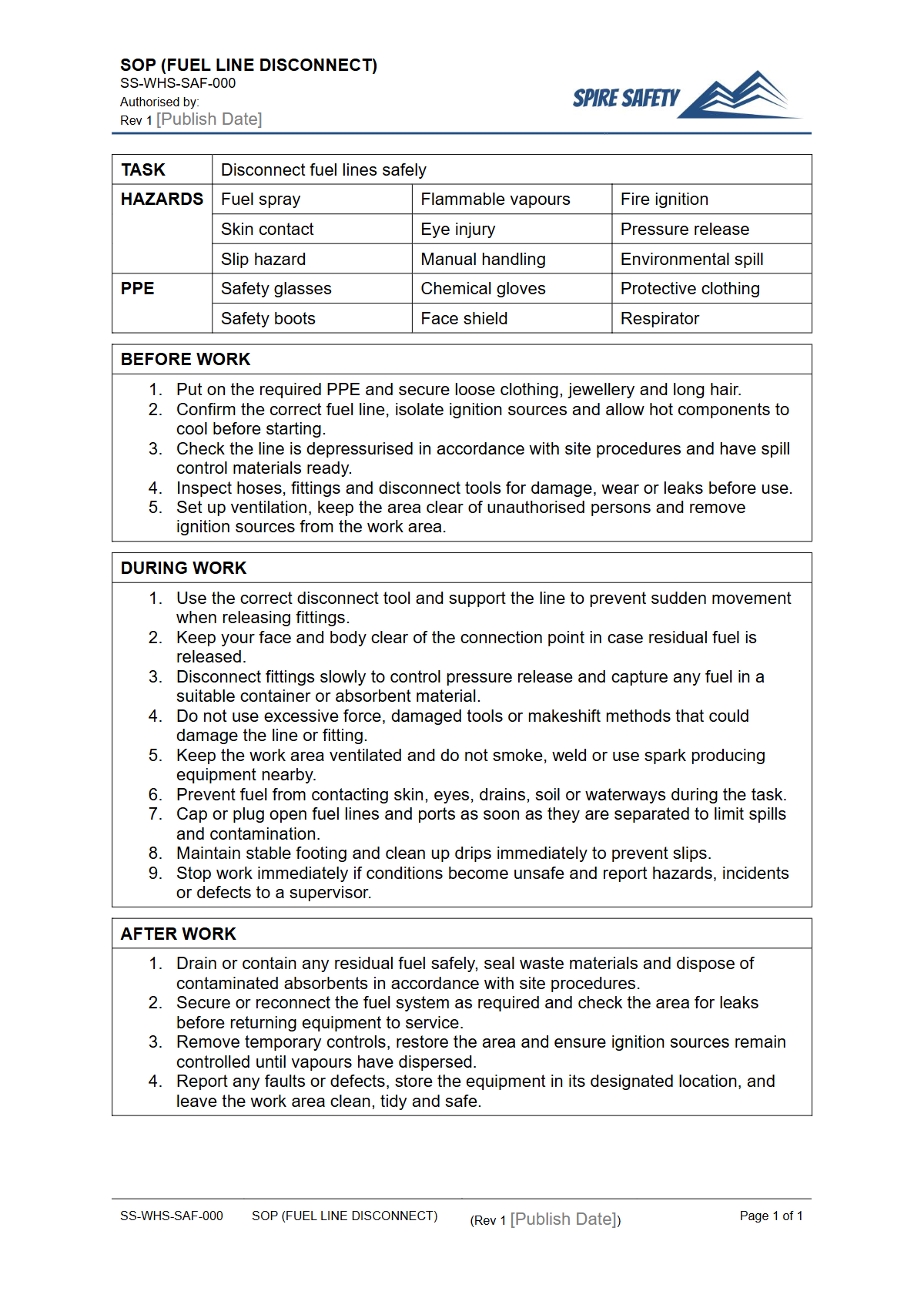
Download our free Safe Operating Procedure (Fuel Line Disconnect) Template to manage risks associated with vehicle maintenance. Customisable DOCX & PDF format.
Free Safe Operating Procedure (Fuel Line Disconnect) Template
DOCX • 126 KB + PDF
Updated Oct 2026
No signup required
Purpose of the Free Safe Operating Procedure (Fuel Line Disconnect) Template
Working with fuel systems presents significant risks, including fire, explosion, and exposure to hazardous chemicals. This free Safe Operating Procedure (Fuel Line Disconnect) Template provides a structured framework for documenting the required steps to perform this task safely.
An SOP is a critical administrative control that formalises a safe system of work, helping your organisation meet its duty of care obligations under Australian WHS laws. It guides workers through the process of depressurising fuel systems, managing spills, controlling ignition sources, and selecting appropriate personal protective equipment (PPE).
Implementing a comprehensive SOP is a fundamental part of robust WHS management systems, ensuring that high-risk tasks are performed consistently and safely every time.
Video walkthrough
How to use the Free Safe Operating Procedure (Fuel Line Disconnect) Template
This document serves as a starting point. It must be adapted to reflect the specific vehicles, equipment, chemicals, and conditions at your worksite. To implement this Safe Operating Procedure effectively:
- Download: Get the template in your preferred format (DOCX or PDF).
- Consult: Involve your mechanics, technicians, and supervisors in the customisation process. Their hands-on experience is invaluable for identifying practical risks and effective controls.
- Customise: Add details specific to your workplace, including emergency contacts, required permits (e.g., hot work permits), and details of the specific tools and equipment used. A generic procedure is not sufficient; detail is key.
- Train: Ensure all relevant workers are trained on the final SOP and understand every step. Training records should be maintained.
- Review: Schedule regular reviews of the SOP (e.g., annually or after any incident) to ensure it remains current and effective.
Important: We have created this template as a guide; it must be customised to suit the specific equipment, environment, and personnel at your workplace. It should be used in conjunction with a thorough risk assessment.
You may find our Free Air Compressor SOP useful for other common workshop tasks.
When to use it
This Safe Operating Procedure should be used whenever a worker is required to disconnect a fuel line on a vehicle or piece of equipment. This includes tasks such as:
- Replacing a fuel filter or fuel pump.
- Repairing a leak in a fuel line or connection.
- Removing a fuel tank for repair or replacement.
- Preparing a vehicle for certain types of hot work where the fuel system must be isolated.
- Decommissioning vehicles or plant.
The procedure reinforces critical safety checks, such as battery disconnection to eliminate ignition sources, and ensures the correct method for relieving system pressure is followed, preventing uncontrolled release of fuel. Integrating this SOP into your work order or job card system ensures it is referenced before work commences. The effectiveness of such procedures can be verified through routine WHS compliance auditing.
Who should use it
This SOP is designed for any person conducting a business or undertaking (PCBU) where fuel systems are maintained. It is intended for use by qualified and competent personnel, including:
- Automotive mechanics and technicians
- Heavy vehicle and mobile plant mechanics
- Maintenance fitters
- Apprentices under direct supervision
- Workshop supervisors and managers
Supervisors should use this document to induct new employees, provide refresher training, and monitor safe work practices. For workers in workshops that also perform fabrication, it's vital to ensure tasks are properly segregated.
For example, procedures outlined in our FREE Plasma Cutter SOP should never be performed in the same area as fuel system work without extensive risk controls.
Using equipment safely is paramount in any workshop environment. Even simple tasks like accessing parts on a larger vehicle can introduce risks if not managed correctly.
Our FREE Step Ladder SOP can help formalise procedures for common access equipment.
By providing clear, written instructions, this SOP helps ensure that every worker, regardless of experience level, follows a standardised, safe method for this hazardous task. Explore our entire free WHS resources library for more templates to support your safety management system.
Common mistakes
Common mistakes to avoid
- Forgetting to disconnect the vehicle's battery before starting work.
- Failing to safely relieve the fuel system pressure before opening a line.
- Using tools that can create sparks (e.g., grinders) near an open fuel system.
- Not having a fire extinguisher and spill kit immediately available.
Legal references
Legal considerations
The following legal requirements may be relevant to this type of work.
- Work Health and Safety Act (Harmonised) — Provides the primary duties for protecting workers and other people from work health and safety risks.
- Work Health and Safety Regulations (Harmonised) — Sets out requirements supporting the management of workplace hazards and risks.
The following codes may be relevant to this type of work.
- Managing WHS Risks Code of Practice — Provides practical guidance on identifying hazards, assessing risks and applying effective controls.
- Work Health and Safety Consultation, Cooperation and Coordination Code of Practice — Provides practical guidance on consulting workers and coordinating with other duty holders.
- Managing the Work Environment and Facilities Code of Practice — Provides practical guidance on safe work environments, workplace facilities and related controls.
Did you know
Vapour is the Danger
It's not liquid petrol that burns, but the vapour it releases. Petrol vapour is heavier than air and can accumulate in low spots like inspection pits, creating a serious and often invisible explosion risk.
Static Spark
A static electricity spark can have enough energy to ignite fuel vapour. This is why proper grounding and bonding procedures are critical, and why you should never re-enter a vehicle while refuelling, as sliding across the seat can generate static.
FAQ
Frequently asked questions
01What are the main hazards when disconnecting a fuel line?
02Is a Safe Operating Procedure legally required for this task in Australia?
03What PPE is typically required for disconnecting fuel lines?
04How do you safely depressurise a modern fuel system?
Share this resource
Free Safe Operating Procedure (Fuel Line Disconnect) Template
Browse Categories
How To Use It
- 1Download and open in Word or PDF.
- 2Replace the placeholders with your business details.
- 3Get it reviewed by a WHS specialist before rollout.
Need it customised?
Our WHS consultants can adapt this template to your site, run a gap analysis, or audit what you already have in place.
Book a Free Consultation WHS consulting servicesor call 1300 156 382
Related templates
- Free Safe Operating Procedure (Fuel Spill Mat Setup) Template
- Free Safe Operating Procedure (Fuel Tank Draining) Template
- Free Safe Operating Procedure (Fuel Transfer Pump) Template
- Free Safe Operating Procedure (Fume Cupboard) Template
- Free Safe Operating Procedure (Funeral Equipment Clean) Template
- Free Safe Operating Procedure (Funeral Flower Handling) Template