
Free Safe Operating Procedure (Fuel Tank Draining) Template
Download our free Safe Operating Procedure (Fuel Tank Draining) template. This customisable DOCX & PDF helps you document safe work methods for fuel handling.
Free Safe Operating Procedure (Fuel Tank Draining) Template
DOCX • 126 KB + PDF
Updated Oct 2026
No signup required
Purpose of the Free Safe Operating Procedure (Fuel Tank Draining) Template
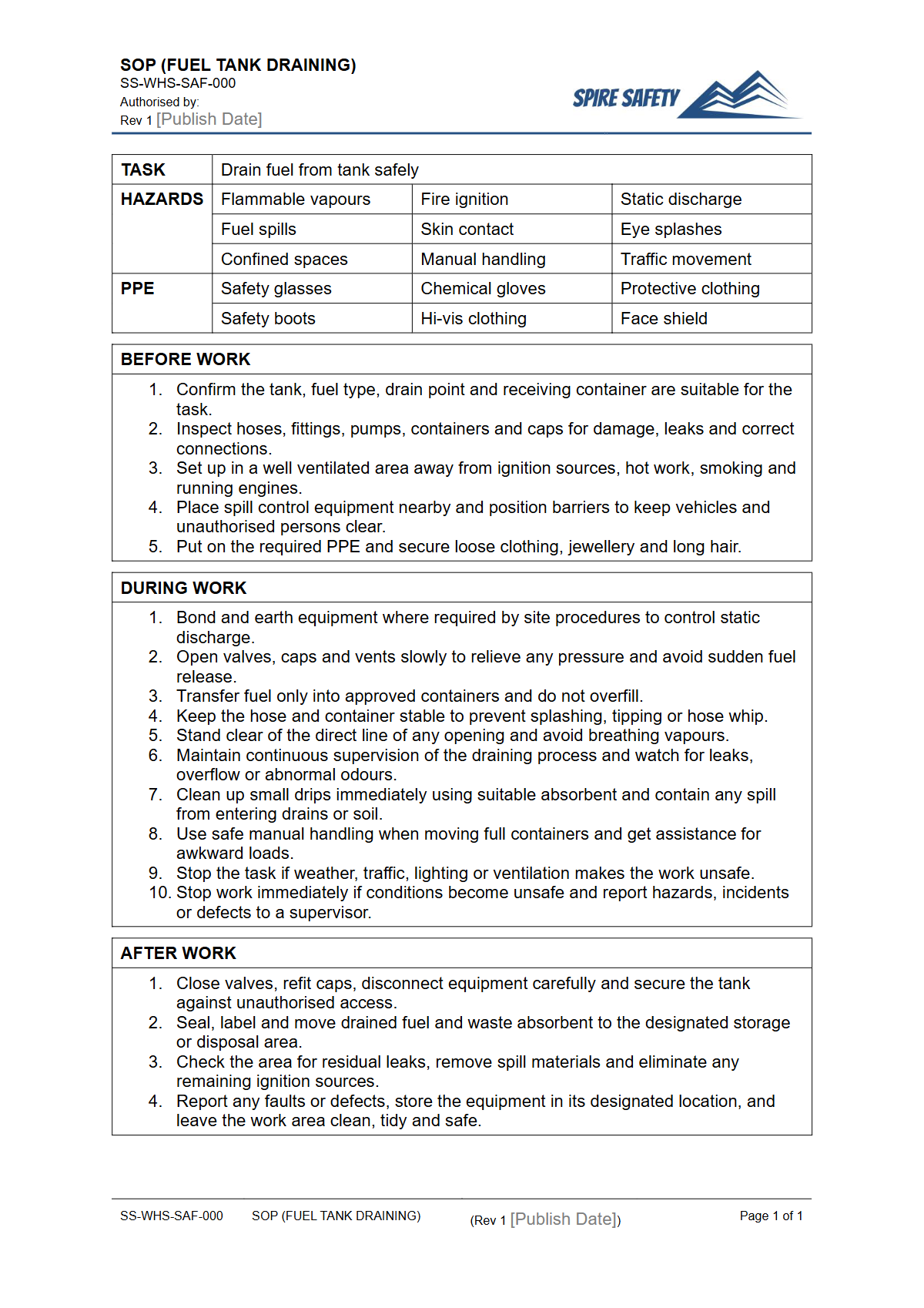
Draining fuel from a vehicle or equipment tank is a high-risk task that requires a formalised, safe system of work. Our Free Safe Operating Procedure (Fuel Tank Draining) Template provides a structured starting point for your organisation to document these critical steps.
The primary hazards associated with this activity include fire or explosion from flammable vapours, health effects from exposure to fuel, and environmental damage from spills. This SOP template helps you systematically address these risks, ensuring the task is performed consistently and safely every time.
By implementing a clear SOP, you can effectively train workers, provide a reference for competent operators, and demonstrate due diligence in managing workplace hazards. It is a fundamental component of an effective safety framework, helping your business meet its duties under Australian WHS legislation. Integrating such procedures into a holistic safety program ensures all operational risks are managed coherently within your broader WHS management systems.
Key Hazards and Control Measures
This procedure guides you in outlining controls for several key hazards. Fire and explosion are the most severe risks, arising from the ignition of fuel vapour by static electricity, sparks from tools, or other ignition sources.
The SOP prompts you to detail requirements for proper ventilation, grounding of equipment, and the use of intrinsically safe or non-sparking tools. It also covers health hazards like inhalation of toxic vapours and skin irritation from direct contact, specifying the correct Personal Protective Equipment (PPE) such as respirators, gloves, and eye protection.
Emergency preparedness is another critical element addressed. The procedure includes sections for detailing spill containment and clean-up processes, as well as first aid responses for fuel exposure.
Having documented emergency plans is vital, similar to how a workplace might have a Defibrillator Operation Safe Operating Procedure ready for a medical emergency.
Video walkthrough
How to use the Free Safe Operating Procedure (Fuel Tank Draining) Template
This resource is available as a fully editable DOCX file and a print-ready PDF. The DOCX version is designed for easy customisation to suit your specific operational context.
It is essential to adapt the content to reflect the unique aspects of your workplace, including the types of vehicles or machinery, the specific fuels used (petrol, diesel, etc.), and the equipment available for the task.
Important: This document is a template and must be customised to your specific workplace. You need to conduct your own risk assessment and adapt the procedures to reflect the actual equipment, chemicals, environment, and personnel involved.
We are not liable for any incidents that may arise from the use of this document. It is the responsibility of the Person Conducting a Business or Undertaking (PCBU) to ensure it is suitable for their workplace.
When customising, consult with workers who perform the task to ensure the steps are practical and accurate. Your final SOP should be a clear and unambiguous guide, much like our free Air Compressor SOP is tailored for the specific risks of that equipment.
Once finalised, the procedure should be approved, version-controlled, and made easily accessible to all relevant personnel.
When to use it
A Safe Operating Procedure for fuel tank draining should be used before commencing any task that involves removing fuel from a tank. This includes a range of common situations in workshops and on-site maintenance operations.
Typical scenarios include preparing a vehicle for hot work (like welding or grinding), decommissioning old machinery, draining contaminated fuel, or undertaking repairs on the fuel tank or fuel system components.
The SOP should be a mandatory reference during worker training and a prerequisite for any operator to read and acknowledge before being authorised to perform the task independently. Regular toolbox talks can also reference the SOP to reinforce safe work practices. You can find many other procedural templates for various tasks in our free WHS resources library.
Who should use it
This Safe Operating Procedure should be used by all personnel involved in the task of draining fuel tanks. This primarily includes qualified mechanics, maintenance fitters, and heavy vehicle technicians.
Apprentices or trainees should only perform this task under the direct supervision of a competent and authorised person until they have been assessed as competent themselves. The procedure provides the basis for this training and assessment.
Supervisors and managers also use the SOP as a tool for ensuring work is conducted safely and for auditing compliance with established procedures. A well-written and consistently applied SOP is a key piece of evidence during safety inspections and is often scrutinised during formal WHS compliance auditing to verify that risks are being controlled.
The document also serves as a critical reference during incident investigations to determine if procedures were followed.
Common mistakes
Common mistakes to avoid
- Using unapproved or unsuitable containers, like glass jars or open buckets, to collect fuel.
- Working in a poorly ventilated area, allowing flammable vapours to accumulate to explosive levels.
- Failing to disconnect the vehicle's battery before starting work, leaving a potential ignition source active.
- Neglecting to wear appropriate Personal Protective Equipment (PPE), especially safety glasses and fuel-resistant gloves.
Legal references
Legal considerations
The following legal requirements may be relevant to this type of work.
- Work Health and Safety Act (Harmonised) — Provides the primary duties for protecting workers and other people from work health and safety risks.
- Work Health and Safety Regulations (Harmonised) — Sets out requirements supporting the management of workplace hazards and risks.
The following codes may be relevant to this type of work.
- Managing WHS Risks Code of Practice — Provides practical guidance on identifying hazards, assessing risks and applying effective controls.
- Work Health and Safety Consultation, Cooperation and Coordination Code of Practice — Provides practical guidance on consulting workers and coordinating with other duty holders.
- Managing the Work Environment and Facilities Code of Practice — Provides practical guidance on safe work environments, workplace facilities and related controls.
Did you know
Static Electricity Risk
Simply sliding across a car seat can generate enough static electricity to ignite petrol vapours. This is why grounding and bonding procedures are critical when handling flammable fuels.
Vapour Density
Petrol and diesel vapours are heavier than air. They can accumulate in low-lying areas like inspection pits, creating a hidden and concentrated fire or explosion hazard that requires mechanical ventilation to disperse.
FAQ
Frequently asked questions
01What is the difference between an SOP and a SWMS for fuel tank draining?
02Do I need a specific fire extinguisher for fuel draining tasks?
03How often should we review our Safe Operating Procedure for fuel tank draining?
04Can this template be used for both petrol and diesel fuel tanks?
Share this resource
Free Safe Operating Procedure (Fuel Tank Draining) Template
Browse Categories
How To Use It
- 1Download and open in Word or PDF.
- 2Replace the placeholders with your business details.
- 3Get it reviewed by a WHS specialist before rollout.
Need it customised?
Our WHS consultants can adapt this template to your site, run a gap analysis, or audit what you already have in place.
Book a Free Consultation WHS consulting servicesor call 1300 156 382
Related templates
- Free Safe Operating Procedure (Fuel Transfer Pump) Template
- Free Safe Operating Procedure (Fume Cupboard) Template
- Free Safe Operating Procedure (Funeral Equipment Clean) Template
- Free Safe Operating Procedure (Funeral Flower Handling) Template
- Free Safe Operating Procedure (Funeral Vehicle Cleaning) Template
- Free Safe Operating Procedure (Furniture Steam Clean) Template